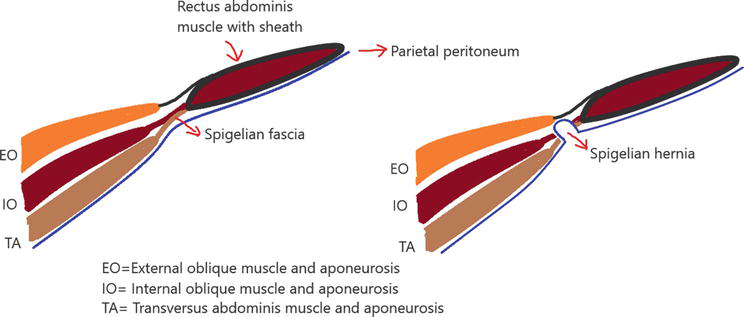
Section: Abdominal wall and retroperitoneum Sub-section: Hernias Curriculum: Curriculum, page 4
Definition
- An acquired ventral hernia though the semilunar line (of Speighel)
- And posterior rectus
Incidence:
- Uncommon ≈ 2% of all hernias
- Mostly in women > 50yo
Aetiology
- Most acquired
- Related to obesity, COPD, ? laparoscopy (ports/gas)
Clinical
- Abdominal pain
- GI Sx
- Cough impulse may be palpable in the iliac fossa when standing (in a thin pt)
- Disappears when lying down
- 20% have strangulation at presentation
- Diagnosis may be difficult as the hernial defect may lie beneath an intact external oblique layer and thus not palpable
Pathology
- Occur at the semilunar line (of Speighel) = Linea semilunaris
- Line where the sheaths of the lateral abdominal muscles fuse to form the lateral rectus sheath
- Hernias are almost always found above the level of the inferior epigastric vessels
- ≈ 90% are at level of the arcuate line (semicircular SDT)
- Hernia often dissects within the layers of the abdo wall
- Lateral to rectus sheath
- Usually lies deep to ext oblique
- Occasionally it lies within the rectus sheath, lateral to rectus muscle
- Almost never penetrate to lie subcutaneously
Management
- Repair
- Open: incise over tenderness / mass
- Split external oblique to expose the sac
- Reduce hernia, excise sac & stitch the defect
- Laparoscopy: useful in Dx & Rx
- Options: suture only (e.g. with ethibond) – for small defects and/or use Mesh
Natural Hx:
- ≈ 20% risk of incarceration
- Therefore should be repaired
- Strangulation in incarcerated hernias is common