Section: Abdominal wall and retroperitoneum Curriculum: Curriculum, page 4
Rational
- Damage control surgery
- Abdominal compartment syndrome
- Severe abdominal sepsis.
- Allows enteric contents and pus to drain.
- Planned relook for evolving pathology
- E.g. ischemic bowel
- Open and transfer/re-operation with a surgeon with a different skill set
Advantages
- In certain situations - this will reduce the rate of recurrent sepsis, minimise wound complications, and avoid IAH.
- Fast ventilator weaning.
- Facilitate early enteral nutrition.
Disadvantages
- Increased fluid and protein loss.
- Loss of domain (abdominal wall retracts laterally)
- Exposed bowel can fistulate.
- Considerable psychological distress.
- Challenging for nursing staff.
- Hernia formation is inevitable.
Options for laparostomy formation
Silo techniques
- A “Bogota Bag” - open up a sterile 3L IV bag and suture to the fascia
- It is difficult to control fluid losses.
Negative pressure systems
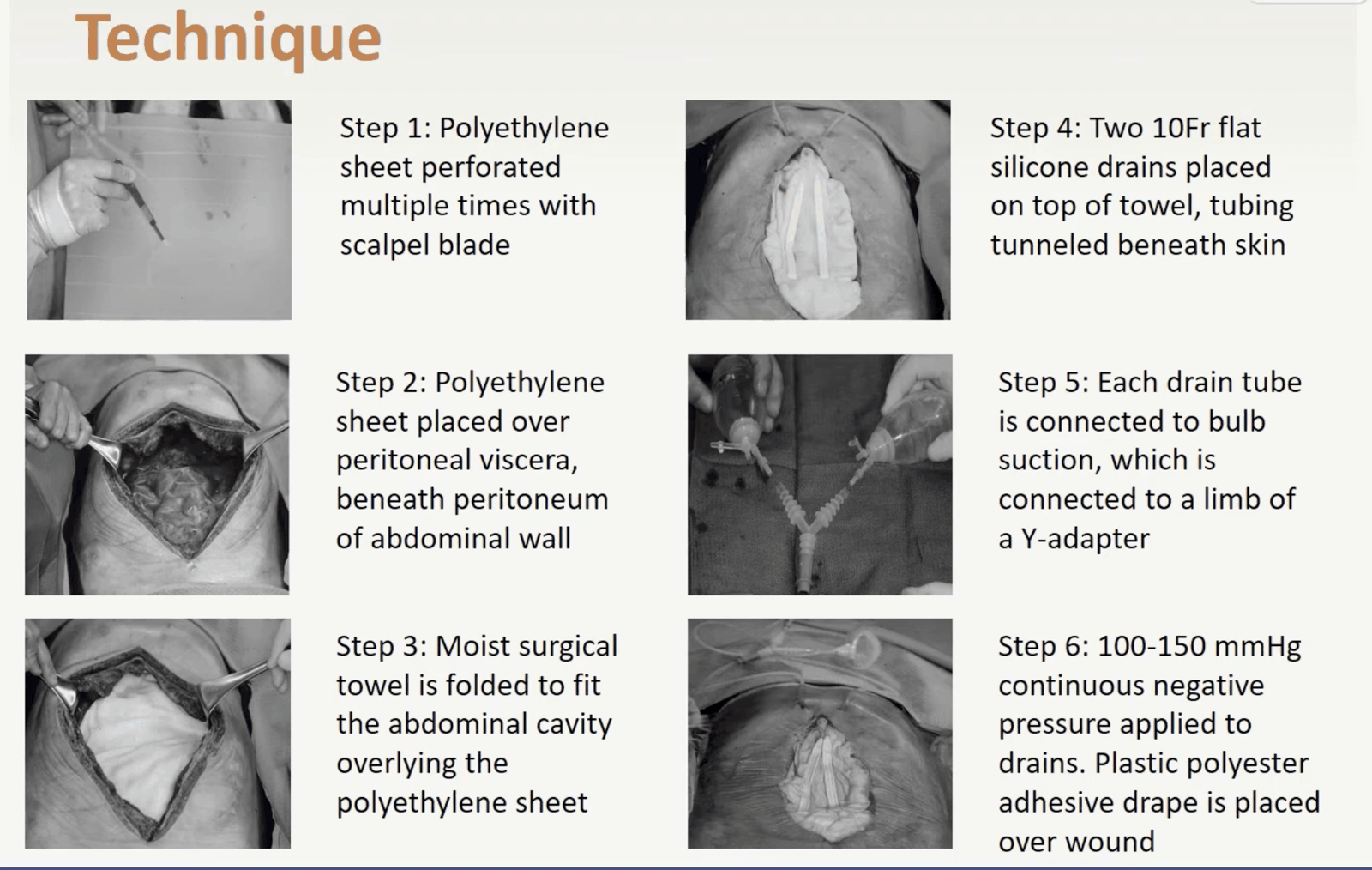
- This involves placing either a “towel” (i.e. Kerlex gauze) or “sponge” (i.e. black foam) over a semipermeable adhesive dressing with slits (i.e. Tegaderm or Ioban)
- Drains are placed in the towel or sponge.
- This is effective at removing and measuring fluid from the wound.
- It also helps prevent loss of domain.
- There is a concern that this method can cause fistulas
AbThera
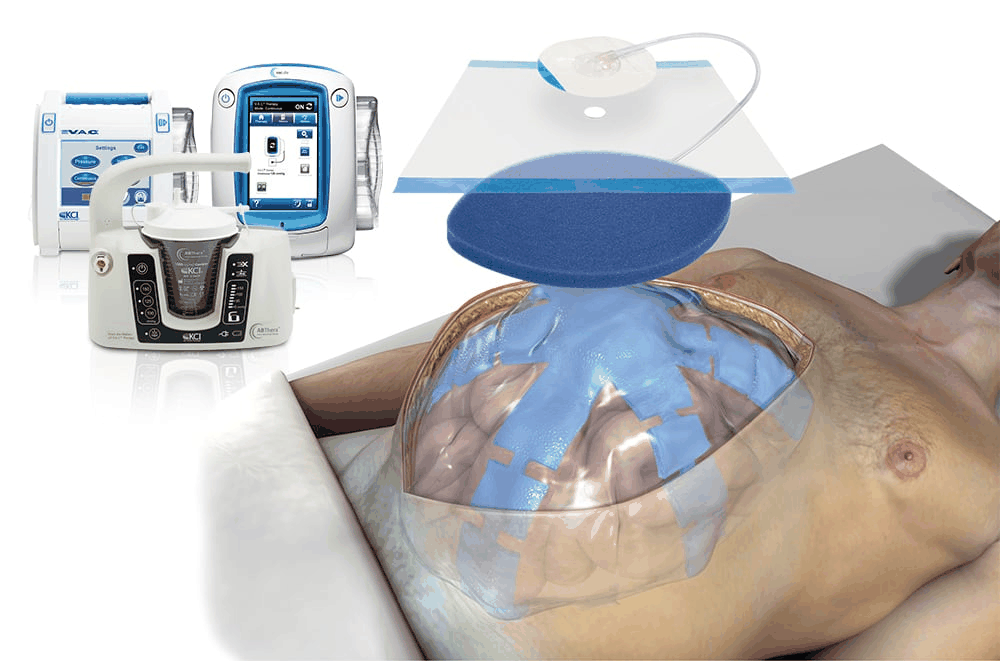
- Components
- Fenestrated Visceral Protective layer
- Perforated Foam
- Suction pad
- VAC drape
- Pressure source unit
- Application
- Place protective layer and trim to size
- Place foam over the top
- Place VAC drape over the top to ensure a seal
- Cut a 2.5cm hole and the place suction pad
- Turn on - 125mmhg
Stomas and laparostomies
- If you are ever creating a stoma - you should bring it through the oblique muscles (not rectus) to avoid problems with abdominal closure (i.e. its gets in your way)
Closing a laparostomy
Primary fascial closure
- This is the ideal option - but is often no possible.
- Rates of ventral hernia are very high
- If able to close, do so. Best to use figure of 8 interrupted 1-0 Nylon
Mediated closure
- Adjuvant fascial traction helps pull the fascia to the midline and improves primary fascial closure.
- Techniques include
- Mesh mediated closure
- Fascial tension sutures
- Primary fascial release (making incision of the oblique musculature)
- Graduated fascial closure technique
- Abdominal re-approximation and Anchor System (ABRA)
- Wittman patch
- There is evidence that adjuvant fascial traction increases rate of primary closure.
Mesh-mediated Closure technique
- Stitch polypropylene mesh to the edges of the fascia
- Each time you return to theatre - cut away central portion and pull edges together
- Place simple black sponge foam VAC over the top
Wittman Patch
- This is an example of graduated fascial closure technique
- A protective bowel barrier is placed into the abdomen.
- Hydrocolloid dressing is placed circumferentially around the defect to protect the skin.
- Bolsters are applied lateral to the rectus sheath
- The loop sheet is placed into the abdomen - is trimmed to fit the defect.
- 1-Ticron suture is placed (bolster - abdominal wall - loop sheet - abdominal wall - bolster)
- The hook sheet is placed.
- The sheets are velcoed together re-approximating the fascia.
- Black foam is placed in the middle of the wound and VAC applied.
- The patient can then be brought back to theatre every 48 hours for wound inspection and tightening.
- Once the fascia has been re-approximated, it can be closed and the bolsters and sheets removed.
- https://www.starsurgical.com/wp.html
Unable to close
- After 7-10 days your aims transition from closure to coverage
Functional closure (planned hernia)
- Inlay mesh
- This involves using an inlay biologic mesh or Vicryl mesh - drains can be placed on the mesh and skin closed over the top.
- Close skin
- Close skin over bowel
- Skin graft
- Leave open to granulate
- Then skin graft over
- This will take a long time to get enough granulation tissue to graft over and the wound management will be difficult without a VAC
Beware
- Main thing you want to avoid is a fistula!
- After 7-10 days, in danger territory of forming fistula if abdominal cavity remains open
- Main goal then becomes: AVOID A FISTULA
- If fistula avoided, no matter what the closure technique was, it will be a success
- Aim now becomes COVERAGE
- Fascia
- Biologic mesh (but needs skin coverage or else it dessicates, can’t VAC)
- Vicryl mesh, synthetic absorbable mesh (best option, can VAC over it, can promote granulation tissue, does not dessicate)
- Skin
- Try to get skin coverage over the top if possible
- If you cant apply VAC over the top – 75mmHg (concern of fistula, no evidence and what is the alternative?)
- Wait for granulation tissue
- Then apply skin graft