Section: Trauma Curriculum: Curriculum, page 76
Anatomy
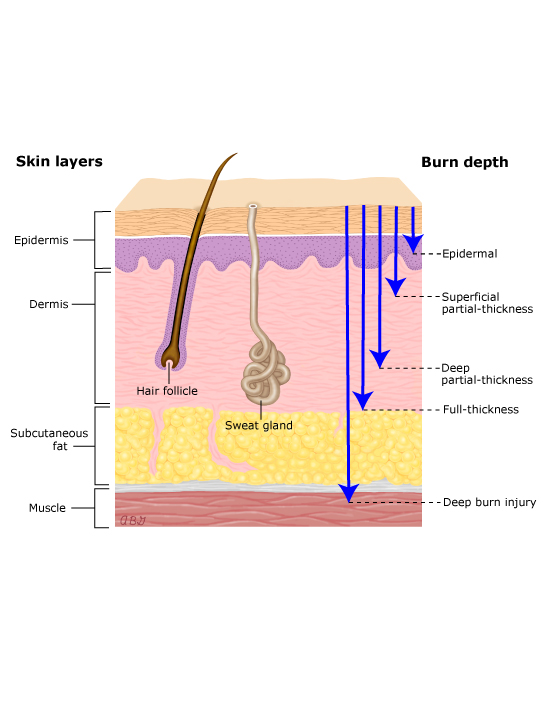
- Need to describe based on initial insult
- Need to describe based on organ systems
- Need to describe based on difference in early and late phase
Pathophysiology
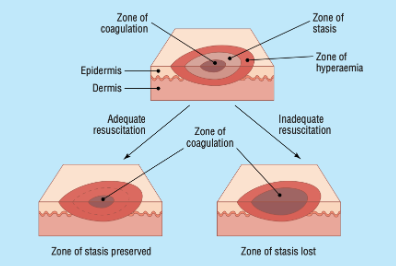
- Jackson’s Burn Wound Mode
- 3 zones
- Coagulation
- Protein coagulation and cell death
- Irreversible necrosis
- Stasis
- Viable but at risk due to impaired perfusion and inflammation
- Can be saved with good aggressive and early resuscitation
- Hyperaemia
- Outermost zone with minimal injury
- Viable tissue with expected full recovery
- Coagulation
- 3 zones
Systemic response
- Initiation
- Direct tissue disruption → cell death, exposure of intracellular contents (DAMPs)
- Metabolic response
- Ebb and flow
- Immune response
- Inflammatory cascade
- Neuro-hormonal response
- SNS, RAAS, coritsol
- Dermal exposure
- Fluid loss
- Protein loss
- Microbial barrier loss
- Heat loss - Convection and Conduction
See Trauma physiology for more detail
- Ebb Phase (First 24–48 hours post-burn)
- Characterised by:
- Hypovolemia and capillary leak → ↓ perfusion
- ↓ Cardiac output
- ↓ Oxygen consumption
- Hypothermia
- Metabolic suppression
- Driven by:
- Catecholamine and cortisol release
- Proinflammatory cytokines
- Goal: Aggressive fluid resuscitation to restore perfusion
- Characterised by:
- Flow Phase (After fluid resuscitation stabilises circulation)
- Characterised by:
- Hyperdynamic circulation: ↑ cardiac output
- Hypermetabolism: ↑ energy expenditure (can double basal rate)
- ↑ Protein catabolism → muscle wasting
- Insulin resistance and hyperglycaemia
- ↑ Temperature (low-grade pyrexia)
- Persistent inflammation (↑ IL-6, TNF-α)
- Characterised by:
Special Types of Burn
- Chemical
- Alkali Burns
- Mechanism:
- Alkalis (e.g. sodium hydroxide, potassium hydroxide, lime) cause liquefactive necrosis
- Hydroxide ions saponify cell membrane lipids and denature proteins
- Resulting in deep tissue penetration and ongoing damage
- Tissue effects:
- Liquefaction allows the agent to spread rapidly through tissue planes
- Can continue causing damage long after contact unless neutralised or removed
- Clinical course:
- Damage is often underestimated initially due to limited surface signs
- Tissues may appear pale and slippery before progressive necrosis occurs
- Examples: oven cleaners, drain cleaners, industrial agents
- Mechanism:
- Acid Burns
- Mechanism:
- Acids (e.g. hydrochloric acid, sulphuric acid, hydrofluoric acid) cause coagulative necrosis
- Hydrogen ions denature proteins, leading to eschar formation
- The eschar limits deeper penetration of the acid
- Tissue effects:
- Injury tends to be more superficial compared to alkalis
- Coagulation of proteins forms a thick eschar that impedes further spread
- Some acids (e.g. hydrofluoric acid) are exceptions and penetrate deeply
- Clinical course:
- Burn is usually well-demarcated and painful
- May evolve over hours depending on concentration and contact duration
- Examples: toilet cleaners, car battery acid, rust removers
- Mechanism:
- Alkali Burns
- Electrical
- High voltage is the worst
- Cardiac arrhythmias - ECG/TnT
- Pattern
- Burn
- MSK from response
- Current runs along periosteum, nerves, vessels and muscles
- Mx includes Debridement/Fasciotomy
Burn Depth
-
Classification
- Superficial - only epidermis
- Partial - epidermis and portions of dermis
- Superficial partial - superficial dermis
- Deep partial - deep dermis
- Full-thickness - all dermis and down to subcutaneous tissue
-
Superficial (sunburn)
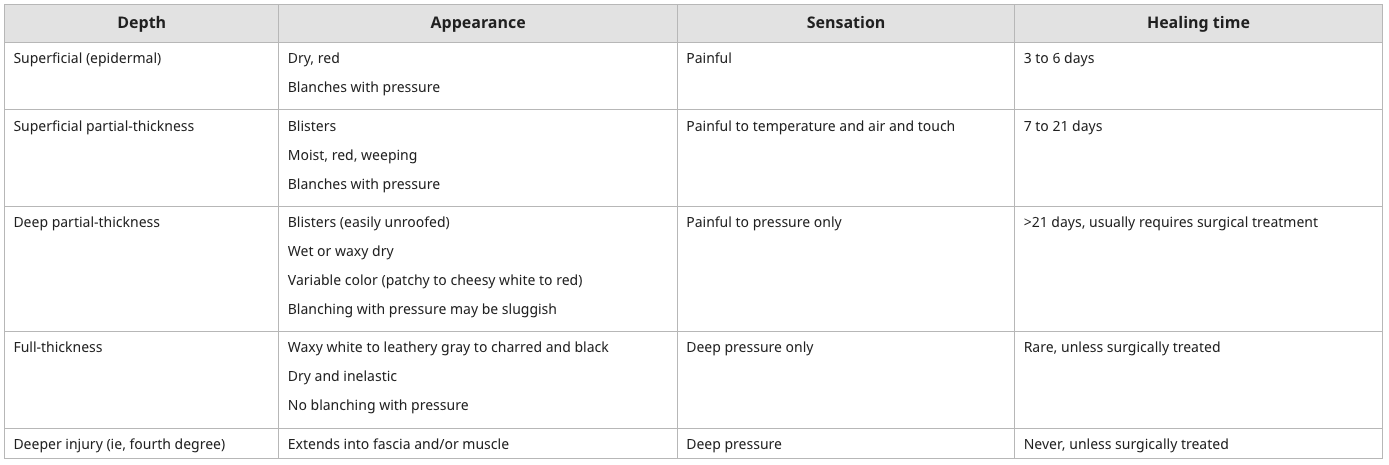
- Pain | dry | No surgery | NOT included in TBSA | Simple analgesia
-
Superficial Partial Thickness
- Whole epidermis, BM and up to ⅓ of dermis
- Heal over 2 weeks without scarring or graft
- Good blood supply and epidermal cells remain therefore small stasis zone
- Wet | blistered | painful | red/white | blanches on pressure | hairs are attached
-
Deep Partial Thickness
- Whole epidermis, BM and middle ⅓ of dermis
- Re-epithelialize over 2-4 weeks - less epidermal cells, poorer blood supply
- Larger stasis zone
- Wet and dry, Drier = deeper
- Sensation variable, less painful
- Thicker and rubbery skin texture
- DOESN’T BLANCH
- Hairs come out when pulled
- 4-6 weeks to heal if not excised
- Poor function due to scarred dermis
-
Indeterminate Partial Thickness
- Mixture of SPT and DPT so has features of both
-
Full thickness
- At least ⅔ of dermis involved
- Minimal cells remain for healing
- Requires debridement to remove eschar
- Scarring high, likely needs grafting, high infection risk
- Thick, dry, insensate, leathery
- Black or yellow
- Thrombosis of surface vessels visible
- Hairs often burnt off
- All electrical burns are full thickness
- Need excision
- If not, they contract, scar and get infected
Summary of Burns Depth
- 4 types of depth = Superficial, superficial partial, deep partial and full thickness
- Superficial is equivalent to sunburn - Red, painful, dry, blanching and heals within 1 week, treated with simple analgesia and soothing creams
- Superficial partial = Up to ⅓ of dermis involved, red, weepy, painful, blanching and blistered. Heals within 2 weeks without need for excision and grafting
- Deep partial = Into middle ⅓ of dermis, variable color red to white, less sensation and pain, hairs can be pulled out, sluggish blanching and don’t heal for 4-6 weeks, if at all without excision and grafting
- Full thickness = All of ⅔ of dermis and into deepest layer, white waxy or charred black, insensate so pain free with hairs all burnt off, doesn’t blanch and wont heal without excision and grafting
Total Body Surface Area
- Include SPT, DPT and FT burns - Not superficial (sunburn)
- Rule of 9’s - Adults
- Head - 9 | Chest - 18 | Back 18 | Arms 9 each | Legs 18 each | Perineum 1
- Lund Brower Charts
- Hands of pt = 1%
Inhalation Injury Signs
- Facial burns
- Singed hair
- Airway oedema/stridor
- Carbonaceous sputum / oral deposits
- CarboxyHb > 10%
- Hoarse voice
Management
- Principles
- Stop the burn process progressing with first aid
- Resuscitation aggressive and early to improve chance of minimizing burn SA
- Manage complications of burns
- Dehydration and electrolyte derangement
- Circumferential eschar - Breathing issues or limb ischaemia
- Burn Specific Things
- BURN FIRST AID - 20 mins warm running water
- Wrap in glad wrap
- Carboxy Hb
- Early intubation AW burns
- Parkland formula starts from burn not arrival to hospital
- UO adult 1ml/kg paeds 2ml/kg electrical >1ml/kg (Myoglobinuria)
- No abx
- Tetanus
- Photos/documentation
- TBSA
- Escharotomy
- Fasciotomy
- First aid
- 20-30 mins cool running water, remove clothing etc
- Warm pt, cool burn
- ABCDE
- Airway and early intubation if signs of inhalation injury
- 3 components of AW
- Upper
- Usual
- Lower
- Delayed pres
- Inhalational toxicity
- Carbon monoxide → Give 100% oxygen
- Tricks pulse oximeter
- Upper
- 3 components of AW
- Oxygen, analgesia, central access if possible, bloods
- Glad wrap burns
- Can still assess them visually
- Minimise fluid and heat losses
- Fluids - PARKLAND FORMULA → 4ml x weight (kg) x TBSA %
- Applied from time of the burn - not presentation to hospital
- Dictates volume required in first 24 hours
- Half of the volume in the 1st 8 hours
- Second half in the remaining 16 hours
- Titrated/monitored with IDC
- Give to any pt with 20% TBSA or 10% in kids > 12
- Goal - UO adult 0.5-1ml/kg and paed 1-2ml/kg
- Exceptions
- Giving too much fluid = Increased capillary leakage, 3rd spacing and SIRS and ARDS
- With electrical burn adult target UO >1ml/kg for myoglobinuria purposes
- Airway and early intubation if signs of inhalation injury
- NGT for early feeding and dietitian input if major burn
Note: In practice, many units start with 2–3 mL/kg/%TBSA (modified Brooke or centre-specific protocols) as Parklands original formula likely over resuscitates patients and causes fluid creep.
Escharotomy
- Indications
- Eschar presence either circumferential or positioned and causing
- Ventilatory issues
- Critical limb ischaemia
- Eschar presence either circumferential or positioned and causing
- How
- Linear incisions
- Can be done under LA although incision is mainly through dead tissue
- Need to reach normal tissue on either side
- Pain at edges of incision where healthy tissue is met
- MAY NEED FASCIOTOMY TOO
- Electrical burn with myonecrosis
- If bleeding muscle = Good sign
Burn debridement
- Early burn debridement
- Within 48 hours
- Clean to allow placement of another dressing (not gladwrap)
- Allows burn reassessment
- Larger TBSA
- Thicker burn
- If thicker, can excise and SSG then and there
- Reduces risk of systemic infection
- At 72 hours, bugs can migrate into the deep dermis making topical agents useless
- Within 48 hours
- Basic Principles for excision of large burns and recon
- Warm theatre and time
- Adrenaline saline injections for lifting
- Tourniquet
Referral Criteria
- Regional Burns Unit - Waikato, Hutt, Chch
-
10% TBSA (5% child)
- Special areas - face, hands, feet, perineum, major joints
- Circumferential limbs/chest
- Inhalation injury
- Electrical/chemical burns
- Extremes of age
- Burns with complex comorbidities
- Abuse related burns
-
- Referral to National Burns Centre - MMH
-
30% TBSA
- FT burns to special areas
- Significant inhalation injury
- High voltage electrical burn
- Significant chemical burn
-