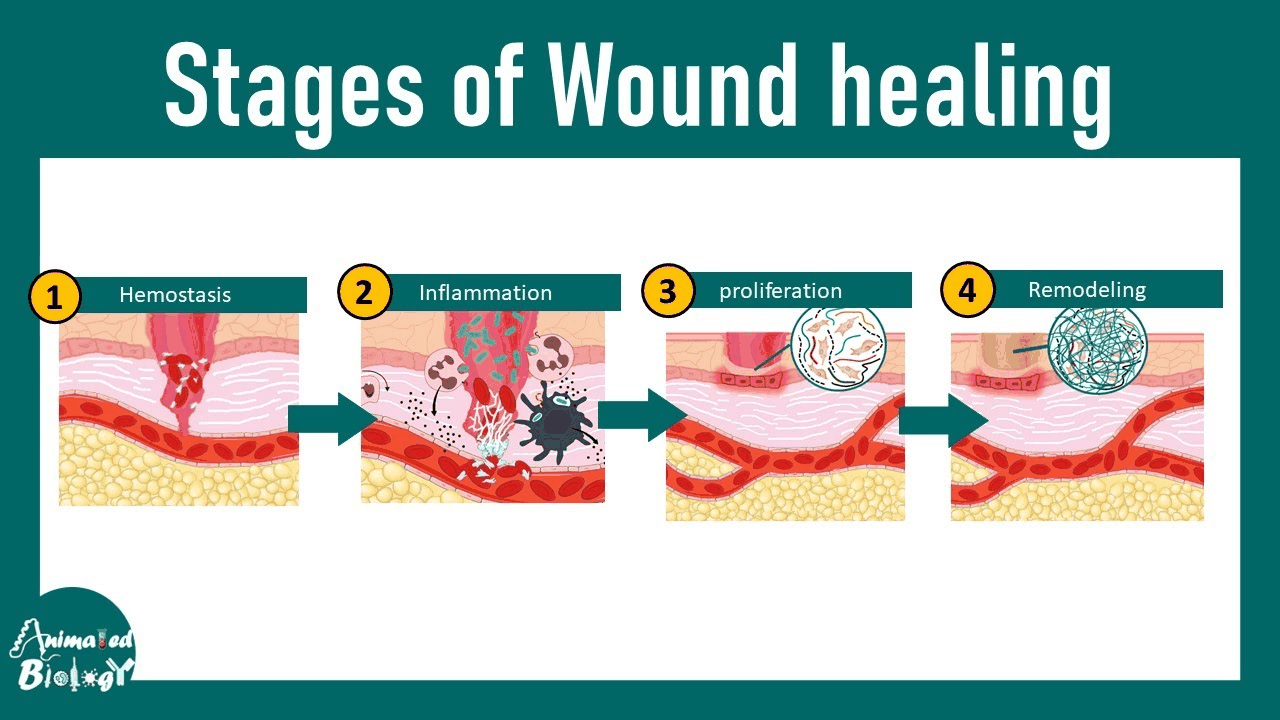
- Haemostasis
- Clot stops bleeding
- But also provides matrix rich in growth factors and chemokines
- Acts as a scaffold for migrating leukocytes and stromal cells
- Inflammation
- Also get inflammatory vascular changes followed by inflammatory cell recruitment
- Within 24hrs neutrophils appear at the margins
- Begin process of wound sterilization and debris degradation
- Granulation tissue
- Within 1-2 days (peak 5-7 days)
- Fibroblasts and endothelium form this
- Highly vascularised loose connective tissue and hallmark of early tissue repair
- Vessels leaky, therefore tissue oedema occurs
- At this stage, wound strength will primarily rely on sutures
- Proliferation
- Migration and expansion of:
- Endothelial cells (Angiogenesis)
- Connective tissue cells (provisional matrix)
- Within 2-4 days, neutrophils largely replaced by macrophages
- Become main cellular elements in clearing debris and directing subsequent angiogenesis and ECM deposition
- Eventually granulation tissue scaffolding is converted to scar composed of fibroblasts and collagen
- Fibroblast migration and proliferation driven by macrophages
- TGF-β most important fibrogenic agent
- After 2 weeks, scar formation (collagen deposition) is the most dominant feature
- Get regression of the vasculature
- Granulation tissue all converted to avascular scar, without inflammation, covered by intact epithelium
- Get rapid increase in wound strength to 30-50%
- Remodeling Phase
- Constant absorption and replacement of collagen along the lines of stress
- Wound contraction accomplished by myofibroblasts
- Have synthetic function of fibroblasts
- Also contractile capability of smooth muscle cells
- Cause decreased surface area of the wound
- Remodelling/change in ECM deposition
- Strength of Wound Over Time
- Initially dependent on suturing
- At 1 week (when sutures removed)
- Typically has 10% strength of normal
- Tensile strength eventually plateaus at 70-80% of normal at 3 months
- Associated with increased collagen synthesis exceeding collagen degradation
- Followed by cross-linking and increased fibre size