- Benign
- Pilomatrixoma
- Tricoepithelioma
- Apocrine Gland Tumours
- Sebaceous Gland Tumours
- Malignant Skin Appendage Tumours
Benign
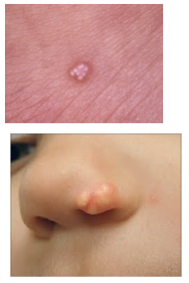
Pilomatrixoma
- “Calcifying epithelioma of Malherbe”
- Benign appendageal tumour with differentiation toward hair cells
- Incidence
- Relatively infrequent (e.g. 1/500 histological specimens)
- More common in children; but does occur in adults → 2 peaks: 5-15yrs & 50-65yrs
- Most reported in white people
- Slight female preponderance (1.5:1)
- Aetiology
- Genetic pathogenesis: Faulty suppression of apoptosis
- Rare association with Myotonic Dystrophy
- Clinical
- Solitary, asymptomatic firm/stony nodule, colour of normal skin
- Often stretch the overlying skin
- 50% occur on head & neck
- 0.5-3cm, but can be up to 15cm
- Pathology
- Lower dermis and subcutaneous fat: Irregular islands of cells ± Ca2+ deposits
- DDx:
- Pilomatrix carcinoma (rare)
- Investigations
- Often calcified on x-ray
- USS: Ovoid complex mass at the junction of dermis and subcutaneous fat, with focal thinning of the overlying dermis
- Management
- Excision with wide margin (1-2cm) to avoid local recurrence
- Prognosis / Natural Hx:
- Slowly grows over months or years
- Do not spontaneously regress
- No association with mortality
- Incomplete excisions → Local recurrence
Tricoepithelioma
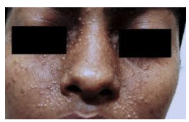
- Solitary nodule
- Face
- Adults
- Familial form
- Histology
- Resembles BCC
- Contains keratin horn cysts
- May rupture
- Get foreign body reaction & focal calcification
Apocrine Gland Tumours
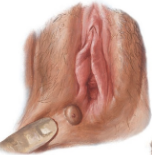
Hidradenoma papilliferum
- 1-2cm diameter
- Vulva, perianal skin
- Females - external genitalia
- Histology
- Papillary processes in cystic cavity
- Lined by double layer epithelial cells and myoepithelial cells
Cylindroma
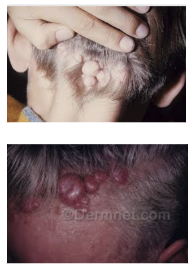
- Scalp
- Can be multiple
- Can cover scalp
- F > M
- Familial variety
- Autosomal dominant
- Multiple
- Histologically
- Nests darkly staining cells
- Thick eosinophilic BM
Sebaceous Gland Tumours
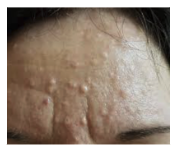
- Sebaceous hyperplasia
- Face, forehead
- Mid-age – elderly
- Yellow papules
- 2-3mm diameter
- Often umbilicated
- Histology
- Sebaceous glands
- Several ducts
- Multiple lesions associated with
Malignant
- Malignant hair follicle tumours
- Apocrine carcinoma
- Rare
- Axilla, areola of nipple, vulva
- Can be associated with extramammary Paget’s
- Eccrine carcinoma
- De novo or in pre-existing lesions
- Mets common (2/3 cases)
- Sebaceous carcinoma