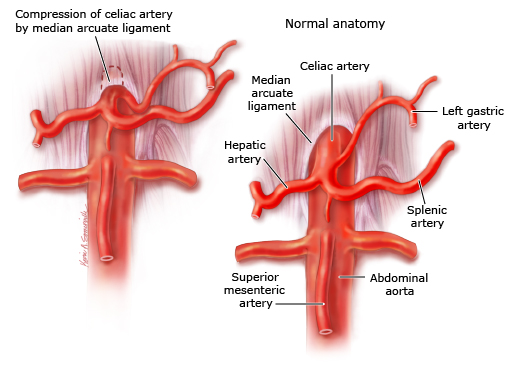
Recurrent abdominal pain related to compression of the celiac artery by the median arcuate ligament
Clinical features
Triad
Postprandial abdominal pain
Weight loss
Sometimes an abdominal brսit.
4x more prevalent in females
Typically in the fourth decade
Diagnosis
Vascular imaging - CT/MR/USS
Can confirm compression of the celiac artery by the median arcuate ligament and is preferably performed with respiratory maneuvers
During expiration, the diaphragm moves cranially, stretching the crura, and exacerbating celiac artery compression
Conversely, during inspiration, the diaphragm moves in a caudal direction and the crura become lax, relieving any compression.
Physiologic tests
Physiologic tests (gastric tonometry, ganglion nerve block) can help confirm the diagnosis in patients with atypical clinical features or indeterminate findings on imaging.
These may also be helpful for predicting clinical success following celiac artery decompression.
Patient selection
The key to successful outcomes is the careful selection of patients for treatment.
When appropriately selected, most patients treated with open or laparoscopic celiac artery decompression have immediate postoperative pain relief.
Late symptomatic recurrence rates are 5 to 10 percent.
Patients with an incidental diagnosis and either no symptoms or symptoms that are not related to the imaging findings should not be treated.
Prior to consideration for celiac artery decompression, preoperative medical and psychological assessment is a necessary step.
Treatment
Treatment of symptomatic patients with celiac artery compression confirmed on inspiratory and expiratory imaging involves dividing the median arcuate ligament and usually also the fibers of the celiac ganglion (ie, neurolysis).
Initial approach
For appropriately selected patients with confirmed celiac artery compression syndrome, we suggest an initial laparoscopic approach (standard or robotic assisted), rather than open surgery
Immediate relief of symptoms is improved for minimally invasive approaches, which may be related to a better operative view and more complete circumferential release and neurectomy.
Following celiac artery decompression, assessment of celiac artery flow can be performed intraoperatively or postoperatively.
Persistent or recurrent symptoms
For patients with persistent stenosis or recurrent symptoms, any of the following may be used: ganglionectomy, if not already performed; percutaneous revascularization (eg, celiac artery angioplasty/stenting); or surgical revascularization (ie, interposition or bypass grafting).