Pathogen
- Schistosomiasis is a disease caused by infection with parasitic blood flukes (Trematode worms) living in certain types of freshwater snails.
- The three major schistosome species that cause infection in humans are:
- Schistosoma mansoni (Africa and South America)
- Schistosoma japonicum (East Asia)
- Schistosoma haematobium (Africa and the Middle East).
Life cycle
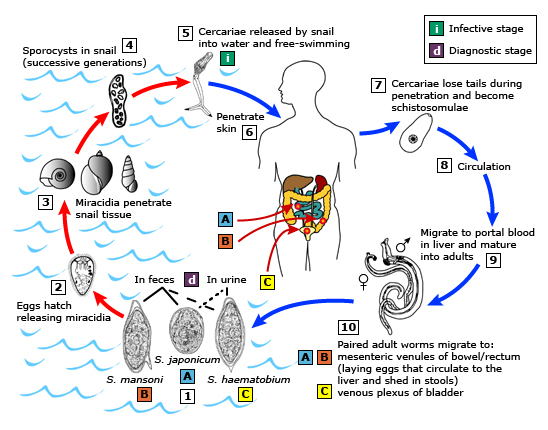
- The life cycle of schistosomiasis is complex and requires both intermediate and definitive hosts
- Cercariae released from snails in fresh water penetrate human skin and migrate to the liver, where they mature into adults.
- The adult worms migrate to the mesenteric venules of the intestine (S. japonicum and S. mekongi), the colon (S. mansoni), or the vesical venous plexus (S. haematobium).
- The female worms deposit eggs in the portal or perivesical systems, which migrate to the lumen of the intestine (S. mansoni and S. japonicum) or bladder (S. haematobium) and are excreted via stool or urine, respectively.
- The eggs hatch and release miracidia, which penetrate snail intermediate hosts; subsequently cercariae are produced.
- In humans:
- Children acquire the infection by bathing in fresh water contaminated with cercariae (the infectious form of the parasite)
- Worm burden gradually increases to culminate during adolescence.
- Most individuals have a mild to moderate parasite load with limited morbidity
- Heavy infection with significant consequence for disease occurs among relatively few individuals in a population.
Presentation
Acute
Typically observed among individuals not living in endemic areas, such as travelers; this is likely because these individuals have not yet developed immunity associated with early exposure
Swimmers itch
- Skin penetration by cercariae usually goes unnoticed. Some individuals develop an itchy rash (“swimmer’s itch”) soon after swimming in fresh water; this is a localized dermatitis that can result in a pruritic papular or urticarial rash at the site of larval entry
- The rash is a hypersensitivity reaction that occurs with repeat exposure (never with initial exposure); it typically develops on the feet or lower legs.
Acute schistosomiasis syndrome
- Also known as Katayama syndrome
- Systemic hypersensitivity reaction to schistosome antigens and circulating immune complexes that occurs three to eight weeks after infection
- Nonimmune hosts such as travelers and may be observed in more than half of infected individuals
- Sudden onset of fever, urticaria and angioedema, chills, myalgias, arthralgias, dry cough, diarrhea, abdominal pain, and headache
Chronic
- Chronic infection related to schistosomiasis is most common among individuals in endemic areas with ongoing exposure
- The severity of disease is related to the number of eggs trapped in tissues, their anatomic distribution, the duration and intensity of infection, and the host immune response
Intestinal schistosomiasis
- chronic or intermittent abdominal pain, poor appetite, and diarrhea.
- In heavy infection, chronic colonic ulceration may lead to intestinal bleeding and iron deficiency anemia
- Intestinal polyps and dysplasia can arise due to granulomatous inflammation surrounding eggs deposited in the bowel wall
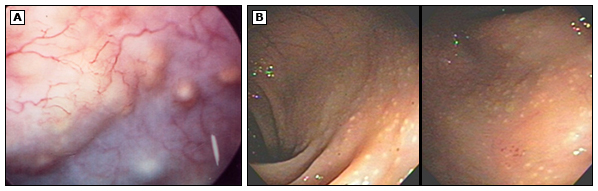 (A) Pseudopolyps of Schistosoma hematobium in bladder of 38-year-old traveler with hematuria four months after returning from Dogon Valley, Mali.
(B) Pseudopolyps of Schistosoma spp in rectocolon.
Hepatosplenic schistosomiasis
- Among children and adolescents, nonfibrotic granulomatous inflammation around trapped eggs
- Among adults with chronic infection, collagen deposition in the periportal spaces by activated hepatic stellate cells, which causes periportal fibrosis (also known as Symmers’ pipestem fibrosis). This leads to occlusion of the portal veins, portal hypertension with splenomegaly, portocaval shunting, and gastrointestinal varices.
Pulmonary complications
- Eggs can lodge in pulmonary arterioles and produce a granulomatous pulmonary endarteritis, with subsequent development of pulmonary hypertension and cor pulmonale
Genitourinary schistosomiasis
- In early infection, eggs are excreted in the urine and patients present with microscopic or macroscopic hematuria and/or pyuria
- In early chronic infection, the eggs provoke granulomatous inflammation, ulcerations, and development of pseudopolyps in the vesical and ureteral walls, which may be observed on cystoscopy and mimic malignancy
- In longstanding infection the bladder wall is fibrosed and may calcify causing bladder neck obstruction, hydroureter, and hydronephrosis can ensue, leading to renal failure
Neuroschistosomiasis
- Neuroschistosomiasis can involve the spinal cord (causing an acute myelopathy) and/or the brain
Diagnosis
- In returned travelers, serology is the most useful test, but it does not reflect definitive evidence of ongoing infection
- In individuals living in endemic areas, the parasite burden should be determined by microscopy for egg detection and antigen detection.
Treatment
Three purposes
- reversing acute or early chronic disease
- preventing complications associated with chronic infection
- preventing neuroschistosomiasis. The goal of treatment is reduction of egg production via reduction of worm load.
Acute schistosomiasis syndrome
- corticosteroids to reduce inflammation.
- praziquantel 8 to 12 weeks after infection (together with prednisolone), followed by repeat praziquantel treatment 4 to 6 weeks later (without corticosteroids)
Chronic schistosomiasis
- praziquantel → test on microscopy and repeat treatment if required