Pathogen
- Trichinellosis is a parasitic infection caused by Nematode (roundworms) of the genus Trichinella.
- Pigs are the most important source of human infection, although a number of other animals are also epidemiologically important hosts.
- Consumption of raw or undercooked meat is the principal mode of transmission.
Life cycle
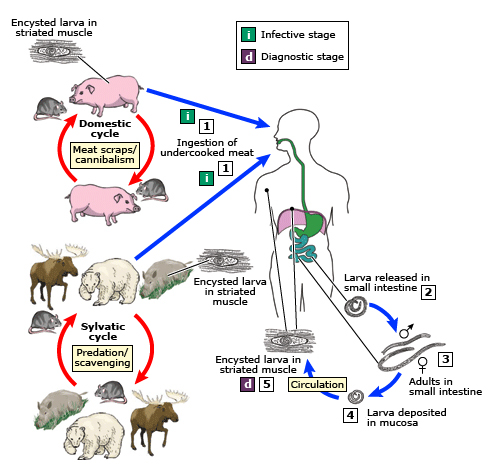 Depending on the classification used, there are several species of Trichinella: T. spiralis, T. pseudospiralis, T. nativa, T. murelli, T. nelsoni, T. britovi, T. papuae, and T. zimbabwensis, all but the last of which have been implicated in human disease. Adult worms and encysted larvae develop within a single vertebrate host, and an infected animal serves as a definitive host and potential intermediate host. A second host is required to perpetuate the life cycle of Trichinella. The domestic cycle most often involved pigs and anthropophilic rodents, but other domestic animals, such as horses, can be involved. In the sylvatic cycle, the range of infected animals is great, but animals most often associated as sources of human infection are bear, moose, and wild boar.
Trichinellosis is caused by the ingestion of undercooked meat containing encysted larvae (except for T. pseudospiralis and T. papuae, which do not encyst) of Trichinella species (1). After exposure to gastric acid and pepsin, the larvae are released from the cysts (2) and invade the small bowel mucosa where they develop into adult worms (3). Females are 2.2 mm in length; males 1.2 mm. The life span in the small bowel is about four weeks. After one week, the females release larvae (4) that migrate to striated muscles where they encyst (5). Diagnosis is usually made based on clinical symptoms, and is confirmed by serology or identification of encysted or nonencysted larvae in biopsy or autopsy specimens.
-
Clinical presentaiton
- The severity of infection correlates with the number of ingested larvae
- Heavy infection may have two stages:
- the intestinal stage (in which larvae mature into adult worms that burrow into the intestinal mucosa)
- muscle stage (in which larvae disseminate hematogenously from the intestines and enter skeletal muscle).
- Serious infections may include cardiac, central nervous system, and/or pulmonary involvement. Fatal outcomes in acute trichinellosis usually result from myocarditis, encephalitis, or pneumonia
Diagnosis
- Eosinophilia is a hallmark of trichinellosis
- Diagnosis is usually based on clinical symptoms and confirmed by serology.
- A definitive diagnosis may be established by identifying larvae on muscle biopsy
Treatment
The clinical course for most Trichinella infections is uncomplicated and self-limited.
Mild infection
- Antiparasitic therapy is not required
- Symptomatic treatment with analgesia and antipyretics is appropriate. Severe infection
- Antiparasitic therapy together with corticosteroids.
- Albendazole or mebendazole