Section: Colorectal Sub-section: Proctology Curriculum: Curriculum, page 19
Definition
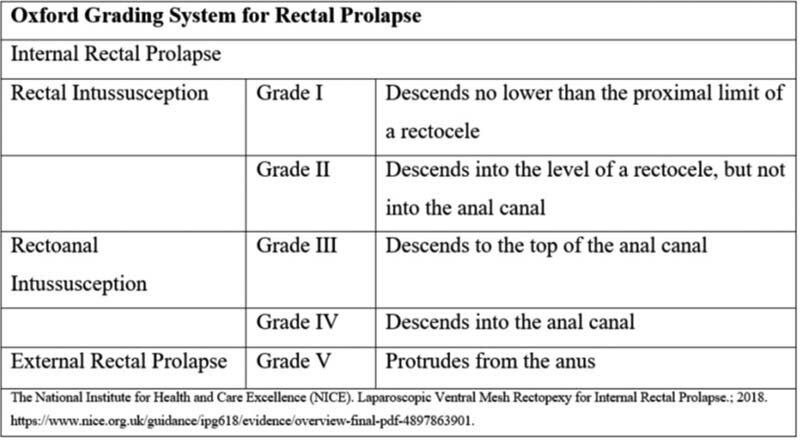
External protrusion of the rectum through the anus
- Mucosal
- Full thickness
Investigation
Proctography
Risk factors
- Elderly women
- Connective tissue disorders e.g. Marfans, Ehler’s Danlos syndromes
- History of anorexia nervosa (due to poor cross-linking of collagen fibres in pelvic floor during adolescence)
- High BMI
- High birth weight during vaginal deliveries
Mucosal
- Can occur in isolation or with obstructive defecation syndrome and solitary rectal ulcer syndrome.
- Symptoms: perianal discomfort, passage of mucus or blood, constipation and straining
Treatment:
- Conservative: bulking agents, fibre, improving toileting technique.
- Surgical: banding, sclerotherapy, surgical excision or plication, RFA
Full-thickness
Conservative measures may improve symptoms, but usually need definitive surgery. Various approaches
- No difference in recurrence rate but all high rate. All associated with improvement in quality of life.
Definition
Operative management
Choice of procedure should take into account:
- Pelvic floor integrity
- Presence of concurrent genital prolapse
- History of pelvic floor injury
- Bowel function
- Constipation
- Difficulty evacuating
- Incontinence
Perineal approach
- Good for elderly patients.
- Can be done under a spinal or even local anaesthetic.
- Is a mucosal proctectomy and muscularis plicating procedure
- Typically done in lithotomy with a lone-star retractor.
- Sponge forceps is used to pull the prolapse out, and guide the upper limit of resection.
- The mucosa is dissected off the underlying muscle and excised.
- The muscle layer is plicated (all the numbers of the clock face).
- The mucosa is re-approximated
- There is approximately a 30% recurrence rate but it can be repeated.
- Can be described as a perineal rectosigmoidectomy.
- Is done where there is full thickness prolapse
- Can be done where there is ischaemia of the bowel wall (which would preclude a Delormes procedure)
- Patient placed in lithotomy.
- Prolapse is brought out through the anus.
- All layers are then excised, mesenteric vessels are ligated.
- Trans-anal coloanal anastomosis is then performed.
- Recurrence rate of 10%
- Does remove the rectum (or most of it) thus can have isses with capacity which can be another cause of faecal incontinence.
- Also has risk of anastomotic leak and pelvic sepsis.
Abdominal approach
Rectopexy - Rectal mobilisation and fixation to sacrum with either sutures or mesh.
- Posterior
- Ivalon sponge (Wells’ procedure
- Fascia lata (Orr Loygue operation)
- Non-absorbable mesh
- Anterior
- Anterior mesh slingaround rectum to sacrum (Ripstein’s procedure)
- Ventral mesh rectopexy (VMR)
- Resection rectopexy (Frykman Goldberg procedure)
- Sigmoid colectomy with handsewn or stapled anastomosis at sacral promontory.
- Can get worsening constipation, evacuatory difficulties or faecal incontinence following abdominal rectopexy.
- Division of lateral ligaments associated with lower recurrence rates but inconclusive on outcomes of postoperative constipation.
Laparoscopic ventral mesh rectopexy
- Laparoscopic approach with dissection along the right lateral aspect of the rectum
- Create a plane between the rectum and the vagina.
- Piece of mesh is sutured onto the front of the rectum, and side of the rectum.
- The top of the mesh is sutured to the top of the sacral promonentry which hitches the rectum up.
- Benefits – avoid posterior and lateral dissection which avoids dissection of the parasympathetic nerves (involved in rectal distension sensation)
- Non-absorbable polypropylene mesh is used.
Laparoscopic
- Fewer complications and shorter LOS Ventral mesh vs posterior suture
- No difference in recurrence rates, functional outcomes or complication rates.
- Increased colonic transit time for both, but significantly higher for posterior suture Recurrence:
- Limited evidence on best approach.