Section: Critical care Curriculum:Curriculum, page 50
Definition
- Unpleasant sensory and emotional experience associated with actual or potential tissue damage, or described in terms of such damage. Subjective and indicates that each individual learns the application of the word through experiences related to injury in early life.
Pathophysiology
- Noxious stimulus is transduced into electrical activity which is conducted in peripheral sensory nerves to the central nervous system.
- Different classes of nociceptors are activated by stimuli such as intense pressure, extreme temperatures, damaging chemicals.
- Nociceptor plasticity – sensitisation occurs in response to nerve injury and inflammation.
- Produced by chemical signals of tissue damage: during infection, inflammation or ischaemia; disruption of cells; degranulation of mast cells; induction of enzymes such as COX-2. Chemokines, cytokines all have an impact on sensitisation.
- Sodium, potassium, calcium and chloride ion channels function in nociceptor transduction and transmission. Sodium channels present in all neurons – principal site of action for LA.
- Primary afferents comprise both medium diameter lightly myelinated A-delta fibres and small-diameter, slow-conducting unmyelinated C fibres.
- Modulated by descending pathways from somatosensory cortex via thalamic relays, amygdala, cingulate cortex, nucleus accumbens, spinal cord. Related to physiological, psychological and social factors.
The injury response
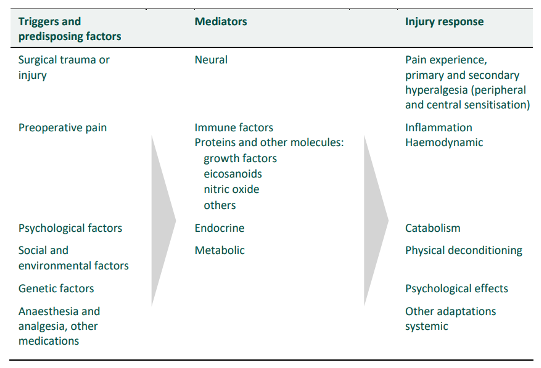
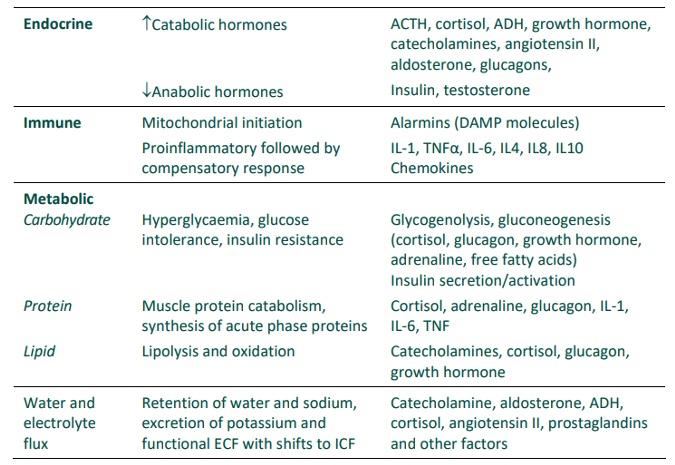
Metabolic, immunological and endocrine responses to injury
Effects of pain on physiological functions
- Cardiovascular: increased sympathetic efferent nerve activity, increasing HR, BP and contractility. Increases myocardial oxygen demand, reduces oxygen supply, increasing risk of cardiac ischaemia.
- Respiratory: inability to cough and reduction in FRC, resulting in atelectasis and ventilation-perfusion abnormalities, hypoxia and increased incidence of pulmonary complications.
- Gastrointestinal: increased sympathetic activity reduces GI motility, causing ileus.
- Neurological: postop delirium exacerbated by under-treated pain. Anxiety, insomnia, demoralisation, loss of control, inability to think and interact with others, and in extreme situations, when unable to communicate, loss of autonomy.
- Immune: injury response suppressed immune function.
- Metabolic: catabolism and altered glucose metabolism contribute to injury response.
Measures of pain
Unidimensional
- Verbal descriptor scale
- Visual analogue scale
- Numerical rating scales
- Functional impact on pain Multidimensional
- Brief pain inventory (BPI)
- Assesses pain intensity and associated disability
- McGill Pain Questionnaire (MPQ)
- Sensory, affective and evaluative dimensions of pain
Local anaesthetics
Classifications
- Esters
- Benzocaine, chloroprocaine, cocaine, procaine, tetracaine
- Amide
- Bupivacaine, lidocaine, ropivacaine, prilocaine
Pharmacology
- Same basic structure:
- Lipophilic end (aromatic ring)
- Hydrophilic end (tertiary amine)
- Intermediate chain – ester or amide
- R groups determine the pharmacokinetic and pharmacodynamic properties of each LA
- Isomerism important for toxicity – (relevant for bupivacaine)
Solutions
- All are weak bases in ionised and unionised forms (both forms required for activity)
- Prepared in slightly acidic solution for storage
Mechanism of action
- LA injected
- pKa determines proportion present as unionised molecule at pH 7.4
- Unionised molecules diffuse through axonal membrane
- Acidic intracellular environment favours ionisation of molecules
- Ionised molecules bind to inside of the voltage gated Na channels
Additives
- Adrenaline – promotes vasoconstriction which prolongs duration of lignocaine
- Has no effect on duration of action for bupivacaine but improves safety profile
Maximal dose:
- Lignocaine = 4mg/kg
- Lignocaine 1% + 1:200,000 adrenaline = 7 mg/kg
- Bupivacaine = 2mg/kg. Each ml of 0.25% contains 2.5 mg.
- Bupivacaine (marcaine) 0.25% + 1:400,000 adrenaline = 3 mg
- Ropivacaine = 3mg/kg
- Adrenaline 1:200,000 = 5mcg (add 100mcg per 20ml LA)
| Property | Lidocaine 1% (10 mg/mL) | Bupivacaine 0.25% (2.5 mg/mL) | Ropivacaine 0.2% (2 mg/mL) |
|---|---|---|---|
| Onset | Rapid | Slow | Moderate |
| Duration | Short (1–2h) | Long (4–12h) | Long (4–6h) |
| Potency | Moderate | High | High |
| Metabolism | Hepatic | Hepatic | Hepatic |
| Toxicity | CNS toxicity at high doses | High cardiotoxicity (arrhythmias, cardiac arrest) | Less cardiotoxic than bupivacaine |
| Max Dose (w/o adrenaline) | 3 mg/kg | 2 mg/kg | 3 mg/kg |
| Max Dose (with adrenaline) | 7 mg/kg | 3 mg/kg | Unchanged |
| Max Volume per kg (w/o adrenaline) | 0.3 mL/kg | 0.8 mL/kg | 1.5 mL/kg |
| Max Volume per kg (with adrenaline) | 0.7 mL/kg | 1.2 mL/kg | |
| Max Volume for 70 kg (w/o adrenaline) | 21 mL | 56 mL | 105 mL |
| Max Volume for 70 kg (with adrenaline) | 49 mL | 84 mL |
Side effects & management
- LA toxicity:
- Relates to high peak plasma concentrations
- CNS signs usually before cardiac
- Neurological symptoms:
- Mild – tinnitus, perioral numbness, metallic taste, altered mental status
- Severe – seizures, CNS depression
- Neurological symptoms:
- Cardiac signs:
- Tachycardia, hypertension, bradycardia, hypotension, arrhythmia, asystole
- Bupivacaine is most toxic – high affinity for cardiac receptors
- Contributing factors:
- Patient factors:
- Extremes of age, pregnancy
- Comorbidities
- Administration factors:
- More likely to have elevated peak plasma levels when injected into more vascular areas.
- Patient factors:
- Intralipid 20% - is antidote for toxicity. Bolus and subsequent infusion.
- Risk of pancreatitis.
- Can also clog bypass or dialysis circuits
- Hypersensitivity
- Para-aminobenzoic acid (ester) is common
- Allergic to local?
- If tachycardia, palpitations, anxiety or vasovagal without other immediate allergic reaction, unlikely to be allergic reaction so continue as normal
- If itch, urticaria, angioedema, bronchospasm, hypotension, tissues not contiguous with site of injection – possible IgE mediated
- If not urgent – allergy specialist. If urgent could continue with different class of anaesthetic.
- Direct neurotoxicity
- Incorrect preparation
- Drug specific effects
- Adrenaline:
- Contraindications:
- Skin flaps
- Diabetes or PAD
- Extremities (digits, penis)
- Inadvertent injection into digit
- Reversal is phentolamine (alpha blocker)
- Contraindications:
LA as IV infusion for perioperative pain
- Lignocaine 1.5mg/kg on induction, followed by 1mg/kg/hr. Can continue postoperatively. - Can be given through peripheral IV.
- Useful for chronic pain management
Laparoscopic
- Wound infiltration and intraperitoneal instillation for lap chole has good analgesic efficacy, especially when combined and prior to trocar insertion and commencement of pneumoperitoneum (Level I)
- Same true for lap gastric surgery (Level I)
Laparotomy
- LA is part of multimodal strategy to reduce overall opioid consumption.
- Epidural vs rectus sheath – case by case basis.
- Rectus sheath are cheaper and less labour intensive.