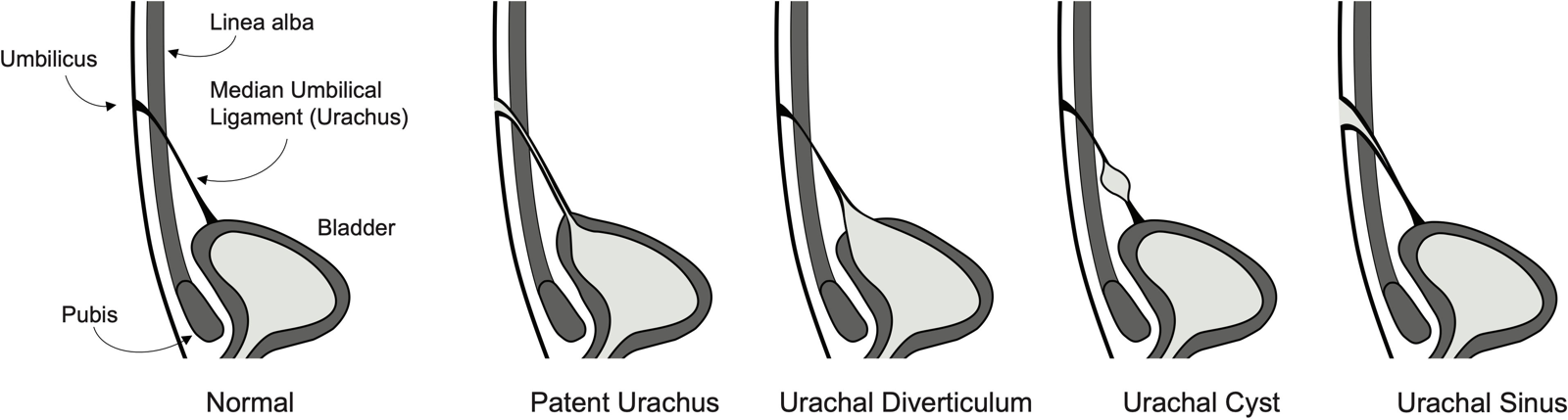
- Embryological origin
- The urachus is a remnant of the allantois, a canal connecting the fetal bladder to the yolk sac via the umbilicus
- It normally becomes a fibrous cord, the median umbilical ligament, running from the bladder apex to the umbilicus
- Types of urachal anomalies (due to incomplete obliteration)
- Patent urachus (urachal fistula)
- Entire tract remains open
- Urine discharges from umbilicus
- Urachal cyst
- Central portion remains open; ends closed
- May become infected, present with tender infraumbilical mass
- Urachal sinus
- Umbilical end remains open
- Discharge from umbilicus but no communication with bladder
- Vesicourachal diverticulum
- Bladder end remains open
- Blind-ending outpouching from bladder dome
- Clinical significance
- Infections can mimic abscesses or other midline masses
- Risk of urachal carcinoma (typically adenocarcinoma) in persistent remnants
- Symptoms may include discharge, lower abdominal pain, UTI symptoms
- Investigation
- Ultrasound or CT scan for structural definition
- Fistulogram or cystogram if communication suspected
- Management
- Infected anomalies: initial antibiotics ± drainage
- Definitive treatment: surgical excision of the remnant (complete urachectomy)