Sub-section: Adrenal Section: Endocrine
Adrenal Cortex
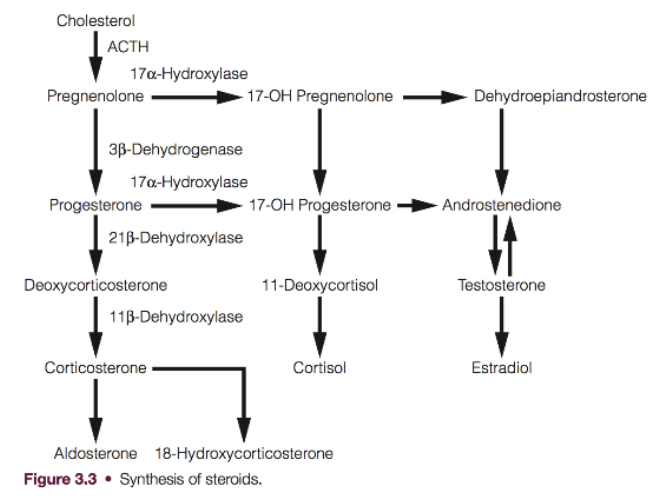
- All synthesized from cholesterol
Mineralocorticoid (Zona Glomerulosa)
- Stimulation
- Mainly Aldosterone
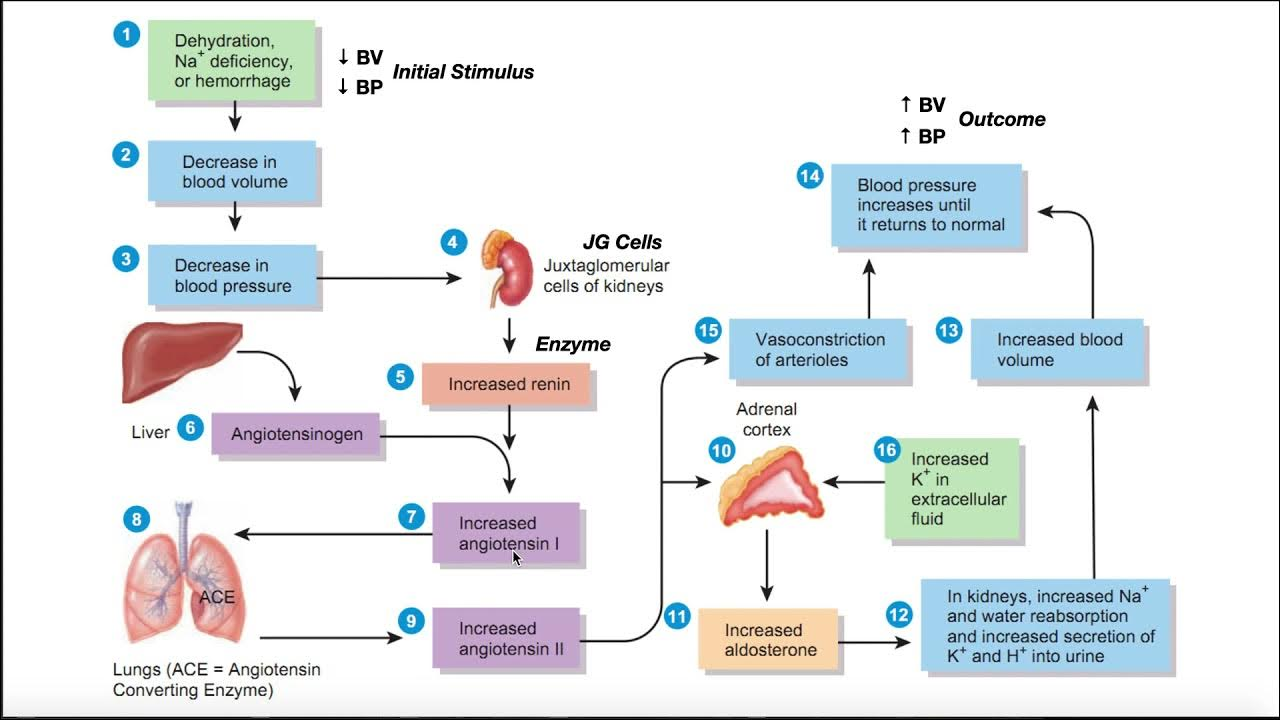
- Secretion stimulated by Angiotensin II
- Can also be stimulated by ACTH and blood K+ level
- Renin-angiotensin-aldosterone axis
- Responds to Na+ delivery to Distal Tubules
- Low if hypovolaemic, shock, Renal Artery constriction, hyponatraemia
- Low Na+ stimulates Renin release (from JGA)
- Responds to Na+ delivery to Distal Tubules
- Renin
- Converts angiotensinogen from liver to Angiotensin I
- Further cleavage by ACE in lungs to Angiotensin II
- Also stimulated by hyperkalaemia
- Inhibited by hypokalaemia
- Angiotensin II
- Potent vasoconstrictor
- Stimulates aldosterone release
- Actions
- Aldosterone actions
- Regulates circulating fluid volume and electrolyte balance
- Acts on distal renal tubule
- ↑ Na+ (and H2O) resorption to ↑ circulating volume
- At the expense of K+ or H+ (lost in urine)
- Also causes chloride retention
- ↑ Na+ (and H2O) resorption to ↑ circulating volume
- Negative feedback
- Increased delivery of Na+ to distal tubules inhibits renin release
- Aldosterone actions
Glucocorticoid (Zona Fasciculata)
- Stimulation
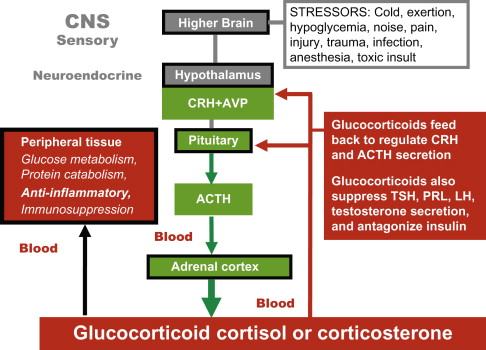
- Mainly cortisol and corticosterone
- Hypothalamus releases Corticotropin-releasing hormone (CRH) in response to stress
- Stimulates Adrenocorticotropic hormone (ACTH) release from Anterior Pituitary
- Normally pulsatile fashion, has circadian rhythm
- Highest levels when waking, lowest early evening
- Normally pulsatile fashion, has circadian rhythm
- Stimulates Adrenocorticotropic hormone (ACTH) release from Anterior Pituitary
- ACTH stimulates glucocorticoid secretion
- Actions
- Broad ranging effects on most organs
- Generally create catabolic state (stress response)
- Glucose and protein metabolism
- Hepatic gluconeogenesis and glycogenolysis ⇒ Hyperglycaemia
- Glucose uptake in peripheral tissues inhibited, general state of insulin resistance
- Protein catabolism in muscle
- Lipolysis in fat (and release of FFA’s)
- Weak mineralocorticoid effects
- Stimulates - gut Ca2+ absorption and ⇧ urinary excretion (high levels cause osteoporosis)
- Potent immunosuppressant and anti-inflammatory effect
- Important cardiovascular effect
- Glucocorticoids enhance the effect of catecholamines by sensitizing arterial smooth muscle to beta-adrenergic stimulation
- Broad ranging effects on most organs
Sex Steroids (Zone Reticularis)
- Weakly androgenic steroids under action of ACTH
- Dehydroepiandrosterone (DHEAS) most important
- Converted in peripheral tissues to
- Dihydrotestosterone and Oestradiol via Aromatase system
- Converted in peripheral tissues to
Medulla
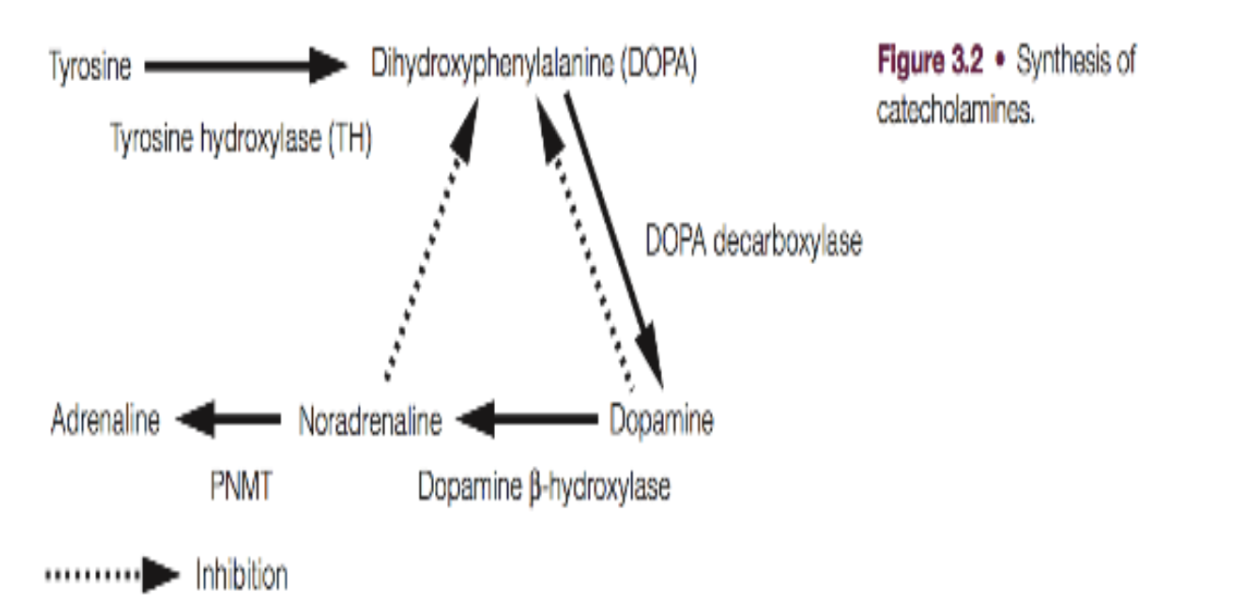
- Catecholamine
- Synthesis
- All from Tyrosine, via DOPA
- Dopamine
- Dopamine β-hydroxylase
- Noradrenaline
- PNMT (only in Adrenal)
- Adrenaline
- Sympathetic stimulation releases stored catecholamines
- Dopamine
- All from Tyrosine, via DOPA
- Synthesis
- Actions
- Exert effects by binding to α- and β-adrenoreceptors
- α- Higher affinity for noradrenaline
- β- Higher affinity for adrenaline
- “Fight or flight”
- ⇧HR, BP, Cardiac output
- CNS excitation
- ⇧ Muscle and CNS perfusion
- Decrease splanchnic perfusion
- Metabolic effects – Lipolysis, gluconeogenesis, glycogenolysis
- Exert effects by binding to α- and β-adrenoreceptors
- Clearance
- Potent, but short acting
- T1/2 = 1 minute (therefore hard to measure)
- Noradrenaline and Adrenaline inactivated by Monoamine Oxidase and COMT
- Breakdown products are
- Metanephrine and Normetanephrine
- Can detect these in both plasma and urine
- Plasma levels of metanephrines much more stable
- Better diagnostic markers
- Metanephrine and Normetanephrine
- Breakdown products are
- Catecholamine metabolites secreted renally
- Potent, but short acting