Section: Endocrine Sub-section: Parathyroid
Signs/Symptoms of Hypocalcaemia
- Acute manifestations
- Tetany
- Seizures
- Also get
- Cardiac abnormalities
- Papilloedema
- Psychiatric – emotional instability, anxiety, depression
- Fatigue
- Hyperirritability
Tetany
- Uncommon unless Ca2+ < 1.1mmol/L
- Due to peripheral neuromuscular irritability
- Hyperexcitable peripheral neurons
- NB: Synergism with alkalosis
- Mild symptoms can cause anxiety, hyperventilation, exacerbation of symptoms
- Symptoms
- Mild
- Perioral numbness, peripheral paraesthesia, cramps
- Severe
- Carpopedal spasm, laryngospasm, seizures
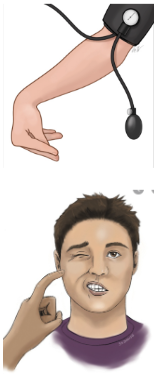
- Classic Findings
- Trousseau’s sign (most specific)
- Induction of carpal spasm by inflating BP cuff over systolic for 3 mins
- Can also induce voluntarily with hyperventilation after cuff removal
- Chvostek’s sign
- Contraction of ipsilateral facial muscles by tapping on facial nerve just anterior to the ear
- Can range from lip twitching to full spasm of all facial muscles
- Can be present in 10% of normal people as well
- NB: Both may be negative in patients with hypocalcaemia
- Trousseau’s sign (most specific)
- Mild
Seizures
- Can be only presenting symptom
- If in absence of tetany may be due to low CSF Ca2+ rather than serum Ca2+
- Can get
- Generalized tonic-clonic
- Generalized absence
- Focal seizures
Cardiovascular effects
- Decreased myocardial performance or CHF
- Myocardial dysfunction reversible with Ca2+
- Mechanism undefined
- ? Ca2+ role in excitation-contraction coupling
- Prolonged Q-T interval
- Can get arrhythmias – but rare
- Most severely can get Torsades-de-pointes
- But less common than hypokalaemia or hypomagnesaemia
Treatment
- IV Ca2+ replacement if:
- Symptomatic (Tetany, seizures, carpopedal spasm)
- Prolonged Q-T
- Or if Ca2+ < 1.9mmol/L
- Rapid infusion
- 1 or 2 g Calcium Gluconate in 50mL normal saline over 10-20mins
- Followed by continued slow infusion
- 10% Calcium Gluconate or 10% Calcium Chloride in normal saline (50mL/hr)
- Treat concurrent hypomagnesaemia
- For mild/chronic cases
- PO supplementation (Calcium Carbonate)
- Don’t forget Vit D supplementation if required
Hypoparathyroidism
- Inadequate PTH secretion leads to
- Hypocalcaemia
- Hyperphosphataemia
- Most commonly a result of damage to normal glands
- Post surgical or after reimplantation
- Can also be
- Congenital
- Pseudohypoparathyroidism
Congenital Hypoparathyroidism
- Extremely rare causes of hypoparathyroidism
- Born without adequate parathyroid tissue (e.g. DiGeorge syndrome)
- Caused by microdeletions occurring in chromosome region 22q11.2
- Features vary widely and include:
- Congenital heart defects
- Defects in the palate
- Facial anomalies
- Recurrent infections
- Learning disabilities
- Hypoparathyroidism secondary to maternal hyperparathyroidism
- Hyperparathyroidism during pregnancy associated with foetal complications in 80% of cases
- Maternal hypercalcaemia results in suppression of foetal parathyroid glands > Foetal hypocalcaemia
- Intrauterine growth retardation
- Preterm delivery
- Low birth rate
- Foetal death
- Most cases of neonatal hypoparathyroidism are transient
- Respond to Ca2+ supplementation
- Born without adequate parathyroid tissue (e.g. DiGeorge syndrome)
Pseudohypoparathyroidism
- Rare metabolic condition
- Have low serum Ca2+ and hyperphosphataemia
- PTH is appropriately elevated because of the hypocalcaemia
- But body fails to respond to PTH
- Linked to a dysfunction of the Gsα subunit of G proteins (3 types)
- Type 1a (Albright Hereditary Osteodystrophy)
- Characteristic phenotypic appearance
- Short fourth and fifth metacarpals and a rounded facies
- Associated with thyroid-stimulating hormone resistance
- Type 1b
- Biochemically similar but lacks the phenotypic appearance
- Associated with a methylation defect
- Type 2
- Occur downstream of type 1a or 1b
- A normal cAMP response to PTH stimulation occurs, despite the inherent abnormality in calcium regulation