Sub-section: Thyroid Section: Endocrine
Definition
- Increased thyroid hormone secretion results in hyper metabolic state
Symptoms
Classic symptoms:
- Sweating
- Unintentional weight loss
- Despite increased appetite
- Heat intolerance
- Increased thirst
- Menstrual disturbance
- Anxiety
- Diarrhoea
- Palpitations
- Hair loss
- Sleep disturbance Other symptoms:
- Bulging eyes
- Hepatomegaly
- Nausea, vomiting
- Loss of libido
- Hand tremors
- Severe thyrotoxicosis can cause heart failure, peripheral oedema, arrhythmias (VT of AF)
Causes
- Primary alterations in the gland (most common)
- Grave’s Disease
- Toxic Nodular Goitre and Toxic Adenoma
- CNS disorders and increased TSH produced thyroid stimulation
- Other hyperthyroid states
- Mismanaged thyroxine ingestion
- Molar pregnancy with increased hCG
- Thyroid malignancy with overproduction of thyroid hormone
- Very rare!
Diagnosis of Hyperthyroidism
- Enlarged smooth thyroid mass with signs/symptoms of hyperthyroidism
- Elevated T3 and T4
- With decreased or undetectable TSH
- I123 radionucleotide scan
- Graves
- High uptake throughout entire gland
- Hyperfunctioning nodule
- Isolated area of increased uptake
- Thyroiditis or exogenous thyroxine misuse
- Low uptake throughout
- Graves
- USS or CT of neck to evaluate clinical landmarks prior to surgery
- Caution with IV contrast if hyperthyroidism untreated
Toxic Nodular Goitre & Toxic Adenoma
- “Plummer Disease”
- Overview
- Toxic adenoma and MNG are the result of focal and/or diffuse hyperplasia of thyroid follicular cells whose functional capacity is independent of regulation by TSH
- Get increased thyroid hormone production independently of TSH control
- Symptoms usually milder, and in older people, than Grave’s
- Thyroid may be diffusely enlarged or associated with retrosternal goitres
- Toxic adenoma and MNG are the result of focal and/or diffuse hyperplasia of thyroid follicular cells whose functional capacity is independent of regulation by TSH
- Initially
- Mild symptoms
- fT4/T3 elevated, TSH suppressed
- Antithyroid antibodies not usually detected
- Diagnosis
- Clinical suspicion leads to Radioactive iodine uptake scan with I-123 or I-131 scan
- Graves disease
- The uptake will be high and diffuse
- Toxic nodule
- The uptake will be focal known as a hot nodule
- Toxic multinodular goiter
- Patchy uptake
- Subacute thyroiditis
- Low uptake, factitious hyperthyroidism
- Graves disease
- Clinical suspicion leads to Radioactive iodine uptake scan with I-123 or I-131 scan
- Management
- Three options
- Thionamides (i.e. Carbimazole, PTU)
- Nodules rarely resolve with this
- RAI therapy
- RAI preferentially accumulates in the hyper-functioning nodule
- Surrounding thyroid tissue doesn’t take it up as TSH suppressed
- Net result is euthyroid state
- Surgery
- Lobectomy or Near-Total Thyroidectomy
- Thionamides (i.e. Carbimazole, PTU)
- Three options
Grave’s Disease
Definition
- Autoimmune disease
- Caused by thyroid-stimulating hormone-receptor antibodies
- Stimulating growth of the thyroid and overproduction of thyroid hormone
Overview
- Most common cause of hyperthyroidism
Risk
- autoimmune disease
- family hx
-
- Women > Men, age 20-40
- smokers
Aetiology
- TSH Receptor autoantibodies stimulate TSH-R
- ? Genetic cause (twin studies)
- Cross reactivity with the retro-orbital tissue
- Leads to mucopolysaccharides deposition in the extra ocular fat
- Inflammation and swelling of occular muscles
Symptoms
- Triad of symptoms
- Signs and symptoms of thyrotoxicosis
- Goitre (may have bruit related to increased vascular flow)
- Ophthalmopathy + Exophthalmos
- Ocular symptoms can be severe, including proptosis, periorbital oedema, lid retraction, tearing, blurry vision, eye pain, chemosis (conjunctival swelling), optic nerve damage, blindness, diplopia
- Retro-orbital tissue has over-expressed TSH-R
- Severe symptoms rarely seen now with screening assays
Treatment
- Beta-adrenergeric blocker
- There are three options to reduce thyroid hormone synthesis. These options are:
- Antithyroid drugs which block thyroid hormone synthesis and release
- Radioactive iodine (RAI) treatment of the thyroid gland
- Total or subtotal thyroidectomy
- Should be euthyroid
- If unable to be give Lugols iodine
- Should be euthyroid
Management of Hyperthyroidism
- Initial medical therapy
- Beta blockers
- Thionamides
- Corticosteroids
- Iodine
- Long-term/Definitive management
- Continue Thionamides
- 1/3 in long term remission after 1-2 yrs treatment
- RAI
- Thyroidectomy
- Continue Thionamides
Beta-blockers
- Thyrotoxicosis causes increased adrenergic stimulation
- Peripheral adrenergic effects can be modulated with beta blockers
- Propranolol
- Should be initiated in patients with tachycardia and in elderly
- Beta blockers don’t inhibit thyroid hormone synthesis
- Hypermetabolic state can remain or even progress
Thionamides
- Propylthiouracil (PTU) and Methimazole
- NB: Carbimazole is completely metabolised to methimazole
- Function
- Blocks synthesis of thyroid hormone (inhibit thyroid peroxidase)
- Inhibit
- Oxidation of iodide
- Organification (block binding of iodine to thyroglobulin)
- Coupling of iodotyrosine molecules to form T3 and T4
- PTU has additional action of preventing extra-thyroidal conversion of T4 ⇒ T3
- Methimazole is preferred over PTU
- Because it can reverse hyperthyroidism more quickly, can be dosed once daily, and has less hepatotoxicity
- Also has less effect on subsequent RAI therapy
- PTU preferred in some special circumstances
- 1st trimester of pregnancy
- Life-threatening thyroid storm (because also prevents peripheral conversion of T4 ⇒ T3)
- Previous minor reactions to methimazole, and don’t want RAI or surgery
- Side effects
- Main concern is agranulocytosis, but this occurs in less than 1% of cases
- Other side effects include
- Rash
- Arthralgias
- Neuritis
- Hepatotoxicity (potentially worse with PTU)
- Contraindications
- Previous severe reactions (agranulocytosis, hepatotoxicity)
- Potentially teratogenic so needs discussion
Corticosteroids
- Can effectively suppress the pituitary-thyroid axis
- Also act in the periphery to inhibit the peripheral conversion of T4 to T3
- Effectively lowers serum T3 levels
- Allows steroids to be used as a rapid inhibitory agent for hyperthyroid conditions
- Steroids can also lower serum TSH concentration
- Due to rapid action, good for
- Primary treatment of severe, previously untreated, or resistant hyperthyroidism
- Usually in conjunction with supportive care and the other above-mentioned agents
Iodide
- Given in large doses in the form of Potassium iodide (SSKI) or Lugol solution
- After the administration of an antithyroid medication
- Wolff-Chaikoff Effect
- Iodide excess causes down-regulation of NaIS symporter
- Usually transports Iodide into the cell on basolateral membrane
- Iodide also decreases amount and activity of TPO
- Less organification
- Reduces vascularisation of the thyroid
- Iodide excess causes down-regulation of NaIS symporter
- Effect transient
- Normal thyroids get escape after 2-5 days
- Can be longer in autoimmune/Graves thyroids – up to 10 days
- NIS no longer down regulated because iodide in thyrocytes so low
- Organification resumes
- Can be used to treat hyperactivity of the gland in preparation for surgery
- Handy for reducing vascularity
RAI Ablation - Therapeutic I-131
- Indications
- Considered as Gold standard for Grave’s
- Also option for Toxic Adenoma and Toxic Multinodular Goitre
- Ablates the thyroid within 6 to 18 weeks
- Patients with mild, well-tolerated hyperthyroidism can safely proceed to RAI ablation immediately
- Patients who are older or severely thyrotoxic may require pretreatment with a thionamide
- Overall cure rate with RAI is 90%
- Hypothyroidism develops post rx
- Needs monitoring of thyroid hormone and TSH levels at regular intervals
- Most patients are candidates for RAI
- Contraindications:
- Pregnancy or lactation
- Suspicious nodule
- Advantages
- Avoidance of surgery and the associated risks of RLN damage, hypoparathyroidism or post-op recurrence
- Might be more cost-effective over time, but the financial advantage is not as clear if repeated 131I therapy is needed
- Disadvantages
- Can exacerbate cardiac arrhythmias, particularly in older patients
- Possible foetal damage in pregnant women
- Worsening ophthalmic problems
- Rare but possibly life-threatening thyroid storm
Thyroidectomy
- Candidates for Thyroidectomy in the setting of Grave’s disease
- Large Goitres
- Pregnant (or may become pregnant within the next 6 months) and breastfeeding mothers
- Thyroid nodule concerning for malignancy
- Concomitant hyperparathyroidism needing operative intervention
- Social factors that would expose family members to RAI
- Ophthalmopathy may be transiently worsened by RAI therapy
- Surgery may more rapidly stabilize ophthalmopathy
- Grave’s disease refractory to RAI
- Advantages
- Rapid, effective treatment of thyrotoxicosis without the necessity for long-term antithyroid medications and their potential side effects
- Amount of residual tissue uncertain
- Complete ablation of thyroid tissue requires Total Thyroidectomy
- Associated with the highest rates of Hypoparathyroidism and RLN damage
- Also has the lowest likelihood of recurrent Grave’s disease
- Other subtotal resections include near-total thyroidectomy or subtotal thyroidectomy
- Complete ablation of thyroid tissue requires Total Thyroidectomy
- Need to correct hyperthyroidism pre-op otherwise at risk of thyroid storm
Thyroid Storm
- Thyrotoxicosis must be managed medically before thyroidectomy
- Tachycardia and other clinical thyrotoxic symptoms must be controlled
- Circulating levels of thyroid hormone should be in normal range
- TSH may remain suppressed
- If not properly treated pre-op, thyroid storm can be life-threatening
- Rarely encountered if appropriately anticipated
- Thyroid storm is precipitated by an acute event on top of hyperthyroidism
- Thyroid or non-thyroidal surgery, trauma, infection, an acute iodine load, parturition
- Or irregular/under use of anti-thyroid drugs, prolonged uncontrolled Graves etc
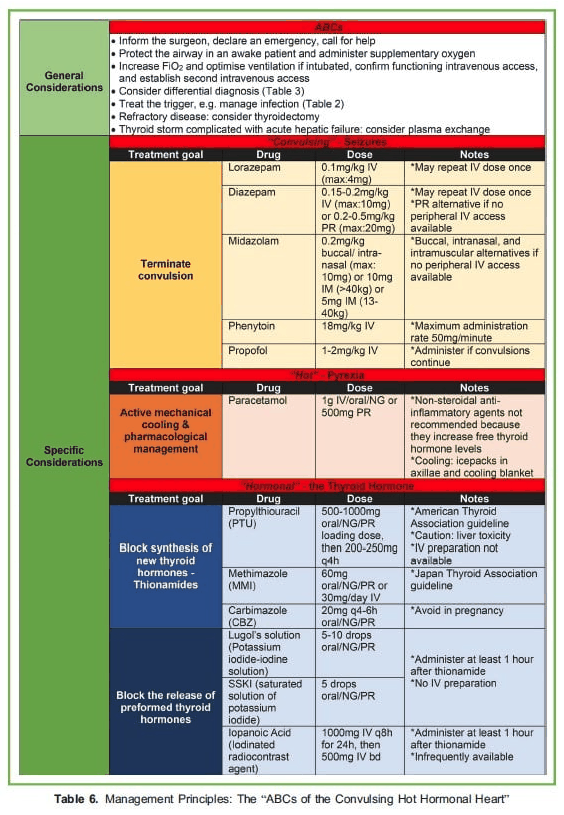
- Treatment of a patient with overt thyroid storm includes
- Rapid fluid replacement
- Close monitoring
- Institution of
- Antithyroid drugs (prevent synthesis of new thyroid hormones)
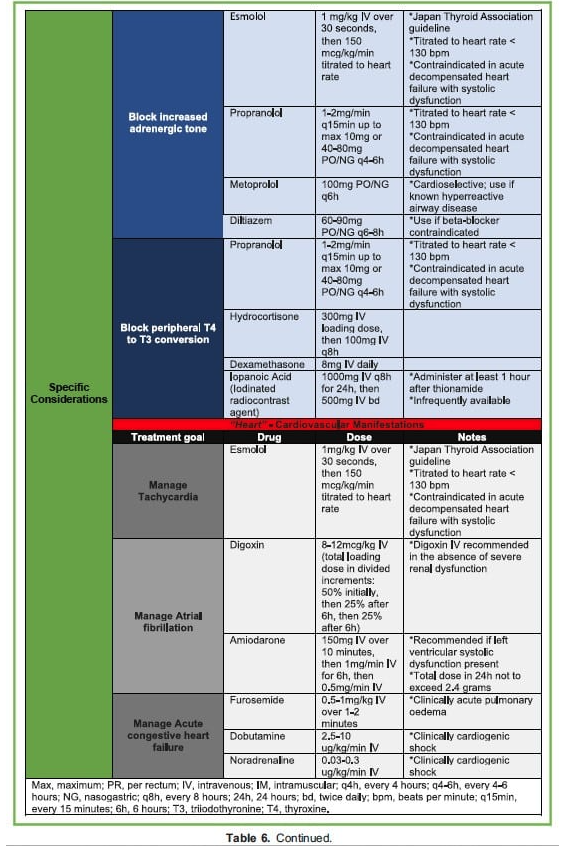
- Beta blockers (counteract peripheral adrenergic stimulation)
- Iodine solutions (block release of thyroid hormone)
- Steroids (prevent peripheral conversion of T4 –> T3)
- In life-threatening circumstances
- Plasmapheresis or plasma exchange may be effective in reducing T4 and T3
- Signs and symptoms
- Severe tachycardia
- Fever
- Confusion
- Vomiting
- Adrenergic overstimulation to the point of mania and coma