Section: Endoscopy Curriculum: Curriculum, page 38
Diathermy
- High frequency (AC) current (200kHz)
- NB low frequency <0.1MHz (NB domestic appliance current = 50Hz) stimulates nerves & muscles, so not used;
- Heat depends on current
- Components:
- Active electrode (tip)
- Dispersive/return electrode (plate)
- Generator to convert low to high frequency current
Monopolar
- Current passes in a circuit from the generator → active electrode = diathermy tip → through the patient → to the diathermy pad = return electrode
- Max heat at point of least cross-sectional area (eg tip)
- ground referenced; isolated
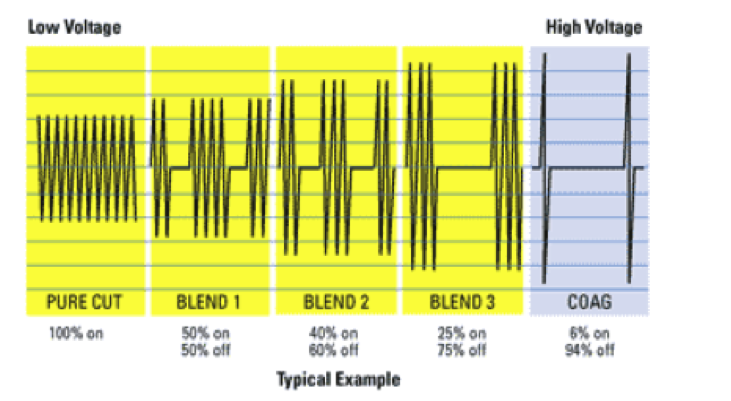
- coagulation = pulsed waveform, higher voltage
- interrupted frequency waveform → produces less heat than a continuous sine wave
- but enough heat to denature cellular protein → forms a coagulum = a protein-rich mixture that allows sealing of smaller blood vessels and control of local bleeding
- cutting = continuous wave form, lower voltage
- continuous sine wave → produces intense heat
- vaporizing water, exploding the cells = minimal coagulum production & so minimal hemostasis
- most effective if held slightly away from tissue to create a spark
- blend: dampens down a portion of the cutting waveform, allowing for greater formation of a coagulum and therefore more control of local bleeding
Bipolar
- The active and return electrodes are in the hand piece, therefore current only flows through the surgical site between the electrodes; not through the patient
- Advantage in pts with pacemakers
- LigaSure – can deal with vessels up to 7mm, thermal spread less than traditional bipolar & thought to be comparable to ultrasonic shears
Complications:
o Fire § Especially with use of alcohol-based preps § Avoid pooling of prep o Insulation failure § May provide alternative exit path for current § If current density high enough then burning will occur o Inadvertent activation § Unintentional burns to patient of staff § Ensure sound is on and audible o Capacitive Coupling § When activated within laparoscopic ports § Electrostatic field generated and surrounding visceral burn § Only in metal ports, 5mm>10mm o Direct Coupling § Contact with other conductive instruments with damage to viscera in contact with other instrument § Metal, uninsulated only o Permanent Pacemaker function § Causes temporary inhibition, reset or thermal injury from elctrodes use Bipolar as doesn’t effect PPM o Return Plate burns § Poor contact between patient and return electrode § Prevention • Trim hair to improve contact • Apply to dry skin • Plate with large surface area • Don’t fold plate • As close to the operative site as possible and practicable • Large, well vascularized muscle mass • Avoid scars and boney prominences • Don’t apply over prostheses o Surgical Smoke § May contain noxious chemicals § Theoretical risk to staff with inhalation § Recommended use of suction devices where possible
- pacemakers:
- modern pacemakers pause during diathermy (old ones fired → fibrillation)
- but may still make the pacemaker fire or reset or cause thermal damage to the heart, via the electrode lead
- Mx
- plate as close to site of surgery as possible;
- monitor patient, have a defibrillator
- alternative: use ultrasonic scalpel (‘harmonic’)
Argon beam coagulation therapy
- uses a coaxial flow of argon gas to conduct monopolar current to the target tissue
- the gas allows more accurate placement of the current flow
- can operate only in two modes: pinpoint coagulation or spray coagulation
- does not cut, even the most delicate tissue
- advantages
- allows use of coagulation without contact of the electrode – therefore no buildup of eschar (eschar resistant to current)
- ↓ smoke & odor
- ↓ tissue damage, as the current is more accurately targeted
- improves coagulation and ↓bleeding
- applications: eg liver surgery and endoscopy
Ultrasonic scalpels
- electrical current is converted to ultrasonic vibrations (at a frequency up to 55,500 cycles per sec) → produce cellular friction and denature proteins → form a coagulum, sealing blood vessels
- the coagulation occurs at a much lower temp (eg 50-100 oC), cf conventional diathermy (150-400 oC) → less lateral tissue damage, little eschar, less smoke
- disadvantage: cost
- no current passed through patient, therefore also safe for pacemakers