- Mesh can primarily be divided into: Absorbable or non-absorbable, biological or synthetic
- Absorbable
- Biologic mesh
- Animal
- Human
- Synthetic
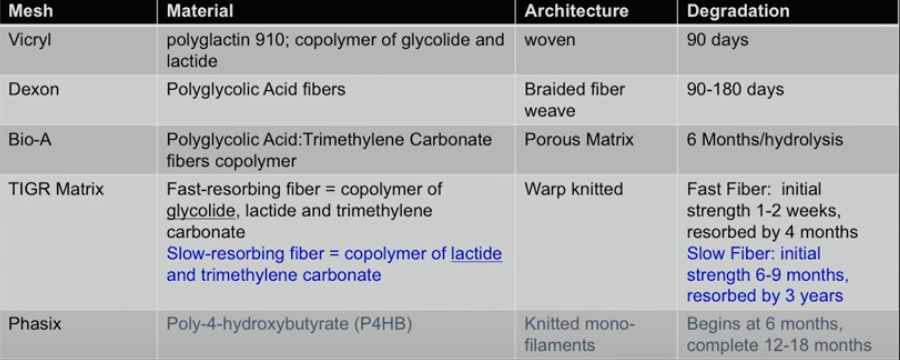
- Vicryl
- Biologic mesh
- Non-Absorbable
- Synthetic
- Polypropylene (monofilament
- Polyester (mono or multi filament)
- Polytetrafluoroethylene (PTFE) mesh
- Synthetic
- Absorbable
Absorbable mesh
- Can be either biological or synthetic.
Biological mesh
- Biological grafts are derived from human, bovine, or porcine tissue that has been decellularized to leave a collagen matrix. This structure acts as a regenerative framework that supports remodeling and new collagen deposition.
Advantages
- Lower risk of infection and can be used in contaminated fields Disadvantages
- Expensive, weaker long-term strength, potential for degradation.
Absorbable synthetic mesh
- Vicryl mesh
- Completely absorbed between 90-180 days.
- Does not have to be removed in the setting of infection.
- Phasix (P4HB) ST (with hydrogel barrier)
Non-absorbable mesh
Polypropylene
- Surgipro Mesh and Parietene
- Associated with a vigorous inflammatory reaction which may contribute to chronic pain as well as loss of activity.
- Lightweight, flexible and durable.
- Available in multiple thicknesses and pore size.
- Less prone to degradation
Polyester
- Parietex
- Medtronic meshs
- lightweight, macroporous mesh
- Polyester mesh coated with a collagen hydrogel matrix.
- Slightly stiffer and heavier than polypropylene.
PTFE
- Microporous woven mesh that was originally used in vascular grafts.
- The material used in abdominal cases generally has two sides—one side is smooth with small pores, the other has larger pores with ridges and groves.
- The material is designed to place the smooth side toward the bowel to minimize adhesions, and the rough side toward the fascia to allow for tissue ingrowth.
- However, experimental studies have shown limited ingrowth of fibers and minimal inflammatory changes surrounding ePTFE grafts.
- High rates of seroma formation
Composite meshes
- Have two layers
- The protective layer has omega 3, regenerated cellulose, collagen hydrogels, or monocryl.
- They require hydration prior to use and should not be cut.
- Benefits include that they can be used intra-peritoneally.
- Symbotex mesh
- Polyester
- Absorbable film of collagen from porcine origin and glycerol. The collagen film is essentially degraded in less than 1 month
- Ventral Patch
- Parietex - Polyester
- Hydrophilic absorbable collagen film
Ideal mesh
- Good tensile strength.
- Easy to manipulate
- Durable.
- Good degree of tissue ingrowth
- Chemically and biologically inert
- Non-carcinogenic.
- Resistant to bacteria.
- Sterilizable.
- Low cost.
- Limited contraction.
Properties of mesh
- Absorbability
- Absorbable
- can be used in clean-contaminated or contaminated fields, often a material safe to use against viscera
- Non-absorbable
- permanent tissue support
- Absorbable
- Porosity
- Macro porous - increases ingrowth, better integration, with lower risk of infection.
- Microporous - Doesn’t allow tissue ingrowth which can be advantage in decreasing adhesions e.g. against bowel. But has a higher rate of infection.
- Weight
- Light increases flexibility, decreases shrinkage and decreases risk of infection
- Heavy - increases tensile strength.
- Filament
- Monofiliment
- reduced infection risk, typically easier to cut and shape, less prone to shrinkage and better tissue intergration
- typically softer and more pliable, increased surface area can encourage rapid tissue ingrowth
- Monofiliment
- Self-fixation mesh
- Has barbs or hooks that adhere to tissues without sutures or tacks.
Preferred mesh should be lightweight <80g/m2, large pore > 1 mm and microporous > 10 μm (if too small, bacteria will hide from larger inflammatory cells). Porosity should be at least 60%.