Surgical options
- Considerations
- Tumour size
- Indication for surgery
- Open for cancer
- Patient size (BMI)
- Options
- Posterior retroscopic
- If >4cm difficult
- If less then 3 fingers between rib and iliac spine
- If high BMI
- Anterior laparoscopic
- Open
- Posterior retroscopic
Laparoscopic transperitoneal adrenalectomy (lateral approach)
Operative steps
- Place in lateral decubitus position
- Stabilise the patient using a beanbag or alternative
- “Break” the table - to maximise the distance between iliac crest and costal margin.
- First the first port in mid-clavicular line, then futher ports in anterior, mid and posterior axillary lines.
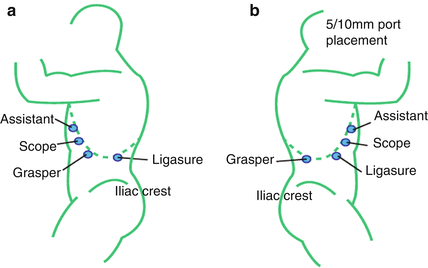
Left side
- Right lateral decubitus position
- 4x left subcostal ports including 1x 12mm camera port and 3x 5mm port
- Mobilise the splenic flexure
- Mobilise the spleen and tail of the pancreas by dividing the spleno-colic and splenorenal ligaments
- Flip them medially exposing the adrenal
- Start dissection at the upper pole - carrying the dissection downwards along both medial and lateral borders.
- Divide small arterial branches with ligasure.
- The lower aspect of the gland frequently goes down as far as the renal hilum.
- Do not grasp the adrenal as it bleeds easily.
- Identify the left adrenal vein on the infero-medial aspect of the gland as it empties into the renal vein.
- Once this is secured, dissect the posterior aspect of the adrenal gland and take it off the kidney - there may be further arterial branches which require clipping.
- The tumour is placed in a bag and then removed by enlarging one of the incision (or if the tumour is large, performing a Pfannensteil incision).
https://www.youtube.com/watch?v=KAvQxAkzCBs&ab_channel=DrDeeprajBhandarkar
Right side
- Divide the right triangular ligament of the liver and retract the liver medially with a Nathenson retractor
- Keep mobilisation the liver until the IVC is identified
- Incise the posterior peritoneum along the lateral edge of the IVC and identify the adrenal gland.
- Continue dissection superiorly along the lateral edge of the IVC until the right adrenal vein is identifed
- It is short and wide
- Divide it between double clips or use a vascular stapler.
- Continue mobilisation along the lateral aspect of the IVC until the superior pole
- Continue medial to lateral dissection rolling the adrenal laterally
- Mobilise the remaining gland off the kidney, liver, and posterior muscles.
- Divide small vessels with a ligasure.
- Remove through a retrieval bag.
https://www.youtube.com/watch?v=hUGZ_7D932E&ab_channel=Cirug%C3%ADaLaparosc%C3%B3picaSevilla-MISS
Laparoscopic retroperitoneal adrenalectomy (posterior approach)
Operative steps
- The operative steps are similar regardless of size.
- Position the patient prone
- Place the arms alongside the head
- Break the table to tense the lumbar fascia.
- Make an incision between the tips of the 11th and 12th ribs and dissect bluntly through the muscles until you can feel the kidney.
- Insert a port and create a space using 20mmHg of C02 pressure
- Introduce 2 further ports on either side of the camera port.
- Identify the kidney and dissect it downwards until you see the edge of the adrenal.
- Dissect the ventral and lateral aspect of the adrenal gland until the renal vein is encountered
- This leaves the adrenal to “hang” by its superior attachment
- Divide it with a vascular stapler or between double clips.
- Complete the dissection of the adrenal gland.
- Check for haemostasis while lowering the insufflation pressures.
[Posterior retroperitoneoscopic adrenalectomy](https://www.youtube.com/watch?v=_uWvESs59sI
Relative Anatomy
- Relationships of adrenal glands
- R) – IVC, liver, hepatic flexure, duodenum, kidney
- L) – Pancreas, spleen, splenic flexure, kidney
- Vascular specifics
- Both drained yia single adrenal vein
- R) vein is very short and fat and drains directly into the IVC
- 3 arteries
- Inferior (from Renal A) is often the most prominent and often requires direct ligation
- Others may be taken with diathermy or other device
- Intraoperative complications & challenges
- Bleeding
- From IVC is the most feared and problematic
- Principles of management
- Immediate pressure to stop bleeding and avoid air embolism
- Compression with swabs above and below defect
- Primary suture closure
- Low threshold for conversion to open
- Call for help early
- Bleeding
- Post-operative complications
- Immediate
- Intra-op
- Bleeding
- Visceral injury
- Phaeo crisis
- Anaesthetic complications
- Early
- Infection
- Haematoma/collection
- Wound complications
- Pancreatic fistula (unidentified injury)
- Hypoglycaemia/BP control (phaeo)
- Immediate