100 mL of GGF solution contains 10 grams of sodium diatrizoate and 66 grams of meglumine diatrizoate with an osmolarity of 2150 mOsm/L (approximately six times the osmolarity of extracellular fluid)
Movement of water into the small bowel lumen by osmosis and decreasing edema of the small bowel wall. It probably also enhances smooth muscle contractile activity. The combination of these effects is thought to generate effective peristalsis, enabling the small bowel to overcome AЅΒO
Prediction
Predicts resolution of bowel obstruction without surgery
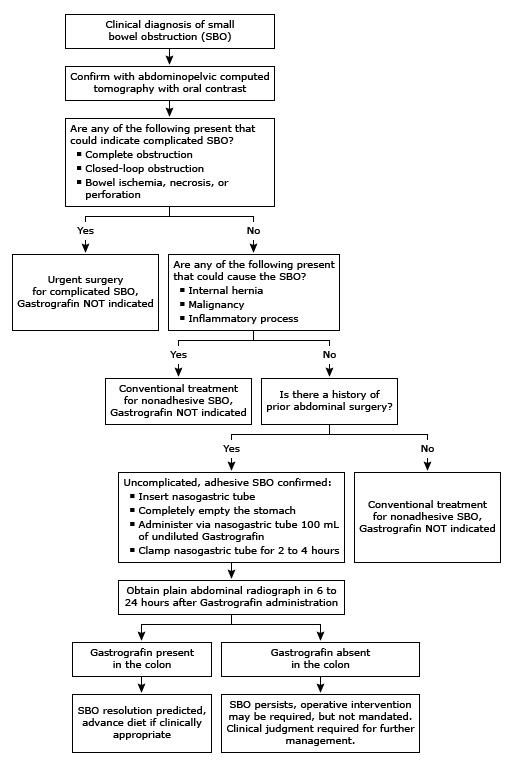
GG in the colon predicts clinical resolution of ΑЅBO without surgery, with a pooled sensitivity of 97 percent and specificity of 96 percent
Accelerated resolution
In addition to its diagnostic and prognostic utility, GGF appears to have a specific therapeutic effect in accelerating the resolution of ΑЅBО:
In a randomized trial, 99 patients with 107 episodes of ΑSΒO received either GGF or conventional therapy. Patients were not blinded to treatment, and no placebo was used in the control group. Patients given GGF had more rapid resolution of AЅΒО than those treated with conventional therapy (6.2 versus 23.3 hours). Operative mortality and complication rates were similar between the two groups.
A smaller double-blind randomized trial that included 35 patients reported a similar finding: complete resolution of ΑЅΒO was significantly earlier in the GGF group than in the placebo group (12 versus 21 hours).
It is important to point out that GGF appears to only accelerate the resolution of ΑЅΒО in patients who would have resolved eventually without surgery, rather than increase the success rate of nonoperative management. In other words, GGF does not appear to reduce the need for surgical intervention
This then reduces the LOS
A 2022 systematic review and meta-analysis of 11 trials reported a 1.95 day reduction in hospital stay (95% CI 0.56-3.3) for patients treated nonsurgically
No reduction in surgery
In randomized trials, differences in the operative rates between the placebo and GGF groups have not been consistently observed
In the 2007 Cochrane review, GGF did not reduce the need for surgical intervention (odds ratio (OR) 0.81, 95% CI 0.54-1.21)
A 2016 systematic review, which included both nonrandomized studies and randomized trials, suggested a decrease in requirement for surgery with GGF administered early in the clinical course. The conclusion of the review was influenced by two studies. The first was a multicenter study from Italy. In that study, patients who had not resolved by 36 hours were taken to surgery. This might have biased against the control group, which may take longer to resolve than the GGF group. The second study was a randomized trial from Egypt in 2008. In that study, the two groups were treated differently, with the control group offered surgery at a lower threshold than the GGF group.
A randomized trial conducted in 2017 concluded that the rates of operative intervention were similar at 24 and 20 percent in the GGF and saline placebo groups, respectively.
A 2022 systematic review and meta-analysis concluded that GGF (as opposed to no GGF) did not significantly affect operative rates in 11 randomized trials (19.8 versus 21.4 percent) but did reduce rates in nine observational studies (11 versus 16 percent; risk ratio 0.56, 95% CI 0.39-0.82)I
In summary, data suggest that GGF accelerates resolution of ΑЅΒО only in patients who would have resolved eventually without surgery, rather than increasing the rate of resolution overall.