- Corticosteroids
- Calcineurin inhibitor
- Antimetabolites (Immunomodulators in the context of IBD)
- Antibody Therapy
- Anti-tumor necrosis factor agents
- Infliximab (Remicade)
- Adalimumab (Humira)
- Golimumab (Simponi)
- Anti-integrin antibody
- Vedolizumab (Entyvio)
- Interleukin inhibitor
- Ustekinumab (Stelara)
- Mirikizumab
- Anti-CD20 Monoclonal Antibodies
- Rituximab
- Anti-tumor necrosis factor agents
- mTOR Inhibitors
- Janus kinase inhibitors
- Tofacitinib (Xeljanz)
- Upadacitinib (Rinvoq)
Overview
- Act predominantly on T cells
- Different classes of agent act at different sites during T-cell activation
- Can be classified according to their principal mode of action in preventing the T cell-dependent rejection response
- Immunosuppression Regimens
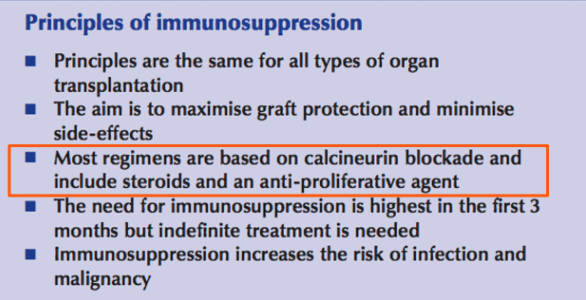
- Most use a combination of agents
Calcineurin inhibitor
- Ciclosporin and Tacrolimus
- Mainstay of most modern immunosuppressive protocols
- Structurally distinct but work through same pathway
- Block activity of calcineurin within the cytoplasm of the T cell
- Calcineurin plays a critical role in transcription of IL-2, (the main T-cell growth factor) and other cytokines after T-cell activation
- Blocks cytokine synthesis
- Similar efficacy, choice between two is unit preference
- Share a number of side effects
- Most notable is nephrotoxicity
- May reduce dose if renal transplant has ATN
- Action depends on blood concentration – needs monitoring!
Antimetabolites
- Immunomodulators in the context of IBD
- Stops lymphocyte proliferation and clonal expansion
- Azathioprine
- Converted in liver to active metabolite: 6-mercaptopurine
- Blocks purine metabolism - thereby inhibits cellular proliferation
- Mycophenolate Mofetil (MMF)
- Newer and has now replaced azathioprine as the agent of choice in many centres
- Converted to its active metabolite, mycophenolic acid
- Inhibits enzyme which is the rate-limiting enzyme in purine nucleotide synthesis
- Lymphocytes do not have a salvage pathway for purine synthesis ⇒ Ability to proliferate selectively impaired
- Main side effects:
- Bone marrow suppression
- Gastrointestinal symptoms
Corticosteroids
- Potent anti-inflammatory agents
- Wide-ranging effects on immune response
- Prednisone
- Methylprednisolone
- Some places try to withdraw steroids in stable grafts to reduce S/E’s
- But can precipitate acute rejection
Antibody Therapy
- Monoclonal Antibodies
- E.g. OKT3
- Directed against the IL-2 receptor on T lymphocytes (CD25)
- Commonly given at the time of transplantation to temporarily augment the effects of calcineurin blockade during the early post-transplant period
- Effect lasts for a few weeks only and they lack any significant agent- specific side-effects
- Polyclonal Antibodies
- Anti-Lymphocyte Globulin (ALG) or Anti-Lymphocyte Serum (ALS)
- Aso widely used as a more potent and alternative induction agent
- Cause a temporary depletion of circulating lymphocytes
- Reduces rejection
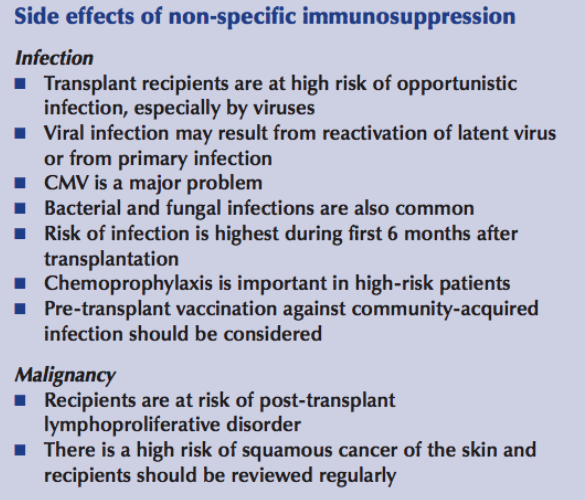
- But may lead to increase in infection and malignancy
mTOR Inhibitors
- Sirolimus and Everolimus
- Inhibit mTOR
- Interfere with intracellular signaling from the IL-2 receptor
- Arrest T-cell division in the G1 phase
- Not nephrotoxic (cf Calcineurin inhibitors)
- Adverse Effects:
- Lymphocele formation
- Impaired wound healing
- Adverse effect on blood lipid profile
- Thrombocytopenia
- Potentially serious pneumonitis
Principles of Immunosuppression
Side Effects of Immunosuppression