Section: Trauma Curriculum: Curriculum, page 80
Surgical Anatomy
- Key Points - Ischium, Ilium, Pubis
- Pelvic inlet/ring fracture’s - almost always anterior and posterior fracture
- Divided into true and false pelvis
- True pelvis - below the pelvis brim/pelvic inlet
- Internal illiac vessels
- Most major pelvic bleeding
- False pelvis - between iliac crest and pelvic brim
- External iliac vessles
- True pelvis - below the pelvis brim/pelvic inlet
- Blood supply is rich within cancellous bone
- Most pelvic bleeding is venous from fractures
- Can accommodate up to 3L of blood
- May track up to retroperitoneum or down thigh
- SIJ crossed by lots of important structures → Debilitating when #
- Iliac vessels
- Lumbosacral nerves
- Sciatic nerve roots
- Ureters
- Pelvic organs bear brunt of force too → Rectum, Vagina, Uterus, Bladder
- Fracture penetration of bladder
- Acetabulum injury should be recognised as are associated with significant disability
Tile’s Classification
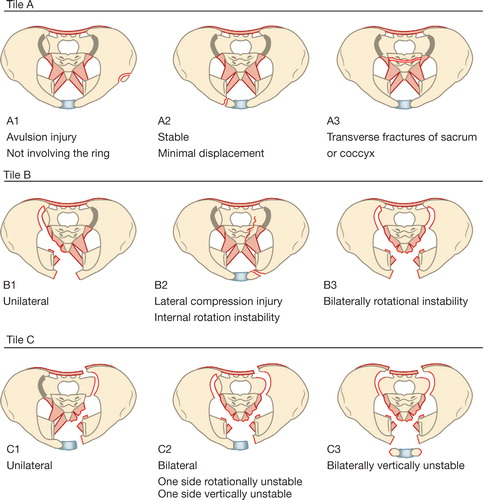
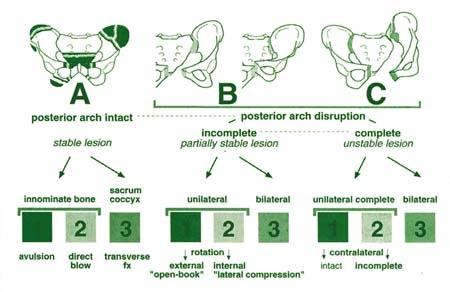
- Based on pelvic ring stability
- Type A - Completely stable with intact Posterior Arch
- Isolated Iliac Wing or Pubic Rami #’s or Transverse Sacral #
- Minimally associated with bleeding
- Conservative mx
- Type B - Rotational instability (vertically stable)
- B1 - Externally rotated # Unilateral
- External rotationally unstable, vertically stable, posterior arch incomplete disruption
- Open Book
- Anterior lesion (Symphysis, Inf/Sup Pubic Rami) +
- Posterior disruption (Ant or Post SIJ ligaments)
- Pelvic organ injury
- B2 - Internally rotated # Unilateral
- Lateral compression
- Internal rotation instability
- Bladder perf
- Shock
- Pelvic organ injury
- B3 - Bilateral
- B1 - Externally rotated # Unilateral
- Type C - Rotation and vertical instability
- C1 - Unilateral complete disruption of posterior arch
- C2 - Unilateral complete disruption of posterior arch with contralateral rotational instability/incomplete posterior arch disruption (B type #)
- C3 - Bilateral complete disruption of posterior arch with spinopelvic dissociation
Clinical
- Tenderness on pelvic palpation or discrepancy in ASIS heights
- Perineal bruising
- High riding prostate
- Haematuria or meatal blood
Management
- If suspicious for pelvic bleeding or has transiently responded
- Pelvic binder or draw sheet compression wrapped around level of greater trochanters
- External fixation - c-clamp applied at level of SIJ
- If ongoing bleeding
- EPP +/- IR
- If pt is unstable
- Consider REBOA/aortic cross clamping dependent on pt situation
- Pelvic binder may block this and need to be repositioned
- EPP and or IR
- If there’s a blush → Arterial → Unlikely to settle with EPP → need IR
- EPP reduces pelvic potential volume and tamponades venous bleeding
- Consider REBOA/aortic cross clamping dependent on pt situation
- External Fixation
- Unable to provide complete stability to a circle with external forces
- Options - Iliac crest route, supra-acetabular route, pelvic c-clamp route
- Laparotomy
- Can do EPP if there is a large or expanding pelvic haematoma
- DCS including post-op IR embolization after EPP
- Extra-peritoneal Packing
- Pelvic binder or ex fix on
- 5cm lower midline incision to fascia → Divided to Parietal Peritoneum
- Protect bladder, develop Retzius space and bluntly develop extraperitoneal plane circumferentially starting from pubic symphysis and following the pelvic brim
- Pack from deep to superficial with large packs after passing the SIJ (palpable bony prominence
- Temporary closure
- NB: EPP should be done prior to DCS laparotomy