- 70% non-variceal bleeding due to PUD
- Majority will stop spontaneously and require no definitive management
- However persistent bleeding is associated with mortality of up to 10%
Initial Management
- Resuscitation
- Large bore IV access x2,
- Restore intravascular volume with IVF and blood products if required
- Consider massive transfusion protocol
- Bloods including U+E, LFTs, Coags, G + x-match
- NG tube
- IDC
- IV omeprazole (80mg)
- Reverse anticoagulants
- All patients should have endoscopy < 24hrs
- Test H pylori status (non-urgent)
Risk Stratification
- Predictive factors of persistent/re-bleeding:
- Age
- Decreased Hb (100)
- Shock at presentation (SBP<100, HR>100)
- Melena
- Requirement for blood transfusion
- Glasgow Blatchford Score
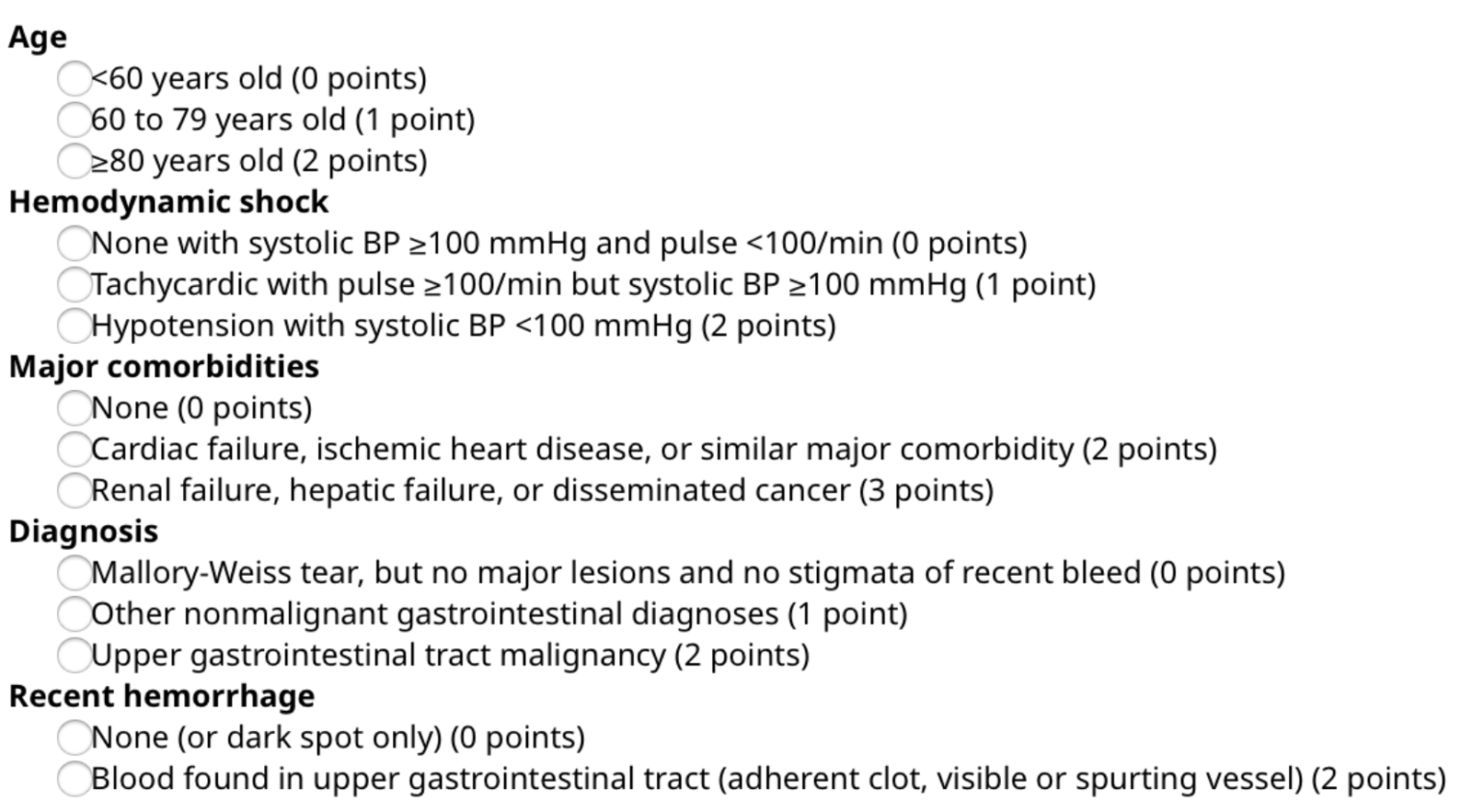
- Rockall score (ABCDE)
- Useful predictor of rebleed and in hospital mortality
- Helpful in determining if surgical intervention may be required after initial resuscitation and evaluation
- AIMS65
Glasgow-Blatchford score
- Predicts need for clinical intervention, rebleed, and mortality
- Similar to Rockall score but doesn’t use endoscopic information
- Can use on initial presentation
- Score of 0-1 is low risk
- Any score above 0 predicts need for transfusion, endoscopy, or surgery
- Sensitivity 99%
- Better sensitivity than pre-endoscopy Rockall score for detecting patients that can be discharged

Rockall Score
- A - Age
- B - Blood pressure
- Presence of shock
- C - Co-morbidities
- D – Diagnosis
- E – Endoscopic stigmata of bleeding
- Score out of 11 to predict risk of re-bleed after endoscopic intervention
- 1-2 = Low risk
-
8 = High risk
Endoscopic Management
- Consent, including possible need for surgery
- Preferably in theatre with anaesthetist
- GA if unstable due to risk of aspiration
- Can move to surgery quickly
- Experienced endoscopy team
- Appropriate haemostatic options
- Mechanical lavage
- Assess the ulcers, describe using Forrest Classification
- Endoscopic appearance helps determine which lesions need therapy or at risk of rebleeding
- Forrest 1A, 1B, 2A should have intervention as high risk of rebleed
- Endoscopic control of bleeding
- Biopsy for H pylori
- Monitoring post-endoscopy
Forrest Classification of Peptic Ulcers
Endoscopic Control of Bleeding
- 90% successful, use dual therapy
- Adrenaline injection (1 in 1000)
- Primary haemostasis rates high
- But up to 30% rebleed if used alone - don’t use as monotherapy
- Clips
- Coagulation/APC
- Fibrin sealants/haemostatic agents
- < 1% complication rate (necrosis, perforation)
- Adrenaline injection (1 in 1000)
- Dual therapy (adrenaline and another) has relative risk of re-bleed compared to monotherapy of 0.3
Monitoring after Endoscopic Therapy
- Monitor in HDU/ICU until all bleeding has stopped for 24hrs
- Place on IV PPI
- Bolus then infusion or intermittent IV doses
- For at least 72 hrs (stabilises clot)
- PPI better than H2 Blockers
- Rebleed rates, rate of emergency surgery, mortality
- If Re-bleeds
- Repeat endoscopic management if tolerated
- Also if remain haemodynamically stable
- Does not increase mortality
- Could consider angiographic embolisation
- Can be tricky due to rich vascular plexus of stomach
- Repeat endoscopic management if tolerated
- 5-10% have ongoing bleeding that requires surgery
- Haemodynamically unstable patients
- Ongoing transfusion requirements (> 6 units RBCs)