Section: UGI Sub-section: Oesophagus
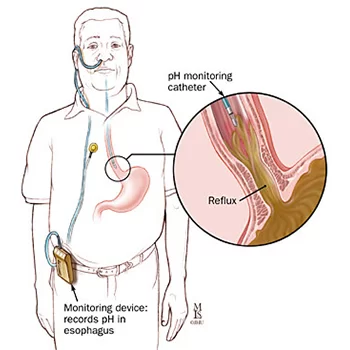
- Gold Standard for diagnosis of GORD
- Sensitivity and specificity 92%
- Indications:
- Refractory oesophagitis after PPI tx
- Atypical presentations
- Pre-requisite before reflux surgery
- Method
- Catheter is placed 5cm above the manometrically-determined LES
- Patient records events & position at time – correlate sx to reflux events
- Begins ‘reflux episode’ when pH drops below 4, records until above 5](← Gold Standard for diagnosis of GORD
- Sensitivity and specificity 92%
Normal Values
- < 5% of the time there is acid (pH < 4) in oesophagus
- No. of reflux episodes > 5mins: < 3.5
- No. of reflux episodes pH < 4: 50
- May get false –ves
- Need to stop PPIs 2/52 before the study
- Generates a DeMeester score
- Based on SD from the mean of reflux times, length & no of episodes
- Correlation with symptoms important for diagnosis
- NB: Normal 24 hour study but significant symptoms = Likely poor outcome from intervention
- Can add
- Multichannel intraluminal impedance pH monitoring
- Bilitec probe (detects bilirubin/bile reflux)
DeMeester Score
- Composite score of acid exposure during a 24hr ambulatory pH study
- Based on six variables
- Percentage of total time pH < 4
- Percentage of upright time pH < 4
- Percentage of supine time pH < 4
- Number of reflux episodes
- Number of prolonged reflux episodes >5mins
- Longest reflux episode
- Normal is < 14.72
Symptom Correlation
- Correlation with symptoms is important for diagnosis
- Multiple calculations to determine symptom to reflux episode association and establish response to PPI.
- Symptom Index
- Symptoms severity Index
- Symptoms Association Probability
Multichannel Intraluminal Impedance pH Monitoring
- Detects changes in impedance
- Conduction of current across oesophageal wall
- Will be stable between reflux/swallow
- Liquids improve conduction and impedance falls
- Gases reduce conduction and impedance increases
- Most sensitive Ix for GORD
- Useful for patients with symptoms despite acid suppression
- 400% more sensitive than pH studies alone
- High sensitivity – can detect:
- Swallow or reflux
- Velocity of transit
- How long it takes swallow/reflux to be cleared
- Liquid or gas reflux
- How proximal reflux extends
- Degree of pH changes with reflux
- High sensitivity – can detect:
- May identify patients who would benefit from fundoplication
- Despite -ve pH study>)
- Despite -ve pH study>)