Section: Urology Curriculum: Curriculum, page 7
Patient Counselling
- Other contraception options and alternatives including permanence of vasectomy
- Social hx including family, partner knowledge, future family intent
- Need interim contraception for 3 months and azoospermia on semenalysis before assuming sterility
- Still 1 in 2000 risk of pregnancy
- Needs condoms to protect against STI’s
Preoperative Assessment
- Full medical hx and O/E - sexual developmental hx, genital injury or surgeries
- Confirm single vas and testicle each side and absence of anatomical abnormalities
- Presence of other scrotal pathologies - varicocoele etc
- Refer solitary testicle, extensive genital surgery and non-palpable vas to UROLOGY
- Varicocoele, hydrocoele, scrotal mass, cryptorchidism → UROLOGY
Contraindications
- Scrotal haematoma
- GU/groin infection
- Sperm granuloma
Relevant Anatomy
- Innervation - ilioinguinal N and genital br of GF N supply anterior scrotum skin and spermatic cord → LA here is sufficient
- Scrotal layers - scrotal skin → dartos fascia and muscle → external spermatic fascia → cremasteric fascia and muscle → internal spermatic fascia which covers cord and contains VAS and neurovasculature
- Vasculature - artery to vas and pampiniform plexus are within the cord
- Varicocoele makes vas isolation difficult
Surgical Technique
Overview
- Division and occlusion of the vas to facilitate sterilization
Techniques
- 3 approved vasectomy isolation methods:
- Conventional vasectomy
- No-scalpel technique
- Minimally invasive
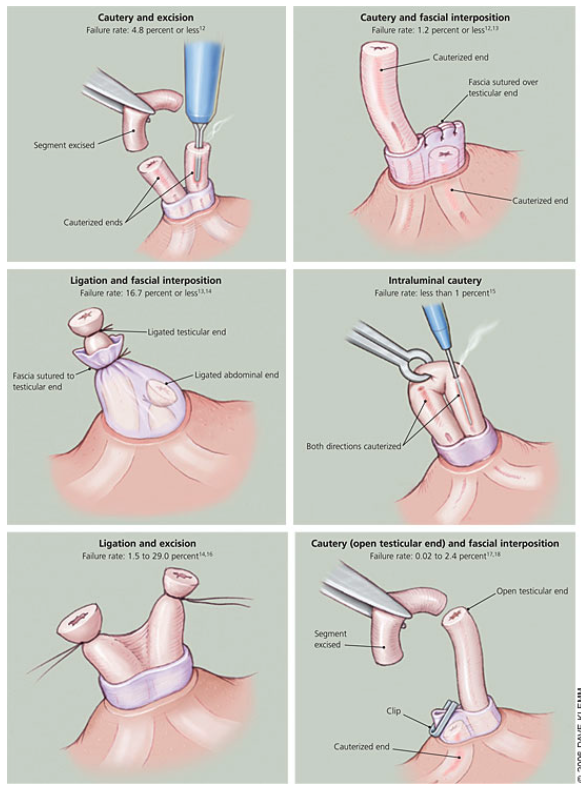
- Vas occluded by one of three divisional techniques:
- Mucosal cautery (MC) with fascial interposition (FI) without clips or ties placed on vas
- MC without FI and without clips or ties on vas
- Open ended vasectomy leaving testicular end of vas unoccluded, using MC on the abdominal end and FI
- OR by the non-divisional method of extended electrocautery
- Vasectomy failure rates based on semen analysis are highest with simple excision and ligation of vas and lowest with occlusion techniques combining cautery and fascial interposition
Operation
- I perform under GA
- Supine. Shave area in operating room. Time out. Sterile prep and drape
- Grasp vas at the neck of scrotum and work it towards the skin.
- Hold the vas close to the skin using non-dominant hand
- Place two Allis forceps either side of a 1cm segment of vas to be excised.
- Make a vertical incision of the skin between the Allis forceps.
- Divide through the coverings layer by layer using the scalpel in the line of wound until the glistening white muscular coat of the Vas is seen.
- Use another Allis to grasp the Vas and free it to deliver a segment about 3cm in length and deliver into wound.
- Both ends of the vas are clamped with artery forceps and the vas cut between the ties and a short segment sent for histology. Each end is tied with 2/0 Vicryl and then stump of vas doubled over and tied again to form a loop.
- I push the lower end back into the scrotum.
- I close the incision with 2/0 Vicryl interrupted sutures.
- I incorporate the upper end into the subcutaneous tissues to keep the ends widely separated.
- I perform the same on the opposite side and apply a scrotal support.
Post-operative care
- Supportive underwear/scrotal support
- Ice pack
- Simple analgesia
- Avoid sex for 1/52 with alternate contraception until confirmational semenalysis 3/12 post-procedure
- Clearance - 3/12, 20 ejaculations and azoospermia (non motile sperm is less reliable and warrants repeat test as could indicate an old test
- Timing of test
- Should be performed 12 weeks post procedure.
- Patient should have had 20 ejaculates to ensure clearance of residual sperm.
- Sperm presence
- Azospermia - complete absence of sperm indicates vasectomy success
- Persistent motile sperm - suggests recanalisation of the vas deferens.
- If sperm (motile of non-motile) is present on the 12 weeks test, additional semen analysis is required 4-6 weeks later.
Complications
- Haematoma - pampiniform plexus
- Infection
- Epididymitis - congestive, leave testicular side of vas open to prevent pressure
- Sperm granuloma - sperm leakage from testicular end of vas, 2-3/52 post surgery is sore, rarely require surgery
- Post vasectomy pain syndrome - usually due to congestive epididymitis, rarely surgery needed - reversal or epididymectomy completion
- Failure - technical errors, recanalization, UPSI prior to azoospermia
Reversal
- Can get pregnant still for 3/12
- Need semenalysis to confirm azoospermia at 3/12
- Use condoms
- Recanalization can occur
- Difficult in - obese, prev scrotal surgery, concurrent scrotal pathology