Section: Abdominal wall and retroperitoneum Sub-section: Hernias Curriculum: Curriculum, page 4
Definition
- Herniation through the obturator canal
Incidence
- Rare
- Most frequently seen in elderly women, who have lost weight
Clinically
- Usually present as small bowel obstruction
- Many present with acute pain
- 1/3 have had similar Sx in the past
- Difficult to diagnose pre-op
- Hernia is rarely palpable in the groin
- Sits deep to pectineus/adductors
- A mass may be felt on PV or PR examination
- Often is a Richter’s type hernia
- Howship-Romberg sign (present in ≈ 25-50%):
- Pain extending down the medial thigh with extension, internal rotation & adduction of the hip
- Causes compression of cutaneous branch of Obturator Nerve
- Hannington-Kiff Sign:
- Intact Patellar Reflex but concurrent loss of Thigh Adductor Reflex
- Due to compression of Obturator Nerve causing weakness of adductor muscles
- Bruising below the med pt of ing lig can occur due to a strangulated hernia
Pathology
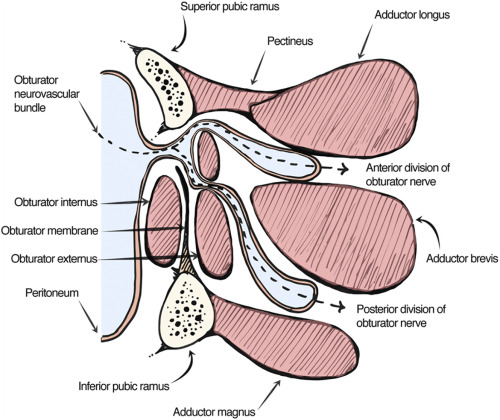
- Hernia follows Obturator Canal
- Courses
- Between the Superior Pubic Ramus & Obturator Membrane
- Sac spreads out deep to Pectineus
- Sac travels between Adductor longus and Adductor Brevis
- Or Adductor Brevis and Adductor Magnus
- Often contains small bowel as a Richter’s hernia
Investigations
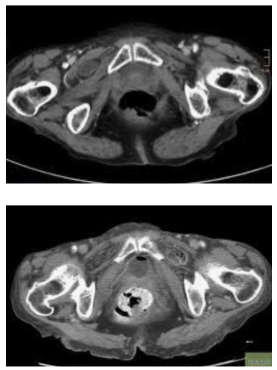
- USS / CT may be useful
- Will be deep/below superior pubic ramus
- C.f. Femoral hernia is anterior to superior pubic ramus
Management
- See Obturator Hernia repair
- Abdominal approach
- Ideally, in Trendelenburg position
- Rarely, it may be necessary to enlarge the canal, by incising posteromedially to the neck of the hernia (so avoiding damage to obturator nerve)
- Repair
- Primary stitch
- Overlay of mesh
- Close primarily + overlay bladder or uterus
- Retropubic approach (Cheatle-Henry approach)
- Median or Pfannenstiel incision, the Retzius’ space is dissected
- Repair similar to a McEvedy femoral hernia repair
- Laparoscopic approach
- TAPP or TEP
Natural Hx:
- Strangulation is common, due to the size and rigidity of the obturator canal
- If defect is not closed → 10% recur
- Associated with highest mortality (13-40%) of any hernia