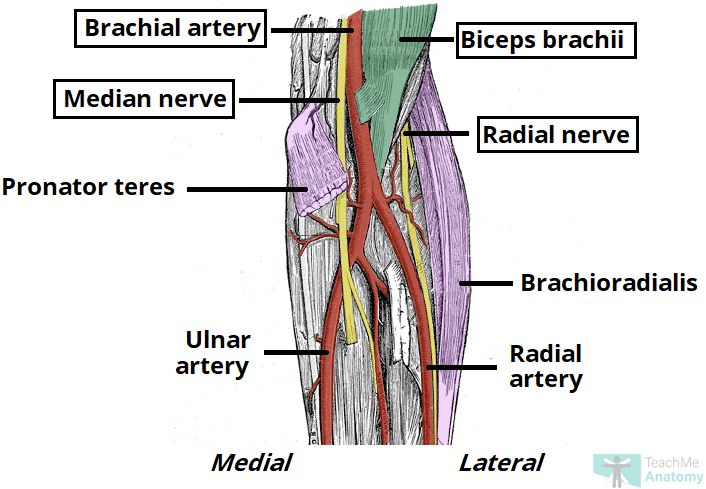
The cubital fossa is an area of transition between the anatomical arm and the forearm. It is
located as a depression on the anterior surface of the elbow joint
Borders
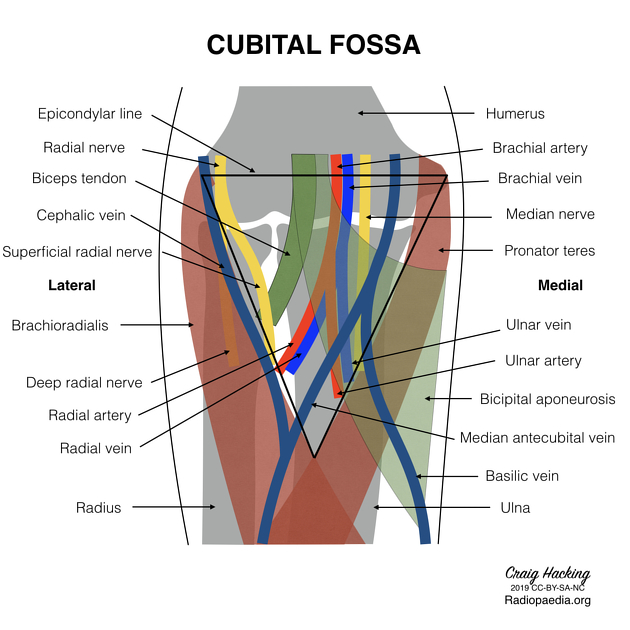
The cubital fossa is triangular in shape, and thus has three borders:
Lateral border – The medial border of the brachioradialis muscle.
Medial border– The lateral border of the pronator teres muscle.
Superior border – An imaginary line between the epicondyles of the humerus.
The floor of the cubital fossa is formed proximally by the brachialis, and distally by the supinator muscle
The roof consists of skin and fascia, and is reinforced by the bicipital aponeurosis
Within the roof runs the median cubital vein, which can be accessed for venepuncture (see clinical relevance below)
Contents
The contents of the cubital fossa include vessels, nerves and the biceps tendon (lateral to medial):
Radial nerve – This is not always strictly considered part of the cubital fossa, but is in the vicinity, passing underneath the brachioradialis muscle. As is does so, the radial nerve divides into its deep and superficial branches.
Biceps tendon – It runs through the cubital fossa, attaching to the radial tuberosity, just distal to the neck of the radius.
Brachial artery – It bifurcates into the radial and ulnar arteries at the apex of the cubital fossa.
Median nerve – Leaves the cubital between the two heads of the pronator teres. It is medial to the artery
Mnemonic for contents of the cubital fossa – Really Need Beer To Be At My Nicest