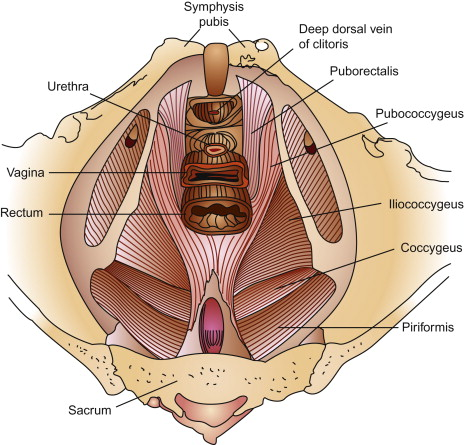
- Consists of two main parts: Pubococcygeus and Iliococcygeus
- Origin: Arise in continuity from the Body of the Pubis, to the Ischial Spine across the Obturator Fascia, along the Tendinous Arch (condensation of the fascia)
- Pubococcygeus:
- Arises from the anterior half of the Tendinous Arch and from the posterior surface of the Body of the Pubis
- Pubococcygeus muscle proper:
- Bulk of posterior fibres sweep backwards in a flat sheet on the pelvic surface of Iliococcygeus and form a tendinous plate in the midline attached posteriorly to the front of the Coccyx
- Puborectalis muscle
- Fibres arising more anteriorly from the Body of the Pubis
- Swing more medially and more inferiorly around the Anorectal Junction
- Join with fibres of the opposite side and the top of the External Anal Sphincter
- Forms a U-shaped sling which holds the Anorectal Junction angled forwards
- Puboanalis muscle:
- Fibres that blend with the longitudinal muscle of the Rectum and the conjoint longitudinal coat of the Anal Canal
- Puboprostaticus or Pubourethralis
- Most medial fibres of Pubococcygeus
- Pass backwards alongside the Prostate and the Sphincter Urethrae in the male
- Decussate across the midline behind the Urethra
- Pubovaginalis
- In the female, the medial fibres sling around the posterior wall of the Vagina
- In both genders, fibres also attach to the Perineal Body
- Iliococcygeus
- Origin: Posterior half of the Tendinous Arch and the pelvic surface of the Ischial Spine
- Overlaps the pelvic surface of Coccygeus
- Insertion: Side of the Coccyx and the Anococcygeal Raphe – extends from the tip of the Coccyx to the junction of the Rectum and Anal Canal
- NB: Muscle does not originate from the ilium (despite its name) – name derived from its former origin on the iliac bone at the pelvic brim