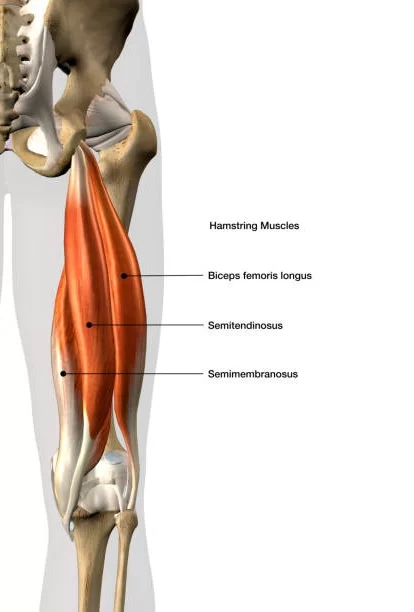
- Muscles of the hamstring group
- Biceps femoris
- Long head
- Origin: ischial tuberosit
- Insertion: head of the fibula
- Innervation: tibial division of the sciatic nerve
- Short head
- Origin: linea aspera and lateral supracondylar line of femu
- Insertion: head of the fibul
- Innervation: common peroneal division of the sciatic nerv
- _Note: Not a true hamstring muscle — does not originate from ischium or cross the hip joint
- Semitendinosus
- Origin: ischial tuberosit
- Insertion: medial surface of proximal tibia (part of the pes anserinus
- Innervation: tibial division of the sciatic nerv
- Semimembranosus
- Origin: ischial tuberosit
- Insertion: posterior part of the medial tibial condyl
- Innervation: tibial division of the sciatic nerv
- Common features of true hamstring muscles
- Origin from the ischial tuberosity
- Cross both the hip and knee joints
- Innervated by the tibial division of the sciatic nerve
- Function as hip extensors and knee flexors
- Function
- Hip extension
- Works with gluteus maximus during walking, running, and climbin
- Knee flexion
- Important in deceleration during running and controlling knee motio
- Medial rotation of the leg (semitendinosus and semimembranosus
- Lateral rotation of the leg (biceps femoris
- Blood supply
- Primarily from perforating branches of the profunda femoris artery
- Also contributions from the inferior gluteal and popliteal arteries