Section: Skin and soft tissue Sub-section: Benign skin and soft tissue] Curriculum: Curriculum, page 55
Definition
- Abnormally increased perspiration
- Cause unknown -? focal dysfunction of ANS
- Usually onset in childhood
- Usually bilateral, intermittent, worse in summer
Incidence
- Primary hyperhidrosis affects 1-4% people
- M = F
- Often have family history
- Secondary Hyperhidrosis develops any time in life, due to disorder of:
- Thyroid, Pituitary, Diabetes, Tumours, Menopause, Adrenal and Drugs
- Nearly all pts with palmar hyperhidrosis also have plantar sweating
- 50% also have axillary hyperhidrosis
- Leads to alteration of lifestyle
- To avoid hand contact
- Pts develop other coping mechanisms
Pathophysiology
- Sweat glands are coiled glands in the hypodermis
- Eccrine secretion
- Regular sweat glands
- Apocrine Secretion
- Modified sweat glands
- Holocrine Secretion
- Sebaceous glands
- CNS control of extremity sweating
Type of glands
- Eccrine Secretion
- Regular sweat glands
- Present all over the body
- Most on palms, soles, axilla & face
- Except:
- Vermillion border of lips, nipples, tympanic membrane, nail beds, labia minora and glans penis, and inner prepuce
- Function for thermoregulation
- Produce sweat that evaporates
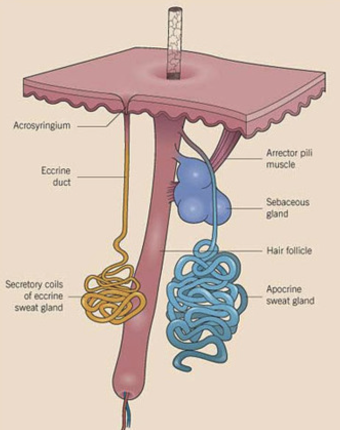
- The eccrine unit
- Consists of coiled gland at the dermal-fat junction
- Discharges into an intradermal duct, then to an intraepidermal portion then opens onto skin
- Secretion is merocrine
- Secretions excreted via exostosis from secretory vesicles into a gland’s acinus (an epithelial lined duct)
- Secretion is initially isotonic, but salt and HCO3 actively reabsorbed in duct, and becomes hypotonic
- SNS cholinergic supply
-
Apocrine Secretion
- Modified sweat glands
- Axilla, areola, perineum, groin, breast, external auditory canal (ear wax)
- SNS adrenergic supply
- Secrete fluid rich in mucin by decapitation
- Apical plasma membrane buds off to enter lumen of gland
- Apocrine unit
- Consists of a coiled gland in dermal-fat junction
- Discharges into a duct through the dermis which empties into a hair follicle
- Fluid initially milky, viscous and odourless
- Then develops a strong odour after bacterial action on skin
- Function probably as scent glands
- Most axillary sweat
- Eccrine sweat + small amounts of apocrine
- Modified sweat glands
-
Holocrine Secretion
- Sebaceous glands
- Cell membrane ruptures and contents released into lumen
- Includes
- Meibomian glands of eyelid
- Open into side of hair follicles & direct to hairless areas of lips, nipples, areolae, prepuce, glans penis & labia minora
- Especially large on the face
- No motor innervation
- Androgens act locally on these glands
- Sebaceous glands
SNS Control of Extremity Sweating
- Palmar Sweating
- Hypothalamic signals reach Preganglionic fibres with cell bodies in the Lateral Horn of the Spinal column at T3 - T6
- Exit via the Ventral Root to join the Sympathetic Chain where they may synapse immediately or travel up or down chain before synapsing
- Converge on T2 & T3 Ganglia, where Postganglionic fibres reach
- Sympathetic Chain
- Then Brachial Plexus
- Then the hand
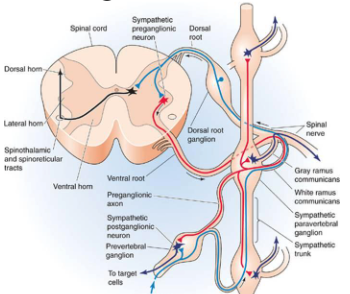
- Acetylcholine is released from the postganglionic neuron
- Stimulates the eccrine sweat gland
- NB: This is the exception to the rule that postganglionic sympathetic nerves release adrenaline or noradrenaline at the target synapse - in sweat glands ACh is released, acting on muscarinic receptors a la parasympathetic system
- Plantar sweating: L3 & L4 ganglia involved
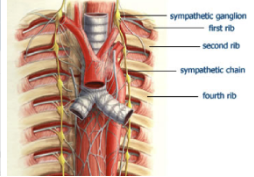
- Sympathetic Chain descends in thorax over rib heads
Management
- Non-Surgical
- Surgical
- T2-3 Sympathicotomy
- Lumbar Sympathectomy
Non-Surgical Management
- Aluminium chloride hexahydrate 20% solution (Drysol)
- Apply daily and cover in plastic wrap
- Works in 3-5 days
- Main side effect is skin irritation
- Iontophoresis
- Placement of hands or feet in tap water through which an electric current flows
- Mechanism unknown
- Botox injection
- Block ACh release at end of Post-Ganglionic nerve end
- Needs 20-30 intradermal injections
- Effective for 6-9 months
- Side effects include weakness in intrinsic muscles of the hand
- Anticholinergic e.g. Oxybutynin or glycopyrrolate
- Effective but common side effects
- Dry mouth, blurred vision, constipation
Thoracic Sympathectomy
-
Indications
- Raynaud’s
- Hyperhidrosis
- Reflex sympathetic dystrophy
- PVD
-
Interruption of sympathetic innervation to hand, axilla, or face by clipping, transection, or resection of ganglia
- Exact level of ablation, and whether ganglia are resected or chain simply transected (sympathicotomy) controversial
-
Palmar - Transect T2 and T3
- Palmar probably best treated with Bilateral Endoscopic Thoracic Sympathicotomy
-
Axillary - Transect T3 and T4
- Isolated axillary best treated with Botox injection
-
Lumbar Sympathectomy more controversial
-
For surgical steps see: Thoracic Sympathectomy
T2-3 Sympathicotomy Results
- Virtually 100% cure for palmar
- 1-3% recurrence
- Less successful for facial or axillary
- Failure can be due to
- Inability to visualise sympathetic chain
- Misidentification
- Incomplete nerve interruption
- Nerve regeneration
T2-3 Sympathicotomy Complications
- Bleeding, pain
- Compensatory sweating - in up to 75% pts
- In torso, thighs and legs
- Most mild and annoying only
- 3% patients may get severe symptoms and, once established, is permanent
- Gustatory sweating is also often reported. Probably occurs due to thermoregulatory response
- In torso, thighs and legs
- Some authors propose interrupting more caudal segments (T3, T4) only and leaving T2 intact
- After T2 sympathicotomy
- Heart rate reduces, but exercise tolerance unchanged
- Horner’s < 1%
- Due to damage to sympathetic nerves passing through stellate ganglia, due to misidentification of level, or diathermy injury
- Ptosis is immediate and often permanent
Lumbar sympathectomy
- Done more to decrease vasomotor tone
- Indications
- Non-reconstructable rest pain
- Reflex Sympathetic Dystrophy
- Raynaud’s
- Visceral pain
- Contraindications
- Small vessel disease
- Poor collateral supply
- Excise or ablate Sympathetic Chain & Ganglia from L2 to L4
- Chemical
- Patient lateral with lateral extension of affected side – kidney break
- LA, Image intensifier
- Localise L2-L4 by palpation
- Spinal needle advanced to vertebral body then walked off tangentially under II control
- 5ml aqueous phenol at 2 sites
- Surgical retroperitoneal approach - see Lumbar sympathectomy