- Preoperative preparation
- Confirm indication, conservative treatment failure, and patient suitability
- Consent for risks: Horner’s syndrome, compensatory hyperhidrosis, pneumothorax, neuralgia
- Anaesthesia and positioning
- General anaesthesia with double-lumen endotracheal tube for lung deflation on operative side
- Patient in semi-prone or lateral decubitus position, arm abducted
- Table tilted for slight anterior elevation to allow gravity-assisted lung retraction
- Port placement and access (VATS approach)
- 10 mm port placed in the 3rd–5th intercostal space, mid-axillary line
- CO₂ insufflation optional; often the lung is deflated for space
- Insert thoracoscope and inspect parietal pleura, lung, sympathetic chain
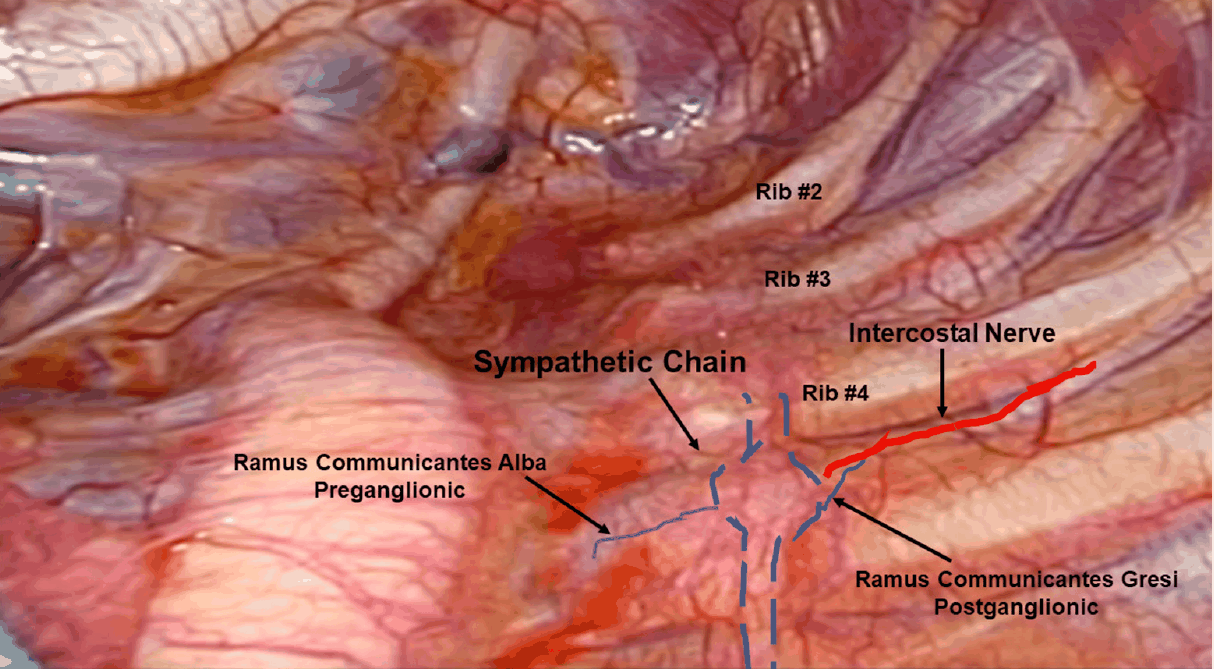
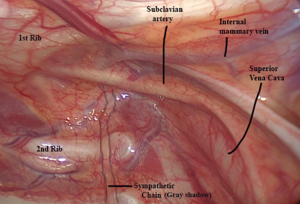
- Identifying the sympathetic chain
- 2nd rib is usually the most proximal visible rib in thorax
- 1st IC space is covered by a fat pad.
- Vertical Superior Intercostal Artery originating from the Costocervical Trunk(2nd part of the Subclavian Artery) (supplies 1st and 2nd IC space) can be seen crossing the rib 1 cm lateral to the sympathetic chain
- Azygous Vein lies at 5th IC space and Aortic Arch at 4th IC space
- Sympathetic Chain
- Lies paravertebrally over the neck of the ribs, just lateral to the vertebral bodies
- Intercostal nerves run below the ribs; chain appears as a whitish cord
- Important to identify and preserve nearby structures like azygos vein (right side) and stellate ganglion (T1)
- Targeted levels and interruption
- For palmar hyperhidrosis: interrupt at T2–T3
- For axillary hyperhidrosis: may extend to T3-T4
- Use diathermy, harmonic scalpel, or clips to divide or ablate the chain
- Destroy at least 2–3 cm of the chain to reduce recurrence
- Avoid cautery near T1/stelate ganglion to prevent Horner’s syndrome (ptosis, miosis, anhidrosis)
- Completion and closure
- Check for haemostasis
- Evacuate any pleural air via temporary catheter or gentle positive pressure ventilation
- No chest drain usually required unless air leak or bleeding present
- Close port site
- Postoperative care
- Monitor for pneumothorax (CXR if indicated), Horner’s syndrome, intercostal neuralgia
- Warn patient of compensatory hyperhidrosis—may develop over trunk or thighs
- Same-day or overnight stay in most cases