Intro
- The lateral femoral cutaneous nerve is a purely sensory nerve that is susceptible to compression.
- Meralgia Paresthetica
Risk factors
- Obesity
- Diabetes mellitus
- Older age
Causes
- Body habitus - large abdomen
- Pregnancy
- Increased intra-abdominal pressure due to ascites
- Tight belts
- Compression from a wallet.
- Prolonged leaning of a thigh against a bench or table.
- Carrying heavy objects.
- Long distance walking
- Groin trauma
- Surgery - inguinal hernia repair, iliac bone harvesting, aorto-bifemoral bypass, spine surgery
Anatomy
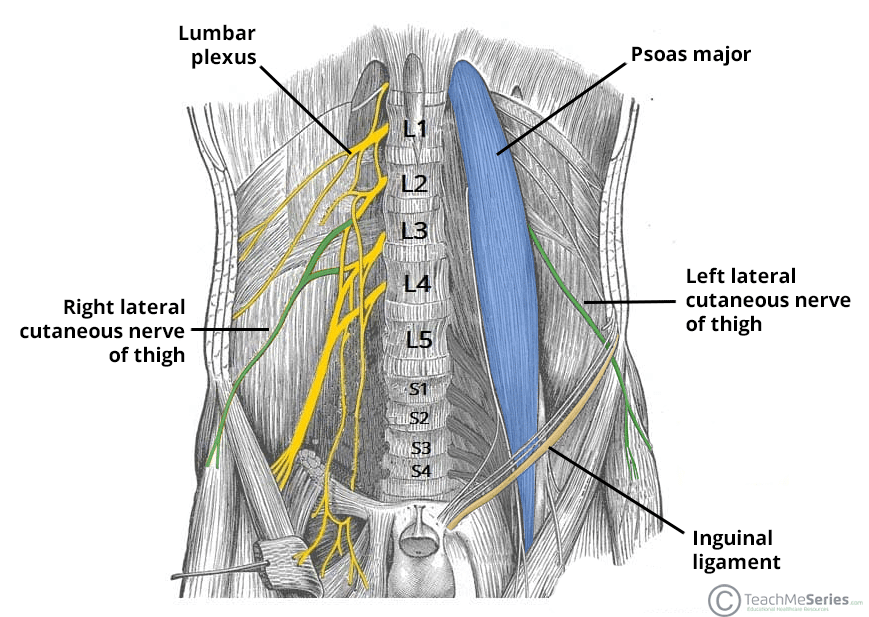
- The lateral femoral cutaneous branches off the lumbar plexus and conveys fibers from L2 and L3 nerve roots.
- The nerve courses through the pelvis running adjacent to the lateral edge of psoas
- It enters the leg underneath or through the inguinal ligament, medial to the ASIS - in this location, entrapment can occur.
Clinical features
Symptoms
- Pain, paresthesia, and numbness over the upper outer thigh
Signs
- Loss of light touch or pinprick sensation of the upper outer thigh.
DDx
- L3/L4 radiculopathy
- Femoral neuropathy - passes under the inguinal ligament medial to the lateral femoral cutaneous and innervates the upper medial aspect of the thigh. You will also get weakness of the quadriceps (knee extension)
Treatment
- Is self-limiting in 90% of cases.
Conservative treatment
- Weight loss
- Avoid pressure to groin.
- Patient reassurance that it does not represent a back problem
Persistent symptoms
- Gabapentin.
- Local nerve block.
Surgical
- Decompression
- Nerve transection - last resort.