Section: Breast Curriculum: Curriculum, page 14
Definition
- True – Hyperplasia of stromal and ductal tissue of the male breast
- Benign proliferation of the glandular component of male breast (≥ 2cm)
- Pseudo – Excess adipose tissue
Incidence
- Any age, up to 35% of males in lifetime
- Association with Klinefelter’s Syndrome
- Risk of Breast Ca approaches risk of female population
Clinical
- Concentric painful swelling
- C.F Cancer, that presents as eccentric, usually painless mass
- Benign, usually reversible
Aetiology
- Imbalance in the ratio
- Relative hyperoestrogenism
- Decreased androgen production
- Increased oestrogen production
- Increased peripheral aromatisation
Classification
- 20% Primary/physiological
- 3 Peaks - Neonatal, Puberty, Elderly (trimodal)
- Neonatal - increased placental estrogen synthesis
- Puberty - estrogen surge
- Elderly - drop in testosterone production
- 3 Peaks - Neonatal, Puberty, Elderly (trimodal)
- 35% Pathological – see table
- 25% Idiopathic
- 20% Drugs
- Anti-Androgen/Inhibitors of Androgen synthesis:
- Spironolactone
- Finasteride
- Cyproterone
- Antibiotics
- Isoniazid
- Metronidazole
- Ketoconazole
- Anti-Ulcer Drugs
- Omeprazole
- Chemo Drugs
- Methotrexate
- Imatinib
- Cardiovascular Drugs
- ACE Inhibitors
- Digoxin
- Calcium Channel Blockers
- Amiodarone
- Statins
- Drugs of Abuse
- Alcohol
- Marijuana
- Amphetamines
- Methadone
- Hormones
- Androgens
- Anabolic Steroids
- Oestrogens
- Growth Hormone
- Psychoactive Drugs
- Diazepam
- Haloperidol
- Tricyclics
- Other
- Domperidone
- Metoclopramide
- Phenytoin
- Anti-Androgen/Inhibitors of Androgen synthesis:
Pathological
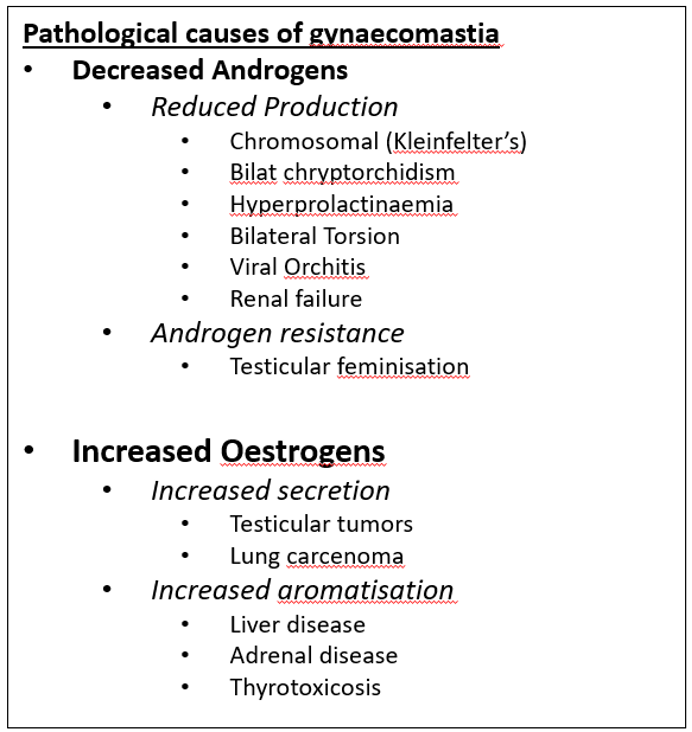
- Decreased Oestrogen Clearance:
- Cirrhosis
- Haemochromatosis
- Wilson’s Disease
Investigations
- Exclude Breast Ca or 2° pathological cause
- Hx + Exam (Breast, axilla, testes abdomen)
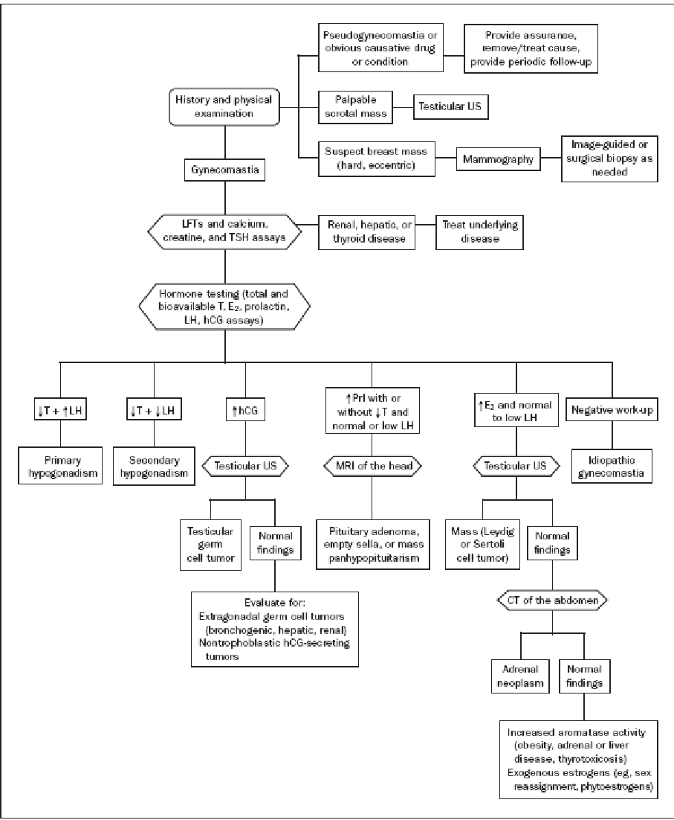
- LFTs and creatinine, AFP, β-HCG, Prolactin if rapidly growing, TFTs
- Triple assess if concerns for Ca +/- Testicular USS
Management
- Initial management
- Adolescent boys
- Observation as 80% will regress within 2 years
- Adults
- Assess for cause and treat
- Observation after:
- Exclusion of precipitating medication
- Underlying medical disorders have been addressed
- If present for > 1 year fibrosis is likely to be present and glandular tissue will not regress spontaneously therefore further management is indicated
- Adolescent boys
- Treatment
- Pharmacologic
- Effective in the early active phase of gynecomastia (for relief of tenderness and partial regression) but not in the late fibrotic stage (after 12 months)
- Adolescent
- Indication
- Significant enlargement
- Causing embarrassment
- Treatment
- 20mg daily of Tamoxifen
- Indication
- Adults
- Indication
- No identifiable cause
- Breast tenderness that persists past 3 months
- Treatment
- 20mg daily of Tamoxifen
- Hypogonadism
- Treatment with testosterone therapy
- Indication
- Surgical
- Indications
- causing considerable psychological distress
- Has persisted >12 months,
- Non-tender, fibrotic stage has been reached.
- Indications
- Radiotherapy
- Can be considered as prophylaxis in patient undergoing high-dose antiandrogen for prostate cancer
- Pharmacologic
Gynaecomastia Management Algorithm