Aetiology:
- Commonly occurs in clockwise orientation when there is lack of retroperitoneal fixation.
Risk factors:
- Younger patient, prior abdominal operation, female, pregnancy and constipation.
Presentation:
- Abdominal pain, distension, nausea and vomiting.
Investigations:
- Xray coffee bean extending across to left upper quadrant
- CT – whirl sign
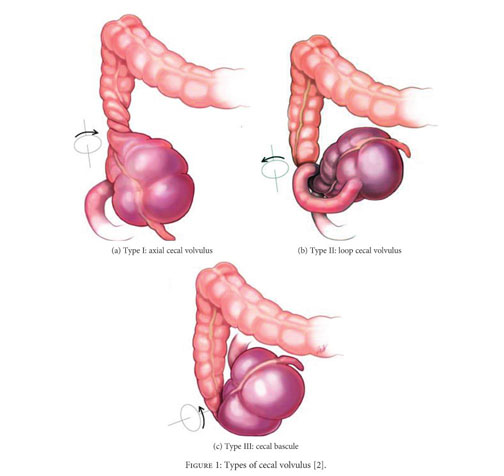
Types:
- Type 1: clockwise axial twisting along long axis
- Type 2: twisting of caecum and terminal ileum with caecum displaced to ectopic location, usually LUQ, and relocated in an inverted orientation. Usually counter-clockwise.
- Type 3: Caecal bascule – type of caecal volvulus from caecum folding anteriorly onto itself without mesenteric twisting.
- Often present with intermittent and recurrent obstructive symptoms.
- CT most useful imaging. Management same for caecal volvulus.
 Management:
- Endoscopic decompression should not be attempted
- Definitive operative management required.
- Once resuscitated, segmental resection and primary anastomosis – if stable
- Resection and ileostomy if unstable and bowel not viable.
- Caecostomy and caecopexy are not recommended; high recurrence rate.