Section: Colorectal Sub-section: Colorectal cancer Curriculum: Curriculum, page 21
Surgery
Perioperative optimisation
- ERAS protocol
- Preop considerations: cardiorespiratory testing. Nutritional state. Obesity – weight loss. Smoking cessation. Anaemia – iron or RBC transfusion.
- Preop bowel prep and oral antibiotics
- Picolax®
- Evidence is mixed.
- VTE: LMWH for 28 days postop
- Skin cover antibiotics - cephalosporin or ertapenum
- IDC in situ
Basic principles:
- Minimum 5 cm bowel resected either side of tumour with at least 12 draining lymph nodes. In practice usually longer segment resected due to ligation of arterial supply.
- Any adjacent organ involvement resected en bloc.
- Complete mesocolic excision (D3 lymphadenectomy) is controversial:
- Sharp dissection in mesocolic plane
- Adequate longitudinal bowel resection
- Central ligation of supplying vessels e.g. right sided is SMA/SMV
- Splenic flexure tumour:
- Controversy on type of operation
- Options include an extended right, left hemicolectomy, or segmental resection of the splenic flexure.
- A 2020 meta-analysis published in Diseases of the Colon and rectum showed no difference in overall complication rate or overall survival.
- A study by Vasey et al from NSH showed that in 96% of patients the splenic flexure lymphatics drained to the left colic. Lymphatic Drainage of the Splenic Flexure Defined by Intraoperative Scintigraphic Mapping, page 1
- NB
- A left hemicolectomy is defined as resection of the left colon including ligation of the IMA (thus including the left colic).
- A segmental resection of the splenic flexure includes ligation of the left colic (thus preservation of the IMA) with ligation of the left branch of middle colic.
- For the exam
- Acute
- Extended right as often the caecum is compromised
- Elective
- Segmental resection taking the left colic and the left branch of the middle colic
- This is my institutions preference and is guided by the Vaset et al study which was performed at NSH
- Segmental resection taking the left colic and the left branch of the middle colic
- Acute
- Anatomical considerations:
- Venous drainage of right/middle colic – Henle trunk. Can have drainage from pancreas (anterior superior pancreaticoduodenal vein), colon (superior right colonic vein and branches of middle colic), and stomach (right gastroepiploic vein).
- No evidence that routine drain placement is beneficial
Types of surgery
Laparoscopic right hemicolectomy Extended right hemicolectomy Transverse colectomy Left Hemicolectomy Sigmoid colectomy
Early large trials which compared laparoscopic colon surgery with open surgery
- CLASSIC trial (2005 Lancet) – UK trial with 4000 patients
- COLOR trial (2009 Lancet)
- ALCCaS trial – australisian trial published in Annals of Surgery 2008 – showed that lap surgery same post-operative complication rate but with quicker return of bowel function and length of stay.
- All of these studies established equivalence for laparoscopic versus open for colon cancer. Lap surgery had less blood loss, quicker return of bowel function and shorter length of stay with equivalent oncological outcomes.
Bowel preperation
- There have been a raft of recent studies with meta-analysis looking at MBP and antibiotics – essentially when combined, they reduce the risk of SSI.
- MBP and antibiotics may reduce ileus and anastomotic leak rates – although the evidence is not as strong (retrospective studies).
- Interestingly, WHO recommends its use but NICE does not.
Chemotherapy
History
- 1980s evidence showed increased survival with the use of 5-FU in stage 3 disease
- The large international QUASAR (Quick and Simple and Reliable) trial demonstrated no difference in disease- free (DFS) and overall survival (OS) between low- and high-dose leucovorin and no evidence of any benefit from the addition of levamisole to 5-FU/LV
- Next step in innovation was oral alternatives
- Two large phase III trials established the non-inferiority of Capecitabine when compared with the Mayo clinic 5-FU schedule as first-line treat- ment of metastatic disease
- The subsequent adjuvant chemotherapy trial (X-ACT) randomised 1987 patients with stage III colon cancer to receive oral capecitabine or the Mayo clinic schedule, demonstrating at least equivalent outcomes for the oral therapy. The long-term follow-up of this trial con- firms oral capecitabine as an effective alternative to 5-FU/LV
- Next step in innovation was adding doublet chemotherapy
- Oxaliplatin or Irinotecan to fluoropyrimidine chemotherapy
- The addition of oxaliplatin demonstrated improved outcome FOLFOX
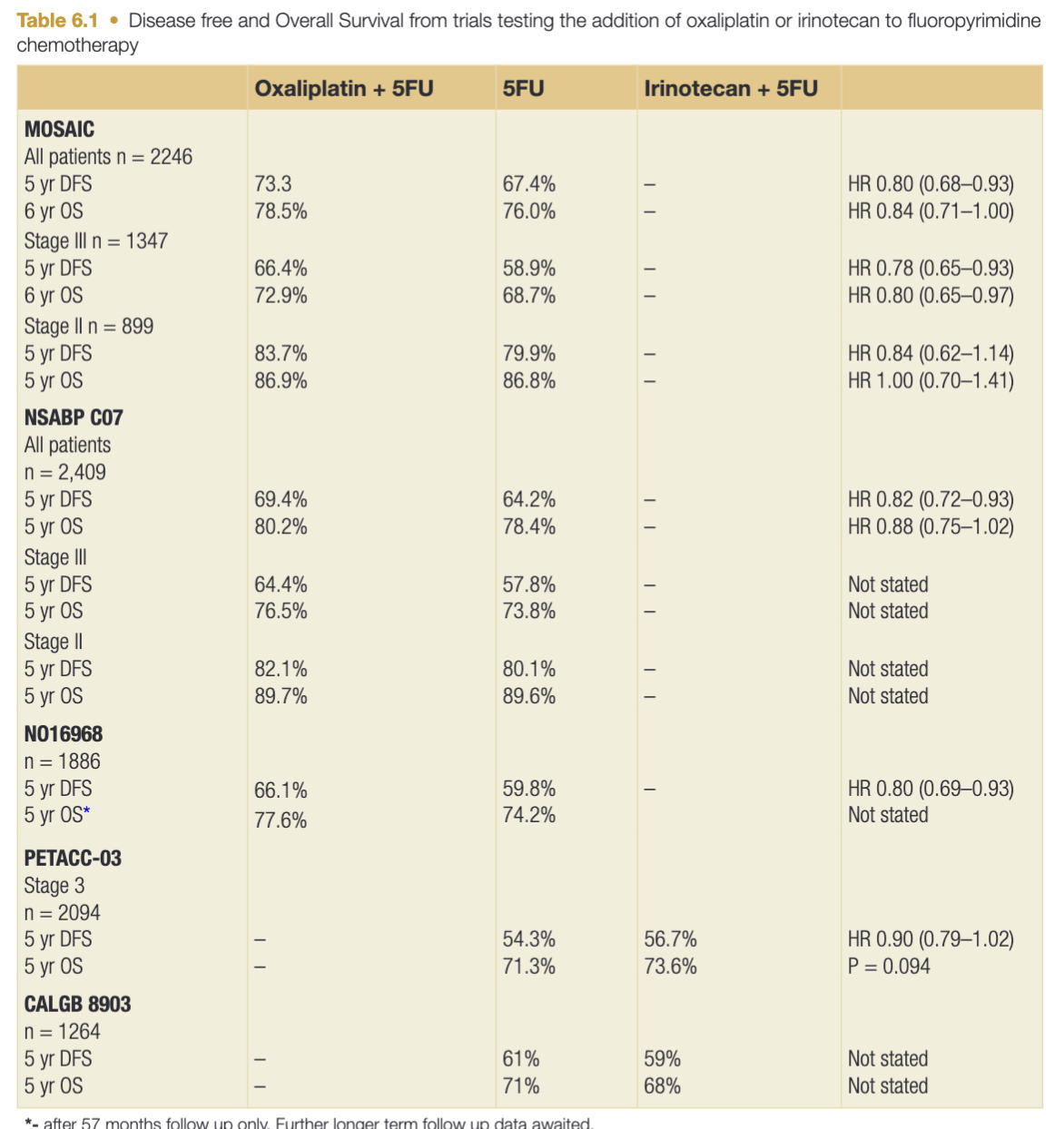
- MOSAIC
- Randomised 2246 patients with high-risk stage II (40%) and stage III (60%) colon cancer. The 5-year disease-free survival was 73.3% and 67.4% and the 6-year overall survival 78.5% versus 76% in favour of the oxaliplatin doublet. When the stage III subset is analysed separately, the 6-year OS is 72.9% versus 68.7% (P = 0.02) in favour of the oxaliplatin doublet
- NSABP C-07, page 1
- Compared the addition of oxaliplatin to 5-FU/LV as an infusion and 5-FU/LV as a bolus, respectively
- Overall, 2409 patients were randomised, with 29% stage II and 71% stage III patients. The 5-year disease-free survival was 69.4% versus 64.2% and 5-year overall survival was 80.2% versus 78.4% in favour of the oxaliplatin doublet. When the stage III subset is analysed separately, the 5-year OS is 76.5% versus 73.8% in favour of the oxaliplatin doublet.
- MOSAIC
- The addition of Irinotecan did not show any improvement.
- PETACC-03 trial
- CALGB 8903 trail
- Target therapy
- Vascular endothelial growth factor (Anti-VEGF)
- Epidermal growth factor receptor (EGFR)
- Useufl in kras wild-type tumpurs
Adjuvant
Stage III
- 5FU/Leucovorin - Not recommended in dMMR but an acceptable option in patient unlikely to tolerate Oxaliplatin
- FOLFOX - Leucovorin (folinic acid), Fluorouracil, Oxaliplatin
- Toxicity of lethargy, mucositis, diarrhoea & hand-foot syndrome, peripheral sensory neuropathy, neutropenia
- Oxaliplatin + 5-FU: Better survival but increased toxicity with diarrhoea, neutropenia & neurotoxicity
- High risk: 6 months duration Low risk: 3 months
- Standard of care in Stage III in patient that can tolerate it
- XELOXA trial shows equal benefit in elderly however careful individual assessment required.
- CAPOX (aka XELOX) (oral capecitabine + oxaliplatin)
- Capecitabine equivalent outcomes TO 5-FU but oral form
- 3 months (compared to 6 months for FOLFOX) – suitable for low-risk stage III e.g. not T4 or N2
- Oxaliplatin can use peripheral IV line (but can be painful), and capecitabine is oral so may do without central line/ambulatory pump.
- May be more toxic than FOLFOX – esp neurotoxicity, hand-foot syndrome, thrombocytopaenia and GI (diarrhoea/dehydration)
- Irinotecan + 5-FU – no benefit
- Timing – should be given 6-8 weeks post op, without delay otherwise a 4 week delay reduced overall survival. Could have 3 or 6 month duration, individual regime
- If >70 can use single agent or not at all
Radiotherapy - Can be considered in adjuvant setting with T4 disease or positive margins
Stage II
- Typically straight to surgery
- Chemo not usually recommended for stage II disease unless high risk features such as:
- pT4
- Positive radial margin
- LVI
- Extramural vascular invasion
- Obstructed or perforated cancers
- Poor or mucinous differentiation
- < 12 LN assessed in specimen
- In pMMR [5-FU]/LV alone is an option or FOLFOX if multiple high risk features
- In dMMR unclear benefit given better prognosis however if adjuvent treatment is chosen then must be Oxaliplatin based given poor response to 5-FU
- A meta-analysis found that Stage II MSI tumours do not derive benefit from adjuvant 5-FU. Thus if you are going to consider chemotherapy for a patient with high risk stage II, you need to test for all the MMR mutations (although we do this for all cancers now anyway).
Other agents
- Immunotherapy e.g. PD-1 inhibitor is useful for MMR deficient patients
- Targeted agents - monocolonal antibody
- Anti-VEGF (Bevacizumab - avastin)
- Not useful in stage II or III colon cancer
- anti-EGFR (Cetuximab) - useful in wild-type KRAS
- not effective in adjuvant setting. Useful for metastases.
- Anti-VEGF (Bevacizumab - avastin)
Neoadjuvant
No consensus
- Surgery
- If thought to be resectable the upfront surgery is likely indicated followed by adjuvant chemotherapy
- Chemotherapy
- No evidence of improved survival but may help if threaten margin
- Early administration of systemic therapy may reduce the risk of micrometastases
- Reduction of the primary tumor can facilitate surgical resection
- Better compliance with systemic therapy when it is delivered preoperatively
- FOxTROT, page 1 RCT pub 2023 gave 6 weeks of neoadjuvent 5-FU + oxaliplatin followed by adjuvent 5-FU + oxaliplatin in stage 3 operable colon cancer
- Lower rates of residual or recurrent disease at two years
- Higher R0 resection
- Fewer surgical complications (anastomotic leak, abdominal abscesses, or emergency reoperation)
- OPTICAL - 752 patients, locally advanced (T3 with ≥5 mm invasion beyond the muscularis propria or T4) colon cancer. 3 months of neoadjuvant FOLFOX or CAPOX followed by surgery and three additional months of chemotherapy, or immediate surgery followed by adjuvant chemotherapy given at the discretion of the treating clinicians
- No difference in disease free survival
- No evidence of improved survival but may help if threaten margin
- Currently not standard practice but may change.
- May consider in locally advanced disease with threatened radial margin
Management of metastatic disease
- Diagnosis & Investigations
- Histological confirmation
- biomarkers including
- RAS (if mutated, poor response to EGFR antibody)
- RAS and BRAF V600E wild-type are eligible for treatment with EGFR inhibitors Cetuximab or panitumumab.
- BRAF mutant (negative prognostic indicator)
- MMR status
- dMMR are susceptible to immune check point inhibitors
- RAS (if mutated, poor response to EGFR antibody)
- biomarkers including
- Can be obtained by colonoscopy, radiology guided or laparoscopic
- If new biopsy not possible, original archived specimen biomarker analysis has reasonable concordance.
- Serial enlargement of lesion + positive PET-CT or rising CEA may be acceptable for tumour diagnosis Radiology:
- Histological confirmation
- CT CAP gold standard for staging.
- MRI – for pelvis and liver.
- PET-CT can be used in selected cases
- US – may use endorectal US for targeted biopsy, assess sphincter involvement. Contrast-enhanced US for characterisation of liver lesions. MDT
- Particularly for order of treatment of metastatic disease, e.g. systemic chemotherapy vs synchronous or staged resection.
Operable metastases
- Determining if a patient is a candidate for resection involves consideration of patient, tumor, and anatomic factors
- PET can be useful to determine if there is other spread of disease
- Contentious: upfront surgery or chemotherapy followed by surgery
- Upfront surgery
- Concern around liver toxicity from chemotherapy
- Increased post-op complication after chemtherapy
- Chemotherapy first
- Allows understanding of natural history of disease
- May downstage tumour and therefore small operation
- European Organisation for Research and Treatment of Cancer (EORTC) trial 40983 suggest there may be a benefit from chemotherapy first approach
- Upfront surgery
Liver
- Metachronous
- Synchronous
- Simultaneous
- Colon first
- Liver first
- Factors
- Patient
- Anatomical
- Ability to perform a R0 resection
- FLR adequate
- Adquate inflow and outflow
- Tumour biology
- Burden of liver metastases
- Presence of extrahepatic disease
- Disease-free interval and/or the response to neoadjuvant therapy
- Nearly resectable
- Conversion chemotherapy
- Ablation - microwave, thermal energy. Can be curative or used in combination with surgery
- Embolisation
- Ipsilateral portal vein/tumour side → hypertrophy of the other side. Can increase FLR by 15%.
- Hepatic vein
Lung
- PulMicc trial - RCT 65 - pulmonary metastasectomy or active monitoring. The study was stopped early for low recruitment. The estimated five-year survival among those who participated was 38 percent for metastasectomy and 29 percent for controls, a difference that was not as large as expected and did not achieve statistical significance.
Inoperable metastases
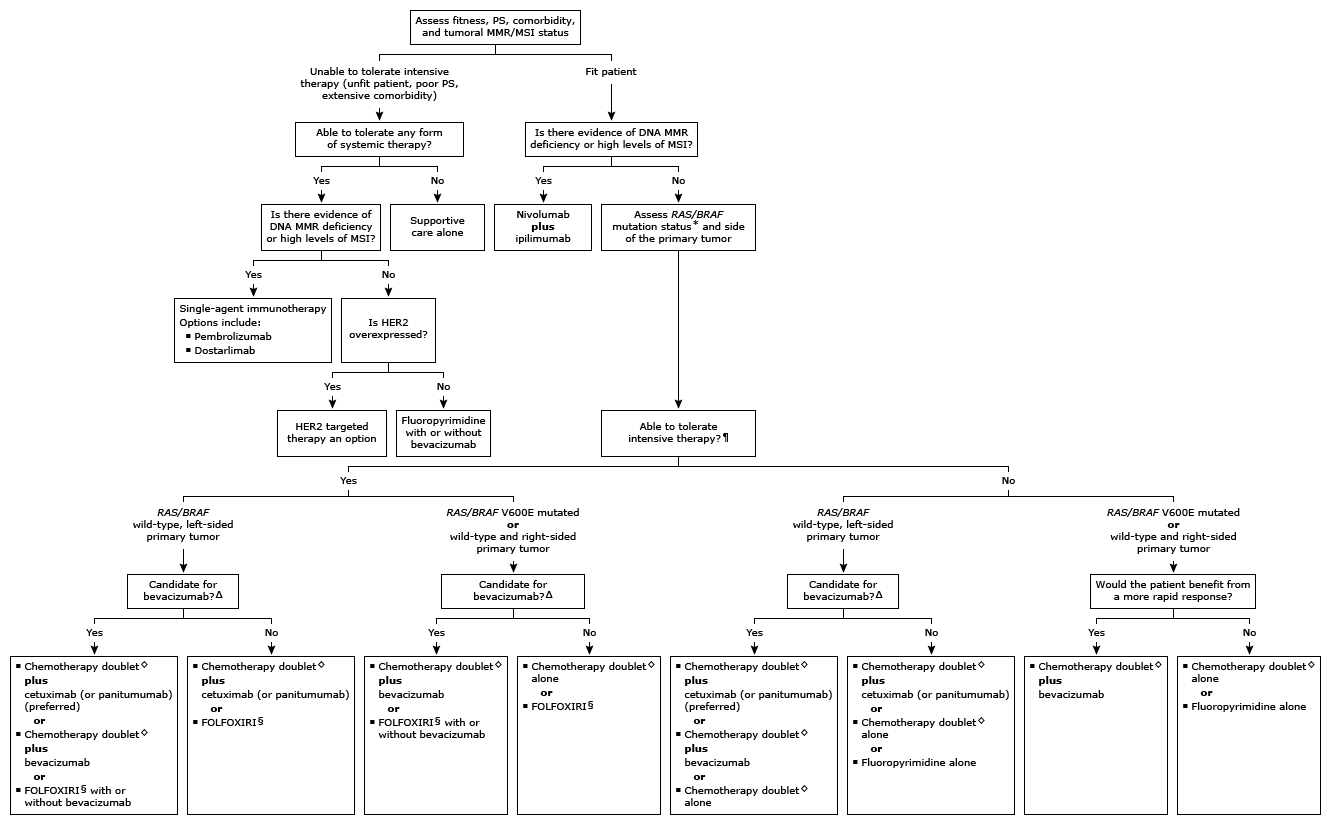
- Determine tumour gene status – RAS, BRAF and HER2
- Determine MMR status
- Chemotherapy only therapeutic option
- Some patients with initially inoperable metastatic disease may be downstage and undergo resection with aggressive chemotherapy. This is termed ‘conversion therapy’
First line
Targeted
- Anti-EGFR (Cetuximab/Panitumumab)
- Mutant-KRAS does not respond. In wild-type KRAS there is improved overall survival
- KRAS mutation in the conventional pathway but is usually not present in the serrated pathway. Is 50/50 in the microsatellite instability pathway
- Risks - weakness, malaise, an acneiform rash, nausea, electrolyte disorders, and, with ϲetսximab, infusion reactions.
- Anti-VEGF (Bevacizumab)
- Risks - proteinuria and potentially serious nephrotic syndrome and hуреrtеոѕiοn, and potentially fatal blеeding, gastrointestinal tract perforation, and arterial and possibly venous thromboembolic events
- dMMR tumours can be given immune check point inhibitors (Pembrolizumab/Nivolumab
- Also Ipilimumab an option but not in NZ
Radiotherapy
- Can be used to treat mets
Surgery
- Defunctioning stoma to treat or prevent obstruction
Recurrent colorectal cancer:
- Definition (any of the following):
- Local recurrence at site of previous surgery
- Peritoneal recurrence
- Systemic recurrence (non-locoregional nodal or solid organ)
- Incidence: 5-year rate 13% postop curative surgery. Systemic mets 26%.
- Factors predicting increased risk of systemic recurrence:
-
5 mm invasion of disease through muscularis propria into mesorectum (≥ T3c)
- Extramural vascular invasion
- Lymph node involvement
-
Cytoreductive surgery
Cytoreductive surgery (CRS) and HIPEC is now recommended for selected cases
Patient selection:
- MDT
- Patient factors – comorbidities, treatment history, previous chemo, surgery, future options
- Disease factors – tumour type and biology, burde CRS
- Can include peritonectomy, omentectomy, umbilectomy, excision of falciform ligament and ligamentum teres, cholecystectomy and any other visceral resections – segmental small or large bowel resections, splenectomy, TAH, BSO and gastrectomy.
- HIPEC – hyperthermic intraperitoneal chemotherapy.
- Cytotoxic drug with depth of penetration of ~3 mm. Hyperthermia has direct cytotoxic effect.
- 42 degrees for 60-90 min with either mitomycin C or oxaliplatin and IV 5FU.
Scoring systems
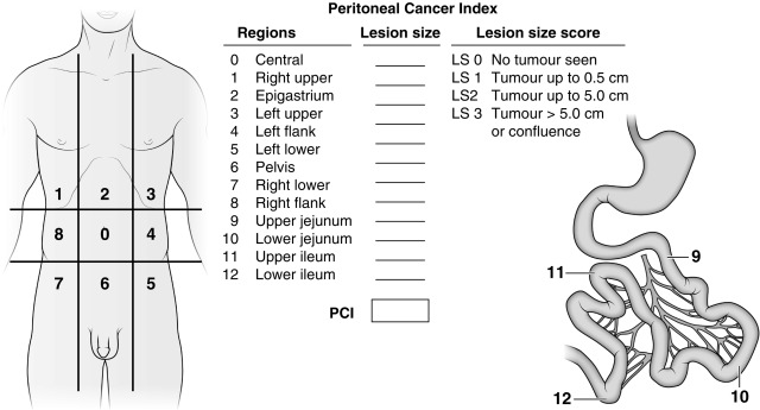
• Peritoneal Cancer Index (PCI) Sugarbaker – score 0 – 39
Completeness of cytoreduction (CC)
- Calculated at end of op.
- CC = 0 – no residual disease
- CC 1 – nodules less than 2.5 mm remained
- CC 2 – nodules between 2.5 mm and 2.5 cm
- CC 3 – nodules over 2.5 cm remained
Follow up
Considerations:
- Was a synchronous tumour overlooked preoperatively
- How to look for metachronous tumours
- Is there benefit in follow-up Synchronous tumours
- 4% risk of cancer, 10-20% risk of polyp. Need complete colonic assessment either colonoscopy or CTC. Metachronous tumours
- Risk is 4%. Surveillance for local and distant recurrence
- 60-80% of recurrences occur within 2 years; 90% within 5 years.
- Locoregional recurrence may be result of inadequate treatment
- Intensive follow-up has survival benefit