- Incisional hernia related to an abdominal wall ostomy site
- Incidence
- 5-10% of colostomies
- 3-10% of ileostomies
- ≈10-20% require repair
Classification
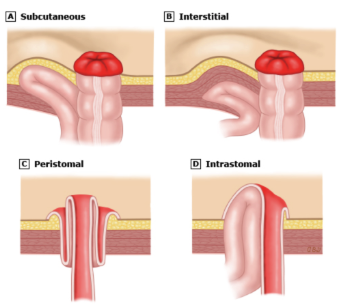
- Devlin Classification
- Subcutaneous - hernia sac lies in subcutaneous plane
- Interstitial - hernia sac lies within the layers of the abdominal wall
- Intrastomal - sac penetrates the spout of an ileostomy
- Peristomal prolapse - where the sac is within a prolapsing stoma
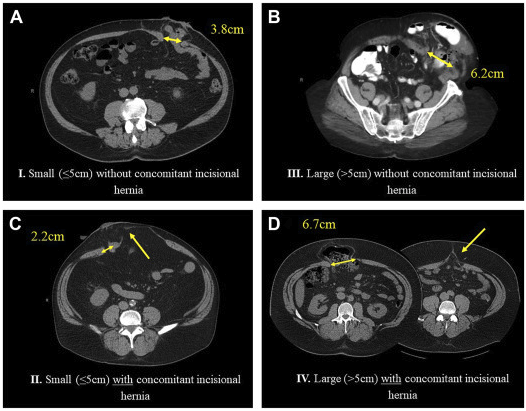
- European Hernia Society (EHS) classification
Etiology
- Only true risk factor is BMI > 30
- Risk factor most supported by evidence
- Patient specific
- Age
- Wound infection
- Chronic increased abdo pressure, COPD
- Obesity, weight gain (or malnutrition)
- Steroids/immunosuppression
- Malignancy
- IBD
- Technical Factors
- Emergency stoma
- Surgical technique
- Abdominal wall strength
Clinical
- Generally asymptomatic
- May present with difficulty placing stoma appliance
- Pain – usually mind
- +/- obstructive Sx
Management
- Indications for repair:
- Difficulty with stoma appliance – unable to see or fit
- Recurrent obstruction
- Skin breakdown
- Strangulation
- +/- cosmetic
- Options:
- Rejoin
- Resite
- Repair
Overview
- Primary vs. Mesh
- Primary
- Technically simple
- Avoids manipulation of intra-abdo contents
- Has low morbidity
- BUT has high recurrence rate
- Significantly higher than mesh repair (OR 8.9)
- Mesh
- Complications rare but difficult to manage, include
- Contamination
- Erosion
- Fistula formation
- Usually preferred technique, may be some instances where primary repair is better
- Complications rare but difficult to manage, include
- Primary
- Open vs Lap
- Not enough data to go other way
- May have presumed lower morbidity and possibly improved outcomes
- Best considered in patients without extensive intra-abdominal adhesions
- Also better for smaller (%3C 8-12cm) hernias
- Onlay vs Sublay
- Onlay
- Technically more straightforward
- Avoids intra-abdo dissection
- Higher risk wound infection
- Sublay
- Increased intra-abdo dissection
- Increases risk for adhesions and intestinal obstruction
- Associated with fewer recurrences
- Intra-abdo pressure cannot dissociate mesh from the repair
- Onlay
Techniques
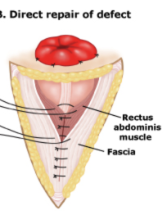
Primary Repair
- Reduce the size of the facial defect by re-approximating the fascial edges with permanent sutures
- Approach generally avoided because of the physics of parastomal hernia and nature of the defect
- Unavoidable to cause tension on the repair
- Leads to high recurrence rates
Onlay Mesh Repair
- Incision made well away from stoma (typically in the midline)
- Subcutaneous dissection along rectus and oblique fascia
- Circumferentially around stoma
- Hernia reduced
- Abdo wall closed using tension free mesh repair
- Note risk ischaemic injury to the skin
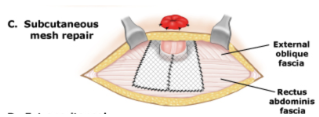
Sublay Mesh Repair
- Less infection risk
- Entails large dissection
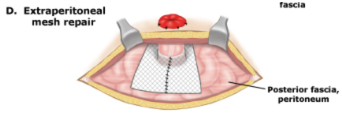
Intra-abdominal Mesh Repair
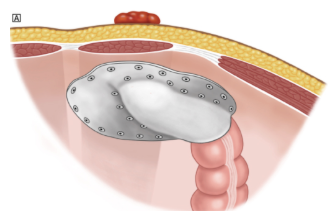
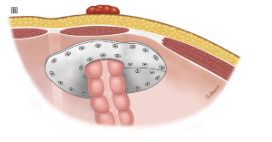
- Reduce hernia contents and close facial defect with mesh under the defect, and wide overlap
Sugarbaker
Keyhole
Parastomal Hernia-Contemporary Management, page 1 Parastomal Hernia Repair, page 1 Pauli, page 1
Prognosis / Natural Hx:
- Most hernias develop within first few years of stoma formation
- Mesh repair may lead to strictures (1/36 pts)