Section: Colorectal Sub-section: Proctology Curriculum: Curriculum, page 19
Definition
- Anorectal Suppurative Disease
- A localised collection of pus formed by the product of inflammation
- Usually caused by bacteria
- Pus composed largely of
- Dead leukocytes
- Exuded plasma
- Liquefied tissue cells
Incidence
- Perianal and ischiorectal account for 80%
- M>F 2:1
Classification by Position
- Perianal
- Subcutaneous
- Submucosal
- Intersphincteric
- Between internal and external anal sphincters
- Ischiorectal
- Deep abscess lateral to sphincter complex in the ischiorectal space
- Supralevator
- Above Levator Ani
Aetiology/Risk Factors
- Immunosuppression
- Diabetes
- Inflammatory bowel disease - Crohn’s
- Hidradenitis Suppurativa
- Anorectal Malignancy
- Fissure, Haemorrhoid, Surgery
- TB/HIV
Clinical Presentation
- Perianal pain, swelling, or discharge
- Fever/tachycardia
- Malaise
Pathology
- Cryptoglandular Theory
- Infection begins in anal glands
- Glands lie in the plane between sphincters and drain into crypts at the dentate line
- Occlusion of the gland (stool, oedema or inflammation for trauma) leads to infection
- Bacteria and stool are trapped in the gland
- Common organisms
- Bacteroides, E. coli, Strep Faecalis
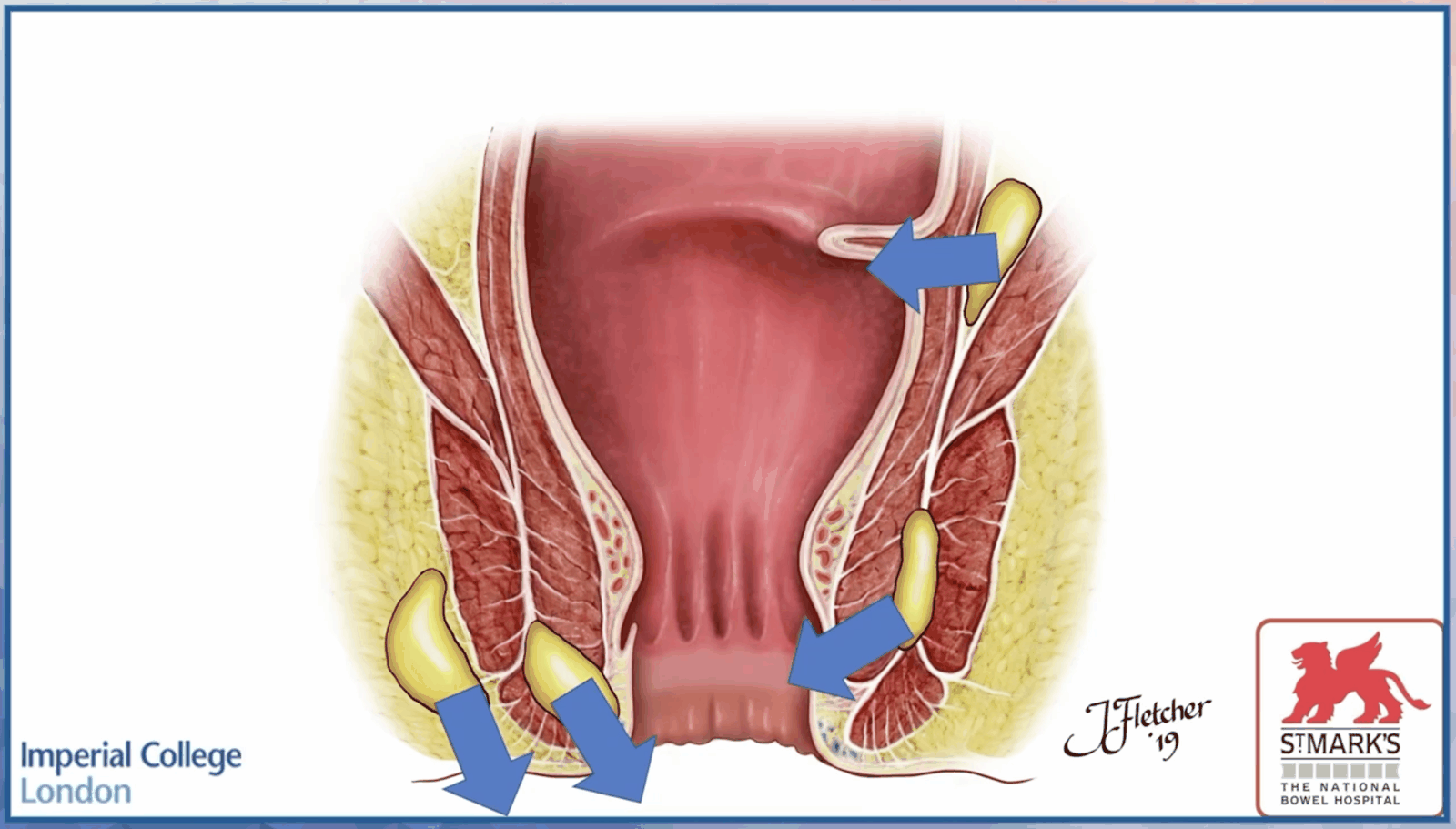
- Abscess may track within the plane
- Or across the plane
Investigations
- Clinical Diagnosis
- Exam and EUA
- Don’t look for fistula
- Won’t do anything acutely and risk of creating tract
- 50% heal spontaneously without need for intervention anyway
- If complex cases or can’t locate
- MRI
- Esp. supralevator
- Sepsis higher up in the sphincter complex may present with rectal pain, and possibly disturbance of micturition, and there may be no external signs of pathology
- The rare submucosal abscess is revealed on digital examination of the anal canal as a distinct tender bulge, and the patient may have reported the passage of pus from the anal canal with relief of symptoms.
- Clues as to the aetiology of perineal sepsis may be gleaned from microbiology
Anal fistula
- Historical evidence suggest there is a fistula in 1/3 of patients
- Current evidence suggests it is 1/6 patients
National UK study Natural history of anorectal sepsis, page 1
- 165,536 patients from 1997-2012 across England
- 15%, 1/6 patients will develop a fistula (idiopathic)
- 40% in patients with IBD
- 70% of patients developed a fistula within the first year
- Independent predictors included: Inter-sphincteric sepsis, UC, Crohns, female sex, age 41-60, ischiorectal location rather than perianal.
- 3% of patients will go on to be diagnosed with Crohns disease
Types
Abscess types:
- Ischioanal fossa
- Low intersphinc
- Higher intersphinc
- Para rectactal
Operative management
Principles:
- Drainage according to locations
- Circumferential incision rather than radial as risk of damaging the sphincter
- DO NOT go looking for a fistula (ACGBI and ESCP recommendation)
- No requirement for repeat packing as per the PPAC 2 study
- Ask yourself - could this be Crohns disease
PPAC 2 study
PPAC 2 study, page 1 BJS 2022 I&D with continued post-operative packing vs non-packing 433 patients. Results: Higher pain score in packing group. No difference in fistula in ano rate or recurrence rate