Section: Colorectal Sub-section: Proctology Curriculum: Curriculum, page 19
Definition
Idiopathic
- Majority non-specific, idiopathic or cryptoglandular, their exact aetiology having not been fully proven
Associated with:
- Lymphogranuloma venereum
- Presacral dermoids
- Rectal duplication
- Aactinomycosis
- Trauma
- Foreign bodies
- Crohn’s disease
- Tuberculosis
- Pilonidal disease
- Hidradenitis suppurativa
Epidemiology
M:F 2-4:1 3rd-5th decade
Pathophysiology
- Anal glands in intersphincteric space
- Drain via anal sinuses onto dentate line
- Sinuses block with debris
- Impaired gland drainage
- Stasis
- Infection
- Abscess
- If abscess cannot drain back into the anal canal then slow increase in pressure until drain by another path
- perianal/subcutaneous, intersphincteric, ischioanal and supralevator
- This path can then either heal or become Epithelialised and a fistula
Clinical
Define:
- Location of the internal opening;
- Location of the external opening;
- Course of the primary track;
- Presence of secondary extensions;
- Presence of other diseases complicating the fistula.
Parkes classification 45%, 30%, 20%, 5% and EL are based on different aetiologies
Colorectal Surgery A Companion to Specialist Surgical Practice 1, page 224
- Inter-sphincteric (45%)
- Usually simple
- Or can have:
- High blind track
- High opening into the rectum
- No perineal opening
- Pelvic extension
- Arise from pelvic disease
- Trans-sphincteric (30%) - through the external sphincter into the ischiorectal fossa
- Can be uncomplicated
- Or can have:
- High blind track
- That terminates above or below the levator ani
- High blind track
- Supra-sphincteric (20%)
- Run up to a level above the puborectalis and then curl back down through the levators and into the ischiorectal fossa to reach the skin
- Exrta-sphincteric (5%)
- Run without relation to the sphincters
Simple - Parkes 1 (intersphincteric) and Parkes 2 (transsphincteric) which are low lying = <30% sphincter involvement Complex - all others
Draw backs of Parks
- Superficial fistulas are not in Parks classification
- There can be clinical difficulty in differentiating between a simple intersphincteric fistula and a very low trans- sphincteric fistula that crosses the lowermost fibres of the subcutaneous portion of the external sphincter.
- And some argue whether suprasphincteric tracks can be part of a classification based on cryptoglandularpathology (arguing indeed that many are iatrogenic).
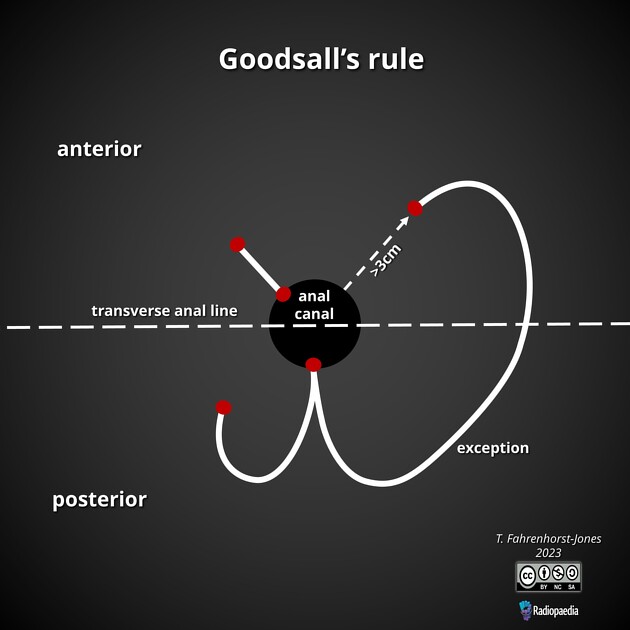
Goodsall’s Rule
- Describes predicted location of internal opening based on transverse anal line
- External openings anterior - radial tract to internal opening
- External openings posterior - curvilinear tract to internal opening to 6 o’clock
- Exceptions
- External opening >3cm from anal verge
- Complex fistula
- Long anterior fistula
Investigations
MRI
Differential diagnosis
- Hidradenitis
- Pilonidal
- Fissure
- Bartholin’s
- TB
- Crohn’s
- STI
- Benign - pilonidal, hidradenitis, fissures, cryptoglandular, TB, Crohns, radiation, divertic
- Malignant - adeno, scc, amelanotic melanoma
Treatment
Parkes Classification
- Superficial (not part of the types)
- Intersphincteric type 1 - 45% ⇒ CANT LIFT
- Transsphincteric type 2 - 30% → LIFT
- Suprasphincteric type 3- 20%
- Extrasphincteric type 4 - 5%
Goals
- Drain sepsis
- Define anatomy - Openings, track, extensions
- Eradicate fistula track
- Prevent recurrence
- Preserve sphincters
- Treat underlying pathology
Fistulotomy Principle
- Anteriorly sphincter is thinner for males and females (more so for females) How to
- Curette the tract to prevent recurrence
- Marsupialise the track to promote healing Mx → how much max sphincter involvement to allow fistulotomy
- Male
- Posterior - 50%
- Anterior - 33%
- Female
- Posterior - 33%
- Anterior - 0% Outcomes
- Recurrence - 5%
- Incontinence - variable, up to 10%
Cutting setons
- Painful
- High incontinence rate up to 40%
- 50% success
- Easy and repeatable
- No sphincter disruption
- 50% success
- Surgisis mesh material - porcine collagen
- Sutured in place
Mucosal advancement flap for fistual in ano
- 50- 70% success
- Excise, suture internal opening with prolene and MAF
Ligation of the intersphincteric fistula tract
- 60-80% success
Summary
- Fistulotomay/ectomy
- Success: 90%
- Incontinance risk: 10%
- LIFT
- Success: 50-80%
- Incontinance risk: 10-30%
- Anorectal advancement flap
- Success: 50-70%
- Incontinance risk: 10-30%
- Fibrin glue
- Success: 50%
- Incontinance risk: Minimal
- Plug
- Success: 50%
- Incontinance risk: Minimal