Section: Critical care Curriculum: Curriculum, page 48
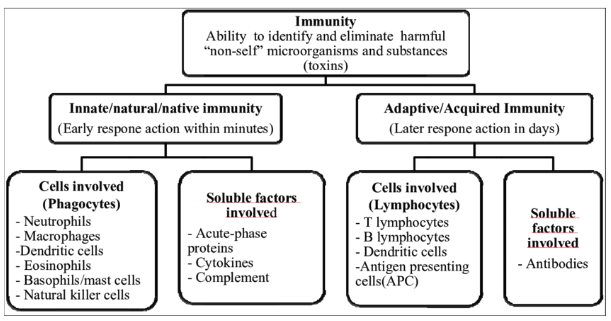
- The immune system is divided into innate and adaptive components.
- Innate
- is the immediate response to microbes
- Adaptive
- is the secondary response which can enhance subsequent innate responses
- Adaptive is divided into
- Humoral
- Cell mediated responses
- Innate
Innate Immune System
- Non-specific and rapid first line defense mechanisms against microbial molecular components
- Features
- Non-specific
- Immediate
- No memory
- Components
- Physical
- Skin, mucosa, tight junctions
- Environment - acid, enzymes (lysozymes in saliva)
- Microbiome
- Cellular
- Phagocytes
- Macrophages, Neutrophils, Dendritic cells
- Natural Killer cells
- Phagocytes - neuts, mono, macro
- Mast cells, eosinophils, and basophils: Involved in allergic responses and defense against parasites.
- Phagocytes
- Physical
- Functions
- Detect microbes
- First line defense against invasion and infection
- Maintain immunological homeostasis - pro vs anti inflammatory mechanisms
- Cardinal signs of inflammation due to it
- Pattern recognition receptors - PRR’s → pathogen-associated molecular patterns (PAMPs) and DAMPS
- Which then trigger the Inflammatory cascade and the activate adaptive immune response
Adaptive immune system
- Brocken down in to Humoral and Cellular systems
- Key Features:
- Specific: Targets specific antigens on pathogens.
- Slower response: Takes days to develop during the first exposure.
- Immunological memory: Faster and stronger response upon re-exposure to the same pathogen.
- Important cells
- T Cells
- Each express a single unique antigen-binding receptors on their membrane, known as the T-cell receptor (TCR)
- Antigen presenting cells (APCs)
- Usually dendritic cells, but also macrophages, B cells, fibroblasts and epithelial cells
- Surfaces of APCs express Class 2 (and Class 1) MHCs
- Major histocompatibility complex (MHC)
- Class 1 - found on all nucleated cells
- Present endogenous (intracellular) peptides
- After activation leads to the differentiation of Cytotoxic T cells (CD8+ cells)
- Class 2 - found only on certain immune cells
- Present exogenous (extracellular) peptides to T cells
- After T cells activation leads to the formation of CD4+ helper cells
- Note this terminology is slightly misleading (but it is the accepted short hand) - MHC is a region of genes that incode HLA proteins. So it is actually the HLA proteins that present antigens to T-Cells.
- Class I: HLA-A, HLA-B, HLA-C Class II: HLA-DR, HLA-DP, HLA-DQ
- Class 1 - found on all nucleated cells
- B cells
- B cells can recognise antigens directly unlike T cells
- Function is the production of antibodies
- Differentiate into plasma cells which secrete an antibody specific to the antigen and memory B cells
- T Cells
Adaptive Humoral System
- Overview
- Antibody mediated
- Results in plasma cells that secrete specific antibodies
- Opsonization
- Although this is good for acute phase it cannot eleminate intra-cellular virus -the advaptive cell-mediate immunity is required
- Process
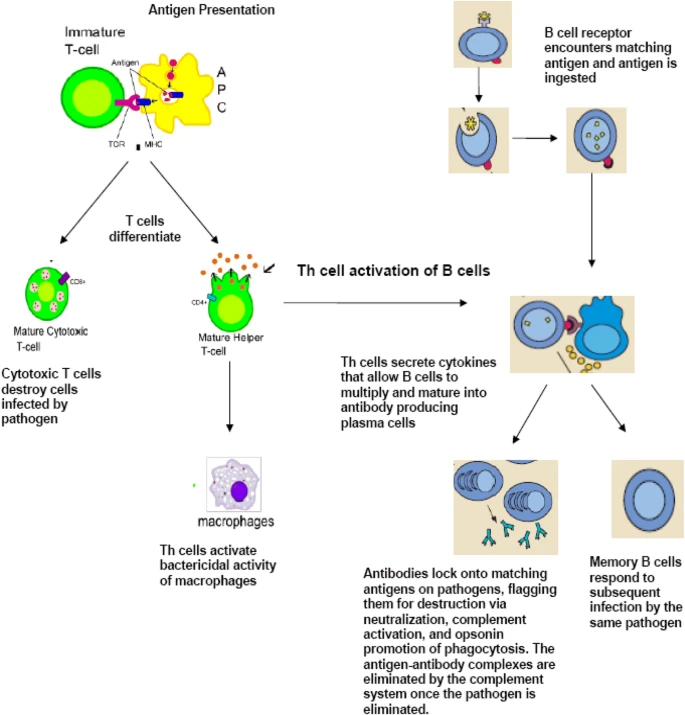
- Antigen presenting cells (APCs) ingest pathogen
- Present the pathogen on Major Histocompatibility Complex Class II (MHC-II)
- T cell is activated after binding to the MHC-II
- Cytokines released by APC to guide differentiation of T cell to T-helper (Th) cells (CD4+ cells)
- Effector cells are created the carry out the function, these die when the infection is resolved but memory T cells remain
- T helper cells active B cells which differentiate into plasma cells which secrete an antibody specific to the antigen and memory B cells
- This is why it is called Humoral - antibody-mediated immunity
Adaptive Cellular System
- Function
- Does not involve antibodies
- Activation of antigen-specific cytotoxic T cells that induce apoptosis of cells displaying foreign antigens or derived peptides on their surface
- The activation of macrophages and NK cells, enabling them to destroy intracellular pathogens
- This type of immunity is most effective in eliminating virus-infected cells and cancer cells, but can also participate in defending against fungi, protozoa, cancers, and intracellular bacteria. Cell-mediated immunity also plays a major role in transplant rejection.
- Process
- Infected cell displays antigen on MHC-1
- T cell is activated after binding to the MHC-I
- Cytokines released to guide differentiation of T cell into Cytotoxic T cells (CD8+ cells)
- Cytotoxic T cells then can cause apoptosis of infected cells
Types
- Passive vs Active
- Passive
- Transfer of antibodies - i.e in-utero or via milk
- Active
- In adults
- Passive
- Primary vs Secondary Phases
- Primary
- First exposure
- Secondary
- Memory B cells put out ABs more effectively upon subsequent antigen exposure
- Germinal centres in secondary lymphoid tissue (e.g. LN) = where humoral response mainly occurs
- Primary
Factors Affecting Immunity
- Nutrition
- Stress
- Comorbidities - obesity DM
- Smoking
- EtOH
- Sleep
- Immune suppression all causes
- Infection
- Autoimmunity
- Medications