Section: Surgical Oncology Curriculum: Curriculum, page 70
Definitions
- Allograft: an organ or tissue transplanted from one individual to another
- Autograft: an tissue or organ transplanted from one part of the body to another in the same individual.
- Xenograft: a graft performed between different species
- Orthotopic graft: a graft placed in its normal anatomical site
- Heterotopic graft: a graft placed in a site different from that where the organ is normally located
- Alloantigen: transplant antigen
- Alloantibody: transplant antibody
- HLA: human leucocyte antigen, the main trigger of graft rejection
Graft Rejection
- Read Immune System first
- Allografts provoke a powerful immune response that results in rapid graft rejection unless immunosuppressive therapy is given
- T-Lymphocytes play an essential role in mediating rejection
- Allografts trigger a graft rejection response because of:
- Allelic differences at polymorphic genes
- Give rise to histocompatibility antigens (transplant antigens)
- Most important
- ABO Blood Group Antigens
- Human Leucocyte Antigens (HLA)
- Most important
ABO Blood Group Antigens
- Expressed not only by red blood cells
- Also by most other cell types
- For all types of organ allograft:
- Vitally important to ensure that recipients receive a graft that is ABO blood group compatible
- Otherwise naturally occurring anti-A or anti-B antibodies will likely cause Hyperacute Graft Rejection
Permissible transplants are:
| Donor | Recipient |
|---|---|
| O | O, A, B, AB |
| A | A, AB |
| B | B, AB |
| AB, B, A, O | AB |
NB: NO NEED to take into account Rhesus Antigen
HLA Antigens
- Most common cause of graft rejection (if blood group compatible)
- Physiological function is to act as antigen recognition units
- Display antigens from foreign pathogens for recognition by T lymphocytes
- Highly polymorphic (amino acid sequence differs widely between individuals)
- Class I: HLA-A, HLA-B, Class II: HLA-DR
- Most important in organ transplantation
- Anti-HLA Class I antibodies may cause Hyperacute Rejection
| Category | Class I | Class II |
|---|---|---|
| HLA loci | HLA-A, -B and -C | HLA-DR, -DP and -DQ |
| Structure | Heavy chain and β2-microglobulin | α- and β-chain |
| Distribution | All nucleated cells | B cells, dendritic cells, macrophages |
- Location
- HLA Class I antigens are present on all nucleated cells
- HLA class II antigens expressed most strongly on Antigen-Presenting Cells, e.g. Dendritic Cells, Macrophages and B-Cells
- T cells recognise HLA molecules via their T-cell receptors
- But full T-cell activation also requires an additional or second signal
Effector Mechanisms of Rejection
- HLA antigens expressed by Graft Cells
- Activate T-Cells and stimulate them to proliferate
- In response to IL-2 and other T-cell growth factors
- Activated CD4 T-Cells through the release of cytokines
- Play a central role in various effector mechanisms that are responsible for graft rejection
- Cellular Effectors of Graft Rejection
- Cytotoxic CD8 T-Cells
- Recognise donor HLA class I antigens
- Cause target cell death by releasing lytic molecules (Perforin and Granzyme)
- Graft-infiltrating CD4 T-Cells
- Recognise donor HLA class II antigens
- Mediate direct target cell damage
- Release cytokines (interferon-γ), to recruit and activate macrophages that act as non-specific effector cells
- CD4 T-Cells provide essential T-cell help for B-Lymphocytes
- B-Cells differentiate into Plasma Cells and produce alloantibodies
- Bind to graft antigen, induce target cell injury directly or through Antibody-Dependent, Cell-Mediated Cytotoxicity
- Cytotoxic CD8 T-Cells
Types of Graft Rejection
- This is focused on renal although mostly applies to other rejection
- Graft rejection manifests as functional failure of the transplant
- Confirmed histologically
- Diagnosis and grading as per the Banff classification
- Confirmed histologically
- Time
- Hyperacute
- Immediate graft destruction due to ABO or pre-formed anti-HLA antibodies
- Characterised by intravascular thrombosis
- Acute
- Occurs during the first 1 year
- Driven mainly by T-cell mediated rejection
- Usually reversible
- Chronic
- Occurs after the first 1 year
- Most common cause of graft failure
- Non-immune factors may contribute to pathogenesis
- Characterised by myo-intimal proliferation in graft arteries leading to ischaemia and fibrosis
- Hyperacute
Hyperacute Rejection
- Mechanism
- Due to the presence in the recipient of pre-formed antibodies against HLA class I antigens expressed by the donor
- Arise from a previous blood transfusion, a failed transplant or pregnancy
- Also seen in ABO blood group- incompatibility
- After revascularisation of the graft
- Antibodies bind immediately to the vasculature
- Activate the Complement cascade and cause extensive intravascular thrombosis and graft destruction
- Within minutes and hours
- Due to the presence in the recipient of pre-formed antibodies against HLA class I antigens expressed by the donor
- Testing
- Can be avoided by ensuring ABO blood group compatibility and by performing a crossmatch test for antibodies directed against HLA antigens
- If crossmatch test is positive ⇒ Transplant should NOT proceed
- Antibodies directed against HLA class II antigens do not cause hyperacute rejection
- But associated with an increased likelihood of acute rejection and a poor clinical outcome
- Can be avoided by ensuring ABO blood group compatibility and by performing a crossmatch test for antibodies directed against HLA antigens
- Organs
- Kidney transplants are particularly vulnerable
- Heart and Liver transplants are relatively resistant
- Heart transplantation patients are also screened for HLA antibodies
- cardiac allografts rarely undergo hyperacute rejection
- But cardiac transplantation in the presence of a positive cross-match is associated with a high incidence of graft loss from accelerated acute rejection
- Even if strongly positive cross-match test, liver transplants rarely undergo hyperacute rejection
- Although their long-term survival is inferior
- Not clear why the liver is resistant to hyperacute rejection
- ? Less susceptible to ischaemia than the kidney by virtue of its dual blood supply
- Kidney transplants are particularly vulnerable
- Management
- Removal of graft
Acute Rejection
- Cell mediated or antibody mediated
- All types of organ allograft are susceptible
- Relatively common (~ 20–30% of grafts)
- Most episodes of acute rejection can be reversed by additional immunosuppressive therapy
- Mechanism
- Active antibody-mediated rejection
- Caused
- Circulating antibodies to donor alloantigens - normally HLA, ABO and other. Usually on graft endothelial cells, which results in inflammation, cell damage, and, ultimately, graft dysfunction
- Diagnosis
- Three criteria: histological evidence of acute injury, evidence of antibody interaction (C4d), circulating donor-specific antibodies (DSAs)
- Treatment
- Plasmapheresis, intravenous IVIG, Rituximab, or complement inhibitors.
- Caused
- Acute T cell–mediated (cellular) rejection (TCMR)
- Cause
- T cells that react to foreign antigens, most commonly HLA
- Characterized by lymphocytic infiltration of the tubules, interstitium, and, in some cases, the arterial intima
- Diagnosis
- Interstitial infiltration with mononuclear cells, tubular inflammation, Vascular inflammation
- Treatment
- Increased immunosuppression or anti-T-cell therapies (thymoglobulin
- Cause
- Active antibody-mediated rejection
Chronic Rejection
- Renamed to: chronic allograft nephropathy in renal transplant
- All types of transplant susceptible
- Liver more resistant than other solid organs
- All types of transplant susceptible
- Major cause of allograft failure
- Pathophysiology
- Not completely understood
- Immune related factors - low grade chronic antibody mediated rejection (ABMR) or chronic T-cell mediated rejection (TCMR)
- Non-immune factors - ischaemic reperfusion injury, infections, toxicity from immunosuppressive drugs.
- Characterised by interstitial fibrosis/tubular atrophy
- Chronic rejection causes functional deterioration in the graft, resulting after months or years in graft failure
- Currently available immunosuppressive therapy has little effect in preventing chronic rejection
Risk Factors for Chronic Rejection
- Of Kidney Grafts:
- Previous episodes of acute rejection
- Poor HLA match
- Long cold ischaemia time
- CMV infection
- Raised blood lipids
- Inadequate immunosuppression
- Incl. poor compliance
- Two most important risk factors for chronic rejection after kidney transplantation are:
- Acute rejection with vascular inflammation
- Recurrent episodes of acute rejection
Histological Changes
- Dominated by vascular changes
- Development of myo-intimal proliferation in arteries
- Results in ischaemia and fibrosis
- Development of myo-intimal proliferation in arteries
- Organ-specific features of Chronic Graft Rejection
- Kidney
- Glomerular interstitial fibrosis/tubular atrophy
- Pancreas
- Acinar loss and islet destruction
- Heart
- Accelerated coronary artery disease (cardiac allograft vasculopathy)
- Liver
- Vanishing Bile Duct Syndrome
- Lungs
- Obliterative Bronchiolitis
- Kidney
Graft-versus-Host Disease
- Reciprocal problem to transplant rejection
- Mostly commonly after stem cell transplant
- Donor liver and small bowel both contain large numbers of immunocompetent lymphocytes
- May react against HLA antigens expressed by recipient tissues
- Clinical
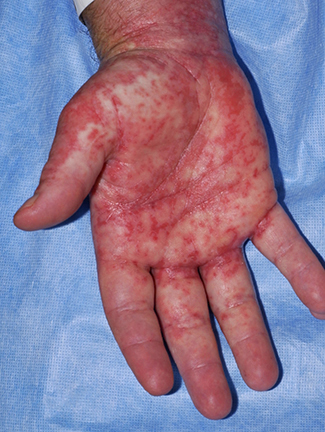
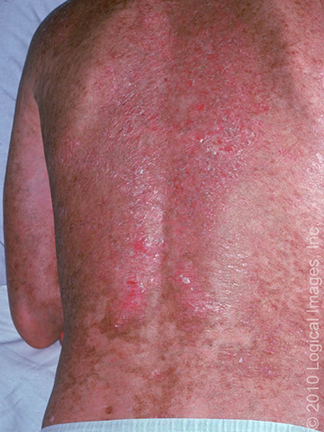
- Frequently involves the skin
- Maculopapular rash
- Characteristic rash on palms and soles
- Liver (after small bowel transplantation)
- GI tract (after liver transplantation)
- Frequently involves the skin
- Can be acute (within 100 days) or chronic (after 100 days)
- Risk factors
- Donor-recipient HLA mismatch.
- Old donors
- Gender mismatch.
- Serious and sometimes fatal complication
- Treatment
- Prophylaxis: Cyclosporine, tacrolimus, methotrexate.
- Treatment:
- First line: Corticosteroids.
- Second line: Mycophenolate mofetil, anti-TNF agents
HLA Matching
- HLA molecules are encoded by the Major Histocompatibility Complex (MHC)
- Cluster of genes situated on the short arm of chromosome 6
- HLA class I antigens comprise HLA -A, -B and -C,
- HLA class II antigens comprise HLA -DR, -DP and -DQ
- In deceased donor renal transplantation (but not other types of solid organ transplantation) attempts are usually made to match the donor and recipient for as many of the relevant HLA antigens as possible
- Reduces the risk of graft loss from rejection
- Well-matched kidney allograft that subsequently fails is less likely to cause sensitisation to the HLA antigens that it expresses
- Particularly important in children and young adults to avoid, whenever possible, grafts that are mis-matched for common HLA antigens
- If re-transplantation is required subsequently, it may be difficult to find an organ donor
- HLA-A, -B and -DR are the most important antigens to take into account when matching
- Well matched grafts may require less intensive immunosuppression
- And have less rejection
- In liver transplants, HLA matching does not confer an advantage
- Although HLA matching is beneficial in cardiac transplantation
- Not practicable because of the relatively small size of the recipient pool and the short permissible cold ischaemic time
Size Matching
- Must also take into account the relative size of donor and recipient
- Not an issue in renal transplantation
- Adult kidneys can be used for paediatric recipients (and vice versa)
- In heart, lung, liver and small bowel transplantation, it is important to consider size compatibility