Definition
- The complement cascade is an essential component of the innate immune system, a series of biochemical reactions involving a group of proteins called complement proteins.
- These proteins play a critical role in defending the body against pathogens, enhancing the ability of antibodies and phagocytic cells to clear microbes and damaged cells, and promoting inflammation.
Functions of the Complement Cascade:
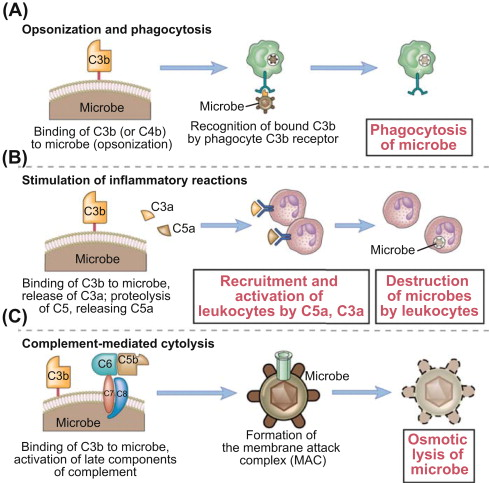
- Opsonization
- C3b coats pathogens, enhancing their recognition and uptake by phagocytes.
- Chemotaxis and Inflammation
- C3a and C5a recruit immune cells to the site of infection and increase vascular permeability.
- Direct Killing
- The MAC lyses target cells, especially Gram-negative bacteria.
Activation
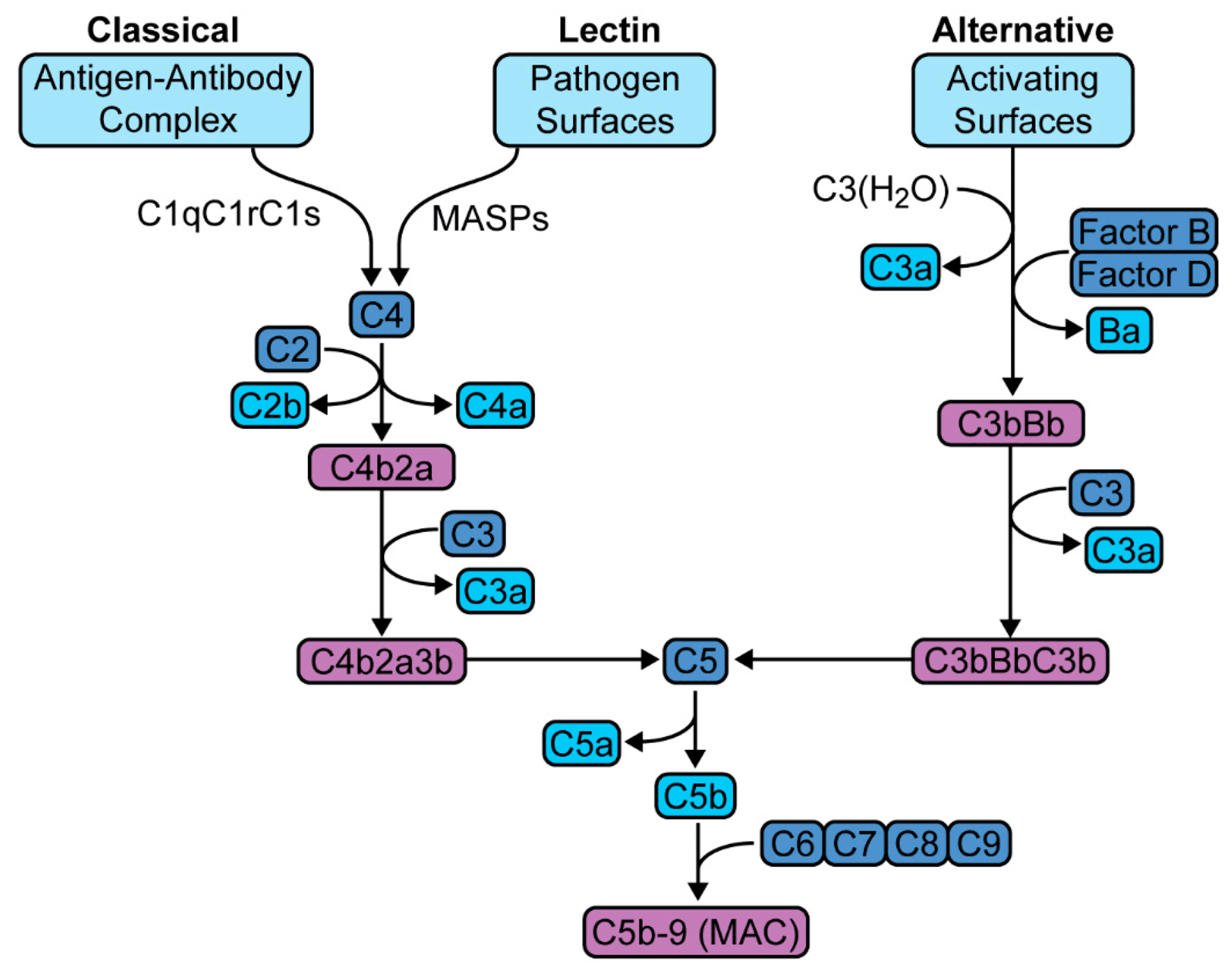
- There are three main pathways for complement activation, each initiated by distinct mechanisms but converging at the activation of C3
Classical Pathway
- Triggered by antigen-antibody complexes (immune complexes).
- Involves complement protein C1, which binds to the Fc region of antibodies (IgG or IgM) attached to a pathogen.
- Leads to activation of C2 and C4, eventually forming C3 convertase, which cleaves C3 into C3a and C3b.
Lectin Pathway
- Initiated by mannose-binding lectin (MBL) or ficolins binding to carbohydrates on the pathogen’s surface.
- Similar to the classical pathway, it activates C2 and C4 to form C3 convertase.
Alternative Pathway
- Activated directly on microbial surfaces in the absence of antibodies.
- Involves spontaneous hydrolysis of C3, stabilizing C3 convertase on pathogen surfaces via factors B, D, and properdin.
Key Components of the Cascade:
- C3 Convertase: Central to all pathways; cleaves C3 into C3a (an anaphylatoxin that promotes inflammation) and C3b (an opsonin that marks pathogens for phagocytosis).
- C5 Convertase: Converts C5 into C5a (a potent inflammatory mediator) and C5b, which initiates the membrane attack complex (MAC).
- Membrane Attack Complex (MAC): Composed of C5b, C6, C7, C8, and multiple C9 proteins, forming a pore in the pathogen’s membrane, leading to cell lysis.
Regulation
- To prevent damage to host tissues, the complement cascade is tightly regulated by proteins such as:
- Factor H and Factor I: Regulate the alternative pathway.
- CD55 (DAF) and CD59: Protect host cells by inhibiting C3 convertase and MAC formation, respectively.
- Dysregulation of the complement cascade can lead to autoimmune diseases, chronic inflammation, or increased susceptibility to infections.
Detail
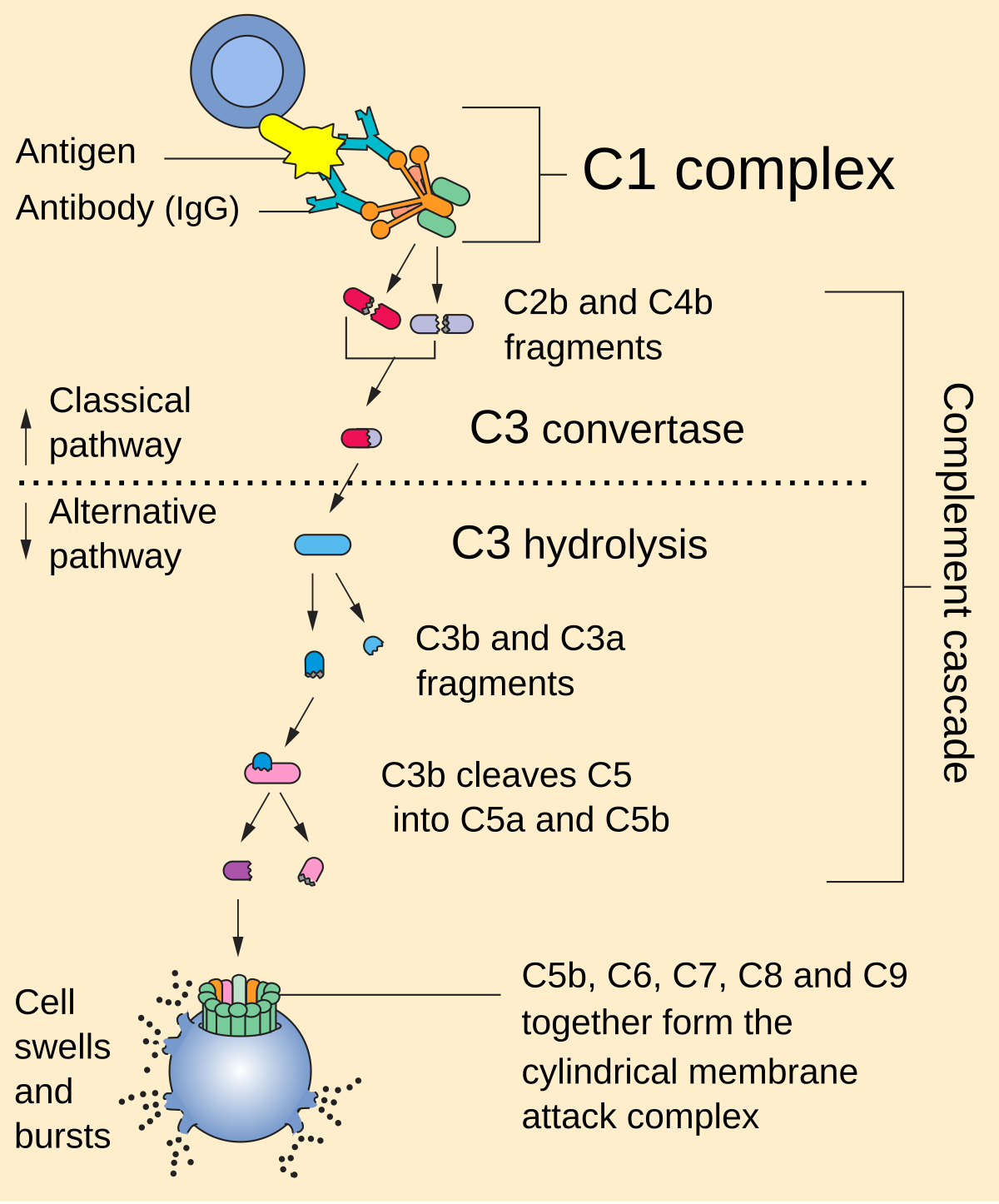
- The classical pathway begins when an antibody (IgG or IgM) binds to an antigen on the surface of a pathogen, forming an antigen-antibody complex.
- The C1 complex (composed of C1q, C1r, and C1s) binds to the antigen-antibody complex.
- C1q recognizes and binds to the Fc region of the antibodies, activating C1r and C1s.
- C1s cleaves C4 into C4a and C4b and C2 into C2a and C2b.
- C4b binds to the pathogen surface, while C2a associates with C4b to form the C3 convertase enzyme complex (C4b2a).
- The C3 convertase (C4b2a) cleaves C3 into C3a and C3b.
- C3a acts as a chemoattractant, recruiting neutrophils and macrophages.
- C3b binds to the pathogen’s surface, facilitating opsonization and enhancing phagocytosis
- The C5 convertase is formed by the association of C3b with C4b2a.
- C5 convertase cleaves C5 into C5a and C5b.
- C5a acts as a potent inflammatory mediator, recruiting and activating neutrophils and other immune cells.
- C5b initiates the assembly of the membrane attack complex (MAC).
- C5b sequentially interacts with C6, C7, C8, and C9, forming the MAC complex.
- The MAC inserts into the pathogen’s cell membrane, forming pores that cause osmotic imbalance and cell lysis.
- Components C3a and C5a act as anaphylatoxins, promoting inflammatory responses by increasing vascular permeability and recruiting immune cells.
- C3b also functions as an opsonin, binding to the pathogen’s surface and enhancing phagocytosis by macrophages and neutrophils.