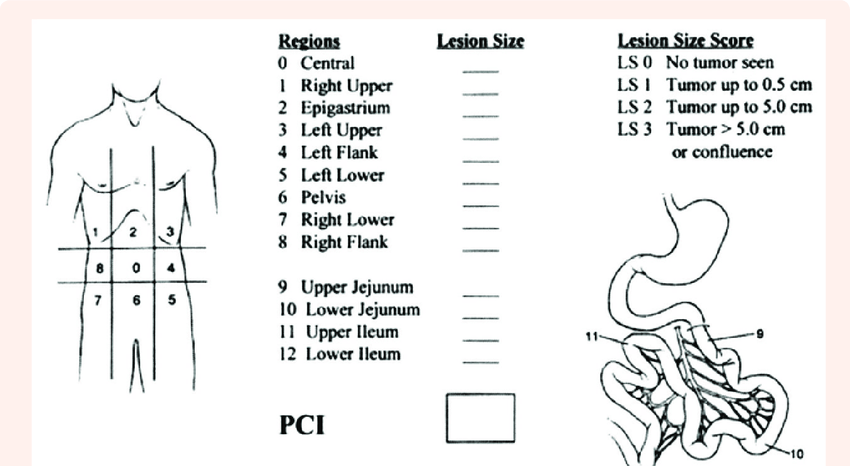
The peritoneal cancer index (PCI) is used to assess the extent of peritoneal cancer throughout the peritoneal cavity. For this purpose, the peritoneal cavity is divided in 13 well-defined regions (see figure). In each of the 13 regions, the size of the largest tumor nodule is measured. If no tumor is visualized, a score of “0” is given to that region. If the largest tumor nodule is smaller than 0.5 cm, the score is “1”. For tumors measuring between 0.5 cm and 5 cm, the score is “2”. For lesions larger than 5 cm, the score is “3”. If there is layering or a confluence of multiple small tumor nodules, the score is “3”. The PCI is calculated by adding the scores of all 13 regions together with a maximum score of 39 (13×3).
In colorectal cancer, the PCI is closely correlated with the prognosis after HIPEC. The higher the PCI, the worse the prognosis. Most institutes have defined a maximum PCI. If a patient’s PCI exceeds this upper limit, the operation is terminated, and the HIPEC procedure is cancelled because the benefit of the procedure in terms of survival does not outweigh its risks.
A diagnostic laparoscopy may be helpful in determining the PCI as can be seen in the video: https://www.youtube.com/watch?v=o0_esnlk6dk&ab_channel=HIPEC