Sub-section: Adrenal Section: Endocrine
Definition and Incidence
- Cushing’s Syndrome
- Disorder characterised by a no. of signs and symptoms, caused by long term effects of elevated glucocorticoid levels
- Cushing’s Disease
- Glucocorticoid excess caused by an ACTH-secreting Pituitary Adenoma
Clinical Presentation
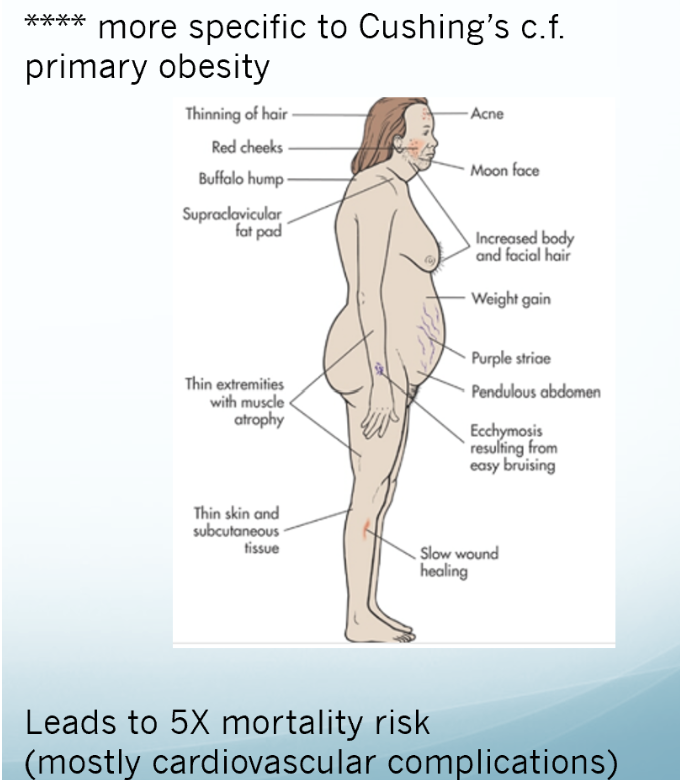
- Symptoms
- Central obesity
- Buffalo hump
- Moon faces
- Facial Plethora ****
- Reddening due to thin skin
- Striae****
- Hirsutism
- Loss of libido
- Menstrual irregularity
- Depression/psychosis
- Proximal myopathy****
- Easy bruising****
- Signs
- Diabetes Mellitus
- Osteoporosis
- Hypertension (> 70%)
- Hypokalaemia
Aetiology
- Most common cause is exogenous steroid use
- Endogenous Cushing’s syndrome is rare (F > M)
- ACTH-Dependent (80%)
- Pituitary-related (Cushing’s disease) (70%)
- Ectopic (10%)
- E.g. NET’s, Bronchogenic Carcinoid, Medullary Thyroid, Phaeo, or Small Cell Lung Ca
- ACTH-Independent (15-20%)
- Primary adrenal Cushing syndrome
- Adenoma (90%)
- Carcinoma (10%)
- Bilateral micronodular/ macronodular Hyperplasia (<1%)
- Primary adrenal Cushing syndrome
- ACTH-Dependent (80%)
Diagnosis
- Screening tests
- 24hr Urinary Free Cortisol
- Reflects average cortisol levels
- Levels > 4x normal - diagnostic of Cushing’s
- Less sensitive at diagnosing subclinical Cushing’s
- Do at least 2 measurements, may need 3
- Late-night Salivary Cortisol
- Cushing’s syndrome shows loss of normal circadian rhythm of cortisol secretion
- Resting midnight plasma cortisol > 50nmol/L is 100% sensitive for Cushing’s
- Salivary results closely correlated to plasma
- High sensitivity and specificity for Cushing’s (> 92%)
- Need to do in low stress environment
- Hence: At home
- Low Dose Dexamethasone Suppression Test
- Exploits loss of negative feedback loop for cortisol
- 1-2mg dexamethasone, given at midnight
- Should suppress cortisol level taken at 9am following am
- If cortisol > 50nmol/L the following am
- Sensitivity for Cushing’s 95%
- Specificity 80%
- Some units may do 2mg/day, 48hr testing
- Gives higher specificity
- 24hr Urinary Free Cortisol
- Establishing a cause
- Corticotropin dependent or ACTH-independent disease
- High ACTH = ACTH-dependent
-
20 pg/mL, 4.4 pmol/L
-
- Low ACTH = ACTH-independent
- <5 pg/mL (1.1 pmol/L
- Intermediate
- Repeat testing
- High ACTH = ACTH-dependent
- ACTH-dependent
- Pituitary vs ectopic
- Noninvasive biochemical testing with
- CRH (if available) or desmopressin (DDAVP) stimulation test
- Both stimulate ACTH
- Increases in ACTH and cortisol is consistent with pituitary adenoma
- High dose dexamethasone suppression
- Pituitary tumours retain some negative feedback control and ectopic source does not
- Give single dose 8mg dexamethasone, or 2mg QID for 48hrs
- If cortisol level drops to < 50% baseline
- Suggests Pituitary Cushing’s
- If no significant drop - Ectopic cause (or Adrenal cause, but will have already ruled this out with prior investigations)
- CRH (if available) or desmopressin (DDAVP) stimulation test
- Imaging
- MRI
- Invasive testing
- Bilateral Inferior Petrosal Sinus Sampling
- To differentiate pituitary Cushing’s from ectopic if dexamethasone suppression test equivocal
- Invasive
- Catheter measures ACTH in each Petrosal Sinus and peripheral ACTH levels
- Central-to-peripheral ACTH gradient
- Catheter measures ACTH in each Petrosal Sinus and peripheral ACTH levels
- Bilateral Inferior Petrosal Sinus Sampling
- Further Investigations of Ectopic ACTH Dependent Cushing’s
- Basic tumour markers
- Urinary 5-HIAA
- Serum Calcitonin
- Chromogranin A
- Other GI neuroendocrine hormones as indicated
- CT neck/chest/abdo/pelvis
- Somatostatin receptor scintigraphy
- Basic tumour markers
- Noninvasive biochemical testing with
- Pituitary vs ectopic
- ACTH Independent
- Adrenal) Cushing’s
- Next step is Localisation
- CT is the initial modality of choice
- Will see adenoma, carcinoma, and macronodular hyperplasia
- Won’t see micronodular hyperplasia
- NB: Overlap in appearances of adrenal adenoma and carcinoma on cross sectional imaging
- Risk of malignancy increased if
- High attenuation
- Irregular outline
- Delayed contrast washout
- Heterogenous
-
4cm in size
- If concerned about malignancy:
- MRI with Gadolinium can help to differentiate
- High water content of carcinoma c.f. adenoma
- CT is the initial modality of choice
- Corticotropin dependent or ACTH-independent disease
Management
- Peri- and Post-op glucocorticoid administration
- Essential
- Initial high dose with taper post-op
- Some units withhold initially post-op
- To assess cortisol levels, ? biochemical cure
- Beware of Adrenal Crisis – Endocrinologist should manage
- Some units withhold initially post-op
- Surgery
- Primary adrenal Cushing’s syndrome
- Cushing’s disease
- Ectopic ACTH independent Cushing’s syndrome
Surgical Management of Primary Adrenal Cushing’s
- Unilateral Adrenalectomy
-
90% effective, but resolution of symptoms takes months-to-years
- Failure could be due to missed or recurrent malignant disease
-
- Perform in specialised center
- High risk of infections, Skin injury, Fractures, Hyperglycaemia
- DVT risk increased (up to 5%) so use clexane
Surgical Management of Cushing’s Disease (Pituitary)
- Initial approach
- Pituitary microsurgery for Cushing’s disease
- Trans-nasal, trans-sphenoidal approach
- If fails, consider:
- Re-operation
- Danger of causing pan-hypopituitarism
- Radiation
- If fail
- Bilateral Adrenalectomy
- Will need lifelong glucocorticoids and mineralocorticoid supplementation
Management Ectopic Cushing’s Syndrome
- Treatment of primary tumour is preferable
- But not always possible
- Controlling symptoms paramount if removing primary not possible
- Ketoconazole inhibits cortisol production
- Bilateral Adrenalectomy best way to achieve symptom palliation
- Even in patients with limited life expectancy
- Esp. if laparoscopic