Sub-section: Thyroid Section: Endocrine
Definition
- Decreased thyroid function
Overview
- Most commonly primary
- Can also rarely be due to peripheral resistance to thyroid hormones
- Most common cause in developing countries
- Iodine Deficiency
- Most common causes in developed countries
- Hashimoto thyroiditis
- Radiation induced
- Surgical removal
- Medications
- Diagnosis
- If clinical suspicion, confirm with TSH levels and fT4 levels
- Treatment
- Levothyroxine (PO, IM, IV) safe and effective
Iodine Deficiency
- Leads to chronic anatomic and metabolic alterations
- Chronic decrease in T3 and T4 production
- Increasing thyroid clearance of iodine and decreased renal excretion
- Body reacts by chronic preferential production of T3 (over T4)
- Also enhanced peripheral conversion of T4 to T3
- Avoids clinical hypothyroidism
- Low fT4, high TSH, normal or increased T3
- In most severe cases, decrease in both T3 and T4 (and TSH increase)
- Can lead to Endemic Goitre
- Severe in-utero deficiency can lead to endemic Cretinism
- Neurologic impairment, stunted growth, mental deficiency, and overt hypothyroidism
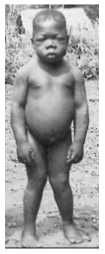
Endemic Goitre
- Diffuse enlargement of thyroid in response to physiologic changes of iodine deficiency
- Hypertrophy of thyroid follicles
- Reduction of follicular spaces
- If severe follicles become inactive
- Distend with colloid
- Focal areas of nodular hyperplasia may develop
- Can form nodules, some autonomous hot nodules
- Can get scarring, necrosis, haemorrhage
- All contribute to goitre, often asymmetric
- Hypertrophy of thyroid follicles
- Most common in Southeast Asia
- India, Indonesia, China
- Mild in Italy, Hungary, Poland, Spain
- In areas where most severe, can get symptoms at early age
- Greatest prevalence in later childhood years
- Peaks at puberty
- Prevalence decreases in adulthood, remains slightly higher in women
Post-Radiation Hypothyroidism
- Usually planned hypothyroidism as a result of rx for hyperthyroidism with I-131
- Multinodular goitre
- Grave’s
- Need to monitor so do not become clinically hypothyroid
- External beam radiation to mediastinum may also cause this
- Lymphoma or head/neck Ca
Post-Surgical Hypothyroidism
- Caused by subtotal/total thyroidectomy
- More aggressive surgery = Higher risk of complications
- Need to supplement with thyroxine and monitor levels
Pharmacologic Hypothyroidism
- Antithyroid drugs
- Methimazole/Carbimazole and PTU if given in excess
- Monitoring mandatory
- Amiodarone, Lithium, Interferon-α, IL-2, antineoplastic drugs
- Mostly interfere with hormone release from the gland or direct toxicity to thyroid itself
- Amiodarone
- Iodine rich (50-100x daily intake)
- Can cause hyperthyroidism (more common in iodine deficient areas)
- Amiodarone induced thyrotoxicosis difficult to treat
- Can also cause hypothyroidism (more common in areas not iodine deficient)
- Also inhibits peripheral conversion of T4 > T3
- Lithium (for BPAD)
- Inhibits cAMP pathway of thyroid hormone production
- Pts with Hashimoto thyroiditis more vulnerable to hypothyroidism from above drugs