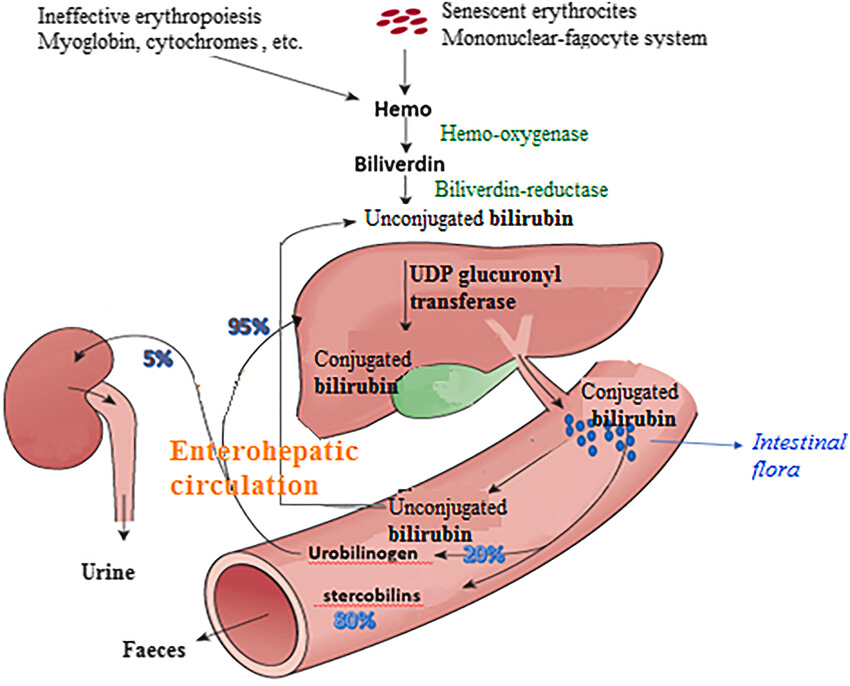
- Made from breakdown of heme (80% Hb), predominantly in the spleen.
- Unconjugated travels in blood bound to albumin
- Taken up by liver sinusoids and conjugated (aqueous soluble) to facilitate secretion across the canalicular membrane.
- Conjugated bilirubin is excreted into bile duct
-
- 1-4% unconjugated bilirubin
-
- In proximal intestine, unconjugated bilirubin is partially reabsorbed across lipid membrane of small intestine and undergoes enterohepatic circulation.
- In distal ileum and colon, conjugated bilirubin is deconjugated by colonic flora to urobilinogen
- It is partly absorbed in the bowel and undergoes hepatobiliary recirculation.
- The fraction that is not cleared by the liver enters the general circulation and is partly excreted in urine as urinary urobilinogen
Classification
- Unconjugated hyperbilirubinemia
- plasma elevation of predominantly unconjugated bilirubin
- Overproduction of bilirubin
- Impaired bilirubin uptake by the liver
- Abnormalities of bilirubin conjugation.
Conjugated hyperbilirubinemia
- both unconjugated and conjugated bilirubin levels increase.
- Biliary obstruction (extrahepatic cholestasis),
- Intrahepatic cholestasis,
- Hepatocellular injury.
In cholestatic disorders, both conjugated and unconjugated bilirubin accumulate in serum and patients have elevations in alkaline phosphatase. In patients with hepatocellular causes of hyperbilirubinemia, elevations in serum conjugated and unconjugated bilirubin and bile salts are accompanied by elevations in the serum concentrations of hepatocellular enzymes, such as aspartate aminotransferase (AST) and alanine aminotransferase (ALT).