Haemostasis physiology
- Haemostasis is blood clot formation at the site of a vessel injury
- Is a dynamic process which goes in 4 different stages.
Stages of haemostasis
- Arteriolar vasoconstriction
- Reflex neurogenic mechanisms
- Local secretion of vasoconstrictive factors (endothelin)
- Primary haemostasis - initiation and formation of a platelet plug
- Formation of the platelet plug
- vWF and collagen exposed
- Platelet activation and change in morphology with secretion of granules
- Platelet aggregation
- Formation of the platelet plug
- Secondary haemostasis - Propagation of clotting through the coagulation cascade.
- Deposition of fibrin
- Tissue factor and collagen exposed; activation of factor VII(a), cascade towards Thrombin formation to mature fibrin.
- Consolidates the platelet plug
- Deposition of fibrin
- Clot stabilisation
- Polymerized fibrin and aggregated platelets contract to form a permanent plug
- Re-absorption
- Termination of clotting through anti-thrombotic control mechanisms
- Counter-regulatory mechanisms are set into motion to limit VTE
- t-PA etc eventually resorb clot
- Termination of clotting through anti-thrombotic control mechanisms
Coagulation Cascade
- Sequential activation of a series of proenzymes into there active enzymes and the outcome of the coagulation cascade is the formation of fibrin which is a stable clot.
- Intrinsic pathway
- Activated by exposure to endothelial collagen
- Actives factor XII to XIIa
- Actives Factor XI to XIa
- Activates factor IX to Ixa
- Goes into common pathway
- Extrinsic pathway
- Tissue factor (Factor III) release through endothelial cells from external damage - binds to factor VII - to form VIIa
- This joins the common pathway
- Common pathway
- X to Xa
- Prothrombin (factor II) to thrombin (IIa)
- Thrombin activates fibrinogen into fibrin
- Clot is stabilised by factor XIII and vWF
Termination of clotting and fibrinolysis
- Antithrombin III - degrades activated factors.
- Fibrinolysis
- Plasminogen is turned into plasmin which degrades fibrin.
Overview
-
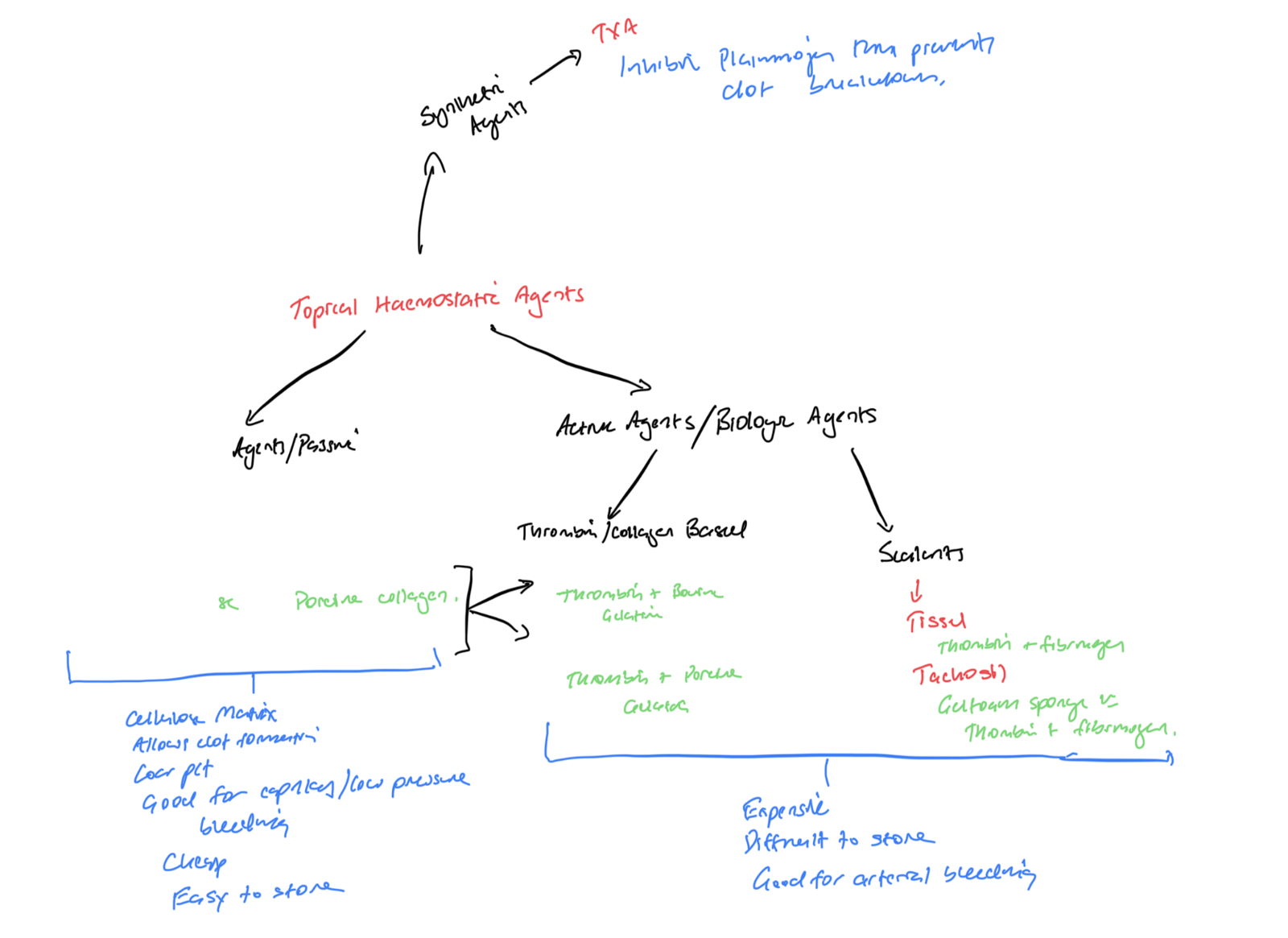
Topical haemostatic agents are usually either:
- Physical or mechanical agents which activate the coagulation cascade and provide a matrix on which the clot can form.
- Examples include Surgicel and Gelfoam.
- Biological agents.
- The enhance or augment the coagulation cascade at the site of bleeding.
- Often contain thrombin
- Floseal and fibrin sealants
- Synthetic agents
- Topical TXA
- Bioglue
- Coseal
- Physical or mechanical agents which activate the coagulation cascade and provide a matrix on which the clot can form.
-
Can also be classified as active or passive
- Active - have biologically active chemicals
- Thrombin and collagen based i.e. Floseal and Surgiflo
- Good for patients with coagulopathies or platelet dysfunction.
- Good for capillary, venous and brisk arterial bleeding.
- Does cause swelling and can cause a foreign body reaction.
- Theoretical risk of DIC and can cause allergic reactions.
- Are expensive
- Fibrin sealants
- Combination of thrombin and fibrinogen +/- factor VIII
- Useful if a patient has a clotting factor depletion
- Doesn’t have same inflammatory reaction that Floseal does.
- Main issue - they come frozen and have to be thawed
- Very expensive.
- Thrombin and collagen based i.e. Floseal and Surgiflo
- Passive - provide a physical structure or matrix i.e. Surgicel (cellulose) and Gelfoam (collagen)
- Generally cheap, easy to store.
- Downsides - nidus for infection, can swell lots compressing nerves or vascular structures, can embolize.
- Active - have biologically active chemicals
Products
- Oxidized cellulose (SurgiCell)
- dry absorbable sterile mesh that can be applied directly to an area of bleeding. It forms a matrix that activates the coagulation cascade and acts as a scaffold onto which thrombus can easily form. Good for ooze (low pressure capillary bleeding) - especially raw areas like the gallbladder bed.
- Has an acidic pH which encourages clot formation.
- These products are absorbed within 4-6 weeks.
- Acidic pH gives them potential anti-microbial activity.
- Gelfoam
- porcine derived collagen that like Surgicel, acts as a scaffold to allow thrombus formation - increased risk of infection and granuloma formation.
- Comes as a foam
- Good for lower pressure capillary bleeding/ooze
- Forms a mesh for platelet aggregation and clot formation.
- Absorbed within 4-6 weeks
- FLOSEAL
- Topical human pooled thrombin which is combined with a bovine gelatin foam
- Gelatin acts as a matrix for clot formation and then thrombin aids with the formation of fibrin for a strong clot.
- Can be effective for patient with clotting factor deficiencies
- Surgiflo is another product - human pooled thrombin and porcine gelatin
- Tisseel
- Fibrin sealant
- Human pooled plasma thrombin and fibrinogen
- Useful for haemostasis from venous oozing, organ injury, to stick tissues back together
- Tachosil
- Gelfoam sponge with is lined with a layer which contains a fibrin sealant (thrombin and fibrinogen)
- Comes as a pad which you can put on structures.
- Tranexamic acid
- synthetic derivative of the amino acid lysine that exerts its anti-fibrinolytic effect through the reversible blockade of lysine binding sites on plasminogen (plasminogen is converted to plasmin, which breaks down clots)
- Shown in the CRASH2 trial to reduce transfusion requirements and 30 days morality.
- Can be given IV or used topically.
- Haemopatch