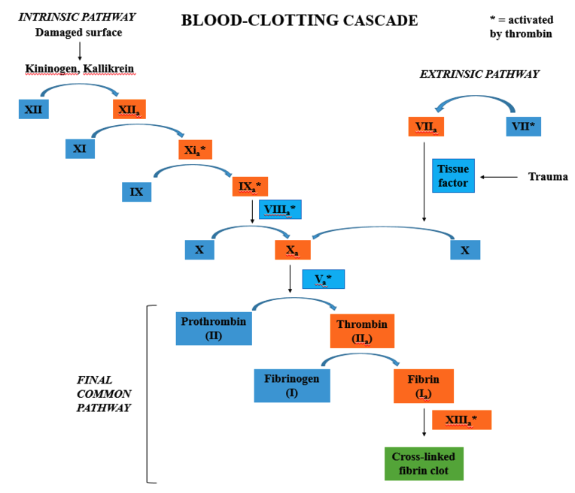
The clotting cascade is a complex series of biochemical events that lead to the formation of a blood clot, crucial for hemostasis and the prevention of excessive bleeding.
It involves two pathways (intrinsic and extrinsic) that converge on a common pathway.
Key Phases
Initiation:
Triggered by vascular injury exposing tissue factor (TF) or collagen.
Amplification:
Rapid activation of clotting factors to amplify the response.
Propagation:
Formation of a stable fibrin clot.
Intrinsic Pathway (“Contact Activation Pathway”)
Trigger: Exposure of blood to collagen or negatively charged surfaces (e.g., subendothelial tissue).
Steps:
Factor XII → Factor XIIa (activated by contact with collagen).
Factor XI → Factor XIa (activated by XIIa).
Factor IX → Factor IXa (activated by XIa).
Factor IXa, along with Factor VIIIa (activated by thrombin), activates Factor X in the common pathway.
Extrinsic Pathway (“Tissue Factor Pathway”)
Trigger: Exposure of tissue factor (TF) from damaged tissue.
Steps:
Tissue factor (TF) binds to and activates Factor VII → Factor VIIa.
TF-VIIa complex activates Factor X in the common pathway.
Common Pathway
Trigger: Activation of Factor X by either the intrinsic or extrinsic pathway.
Steps:
Factor X → Factor Xa (activated by IXa-VIIIa or TF-VIIa complexes).
Factor Xa, with Factor Va (activated by thrombin), converts prothrombin (Factor II) → thrombin (Factor IIa).
Thrombin converts fibrinogen (Factor I) → fibrin, forming the clot.
Factor XIIIa (activated by thrombin) cross-links fibrin strands, stabilizing the clot.