Section: Trauma Curriculum: Curriculum, page 75
Also see: Anticoagulants
Questions to answer when reading
- What is in FFP
- What is in cryoprecipitate and when is it used
- What are the risks of transfusion
- What is the evidence for TXA
- What is a TEG and how does it help
Trauma Induced Coagulopathy
- Despite adequate clotting factors, coagulation cascade does not work if temp below 34 and pH < 7.2
- Coagulopathy is caused and worsened by hypothermia and acidosis
- Hypothermia – keep pt warm
- Acidosis - early aggressive resuscitation to prevent usual trauma response of lactic acidosis
- Pathophysiology
- Coagulation Cascade Activation
- Procoagulants in systemic circulation
- Impairment of endogenous anticoagulant activity
- Thrombin generation in systemic circulation
- Hyperfibrinolysis
- Acute release of t-PA-induced hyperfibrinolysis
- Coagulation activation-induced fibrinolysis
- Consumption Coagulopathy
Resuscitation products
Fresh Whole Blood
- Most similar to lost blood - Natural concentrations
- Factors V and VIII reduce quickly in first 24 hrs of collection and within 7-14 days are subnormal
- Others ok in stored blood
- Platelets are all gone within 3 days
- Warmed and used within 24 hrs is ideal
Platelets
- Indications
- Prophylaxis - < 15
- Pre-operative - < 50
- Active bleeding - < 100
- Effect
- Boosts Platelet count by 10
Fresh Frozen Plasma (FFP)
- Volume = 250mL
- Dose = 10-20ml/kg
- E.g 70kg male → 6 units for 20ml/kg
- Contents
- All clotting factors (factors aren’t in equal concentration)
- Natural pro and anticoagulants - Protein C and S, Anti-thrombin and Tissue Factor Pathway Inhibitor
- Fibrinogen 800mg
- Plasma proteins - Albumin
- Electrolytes
- Indications
- 1:1 with RBCs in trauma
Cryoprecipitate
- Volume = 10-20mL
- Contents
- Fibrinogen 150-250mg
- VWF/Factor VIII complex
- Factor VIII
- Factor XIII
- Indications
- VWD
- Haemophilia A (F8)
- Factor 8 deficiency
- Fibrinogen deficiency
- Benefit
- Source of fibrinogen in ⅛ the volume
Tranexamic Acid
- TXA - Anti-fibrinolytic
- Mechanism
- Binds plasminogen to prevent conversion to plasmin
- Reduced fibrin breakdown
- Fibrin needed to stabilize clot
- Effect
- Helps stop bleeding
- Indication
- In bleeding trauma it is shown to work if given within 3 hours (CRASH2 trial)
- Improved mortality all cause
- NNT 67 to save one life
- 1g over 10 mins then 1g at 8 hours
- Otherwise, no benefit and increases risk of VTE
Risks of Transfusion
- Hyperkalaemia
- Stored blood can have Na pump failure and increased potassium
- Can result in transient hyperkalemia after transfusion
- Infection
- HIV/Hep A-D
- CMV
- Mono
- Malaria, Brucellosis, Yersinia, Syphilis
- Haemolytic Transfusion Reactions
- ABO/rhesus and other incompatibilities
- To cold/hot/pressurized blood
- Immediate generalized reaction to plasma
- Immunological Complications
- Major incompatibility - Error
- GVHD - TRALI
- Immunomodulation in transplant/oncology pts
- Causes of haemostatic failure
- Hypothermia
- Acidosis
- Dilution/depletion/reduced production of red cells or platelets
- Disseminated Intravascular Coagulation
- pRBC is an independent risk factor for
- Nosocomial infection
- SIRS/MOF
- ICU/LOS/M+M
- DVT
Viscoelastic testing
Viscoelastic testing is a point-of-care whole blood assay used to assess coagulation function in real time. It provides dynamic information on clot formation, stability, and breakdown, which is useful in trauma, surgery, liver disease, and massive transfusion protocols.
- Viscoelastic Haemostatic Assays
- INR and aPTT is not useful in a potentially hypothermic trauma patient as these samples are heated so may not reflect the true value → TEG
- How is it done
- Blood sample in cup with pin then oscillated creating fibrin strands
- Pin connected to detector system to get information regarding rotation (TEG) or impedance (ROTEM)
- Generates graph
- What are they testing
- Test of real time coagulation effectiveness
- Can be done bedside and result available within 10 minutes
- Allow goal directed haemostatic therapy - only give what’s needed
- Information about platelets, clotting factors, fibrinolysis
- Helps differentiate between pathological abnormality and surgically correctable bleeding
- Outcomes
- Loss of coag factors → Give FFP
- Loss of fibrinogen → Give FFP or cryoprecipitate or fibrinogen
- Loss of platelets/function → Give platelets
- Hyperfibrinolysis → TXA
- Heparinized → Protamine
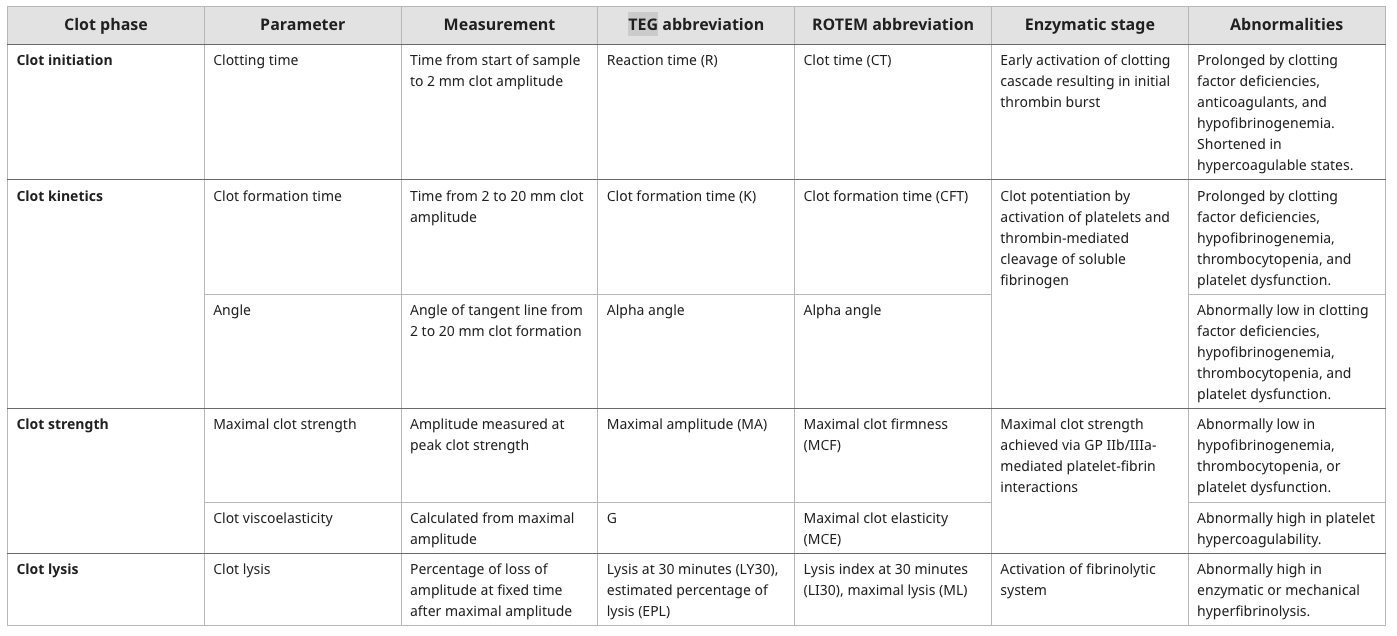
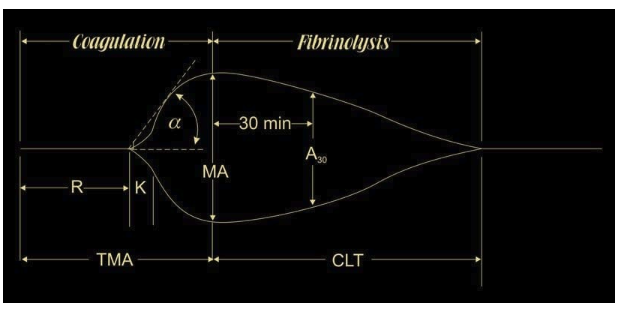
- R value = reaction time (s)
- time of latency from start of test to initial fibrin formation (amplitude of 2mm)
- initiation phase
- dependent on clotting factors
- K = kinetics (s)
- time taken to achieve a certain level of clot strength (amplitude of 20mm)
- amplification phase
- dependent on fibrinogen
- alpha = angle (slope of line between R and K)
- measures the speed at which fibrin build up and cross-linking takes place, hence assesses the rate of clot formation
- “thrombin burst” / propagation phase
- dependent on fibrinogen
- TMA = time to maximum amplitude(s)
- MA = maximum amplitude (mm)
- represents the ultimate strength of the fibrin clot; i.e. overall stability of the clot
- dependent on platelets (80%) and fibrin (20%) interacting via GPIIb/IIIa
- A30 or LY30 = amplitude at 30 minutes
- percentage decrease in amplitude at 30 minutes post-MA
- fibrinolysis phase
- CLT = clot lysis time (s)
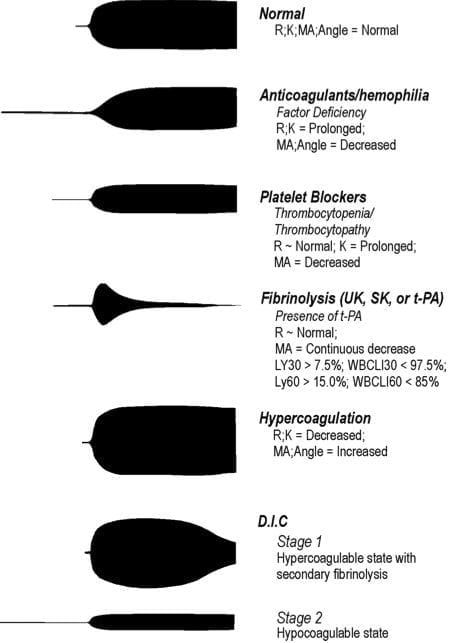
- Increased R time ⇒ FFP
- Decreased alpha angle ⇒ cryoprecipitate
- Decreased MA ⇒ platelets (consider DDAVP)
- Fibrinolysis ⇒ tranexamic acid (or aprotinin or aminocaproic acid)
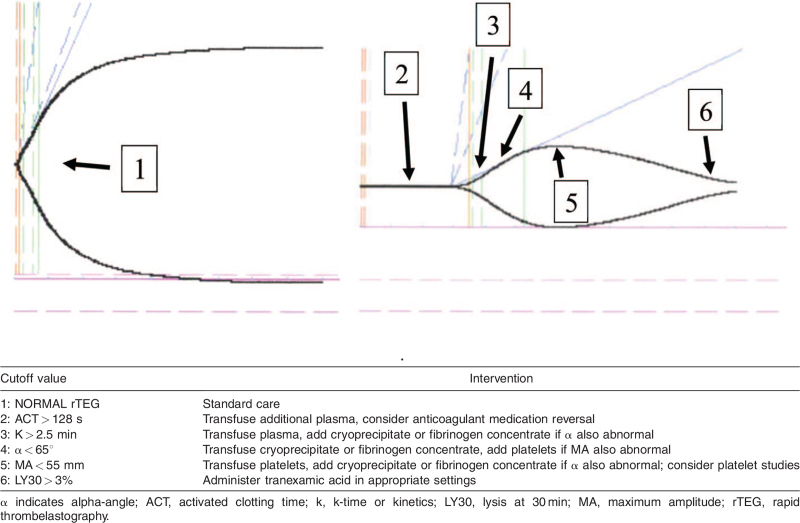 https://pmc.ncbi.nlm.nih.gov/articles/PMC8601668/
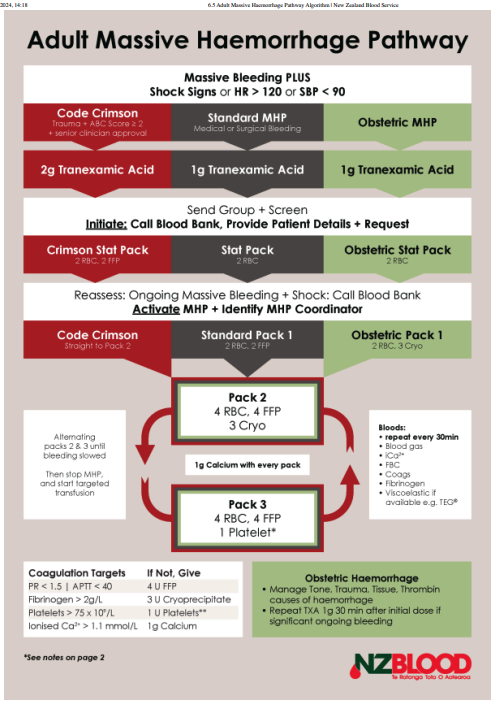
Massive Transfusion Protocol
- Definition
- Replacement of 100% of BV within 4 hours
- Administration of 50% of BV within 1 hour
- Complications
- Hypothermia
- Acidosis
- Hypocalcaemia - Citrate binds ionized calcium
- Impact - impaired myocardial relaxation
- MTP
- System set up at each hospital with goal of improving survival for bleeding pts
- Blood products are administered in a 1:1:1 ratio (RBC/Platelets/FFP)
- Indications for MTP activation
- Replacement of 50% BV within 1 hour
- Replacement of 100% BV within 24 hrs
- Haemorrhagic shock with active bleeding
- Use of 4 units of RBC within 4 hours
- Discretion of treating physician
- Majorly injured patient with high likelihood of transfusion required
- ABC score predicts need for MTP in trauma (also activaiton criteria for Code Crismson)
- 2/4 = Likely need MTP
- Penetrating mechanism
- BP < 90
- HR > 120
-
- FAST
- 2/4 = Likely need MTP
- End points for transfusion
- Active surgical bleeding has been controlled
- No further need for red cells
- Temp > 35
- pH > 7.3
- Fibrinogen > 1.5
- INR < 1.5/ PT < 16/ aPTT < 42
- Hb > 80
- Bloods done before starting and every 6 units
- FBC
- U+E with calcium
- Coags
- ?TEG/ROTEM if possible