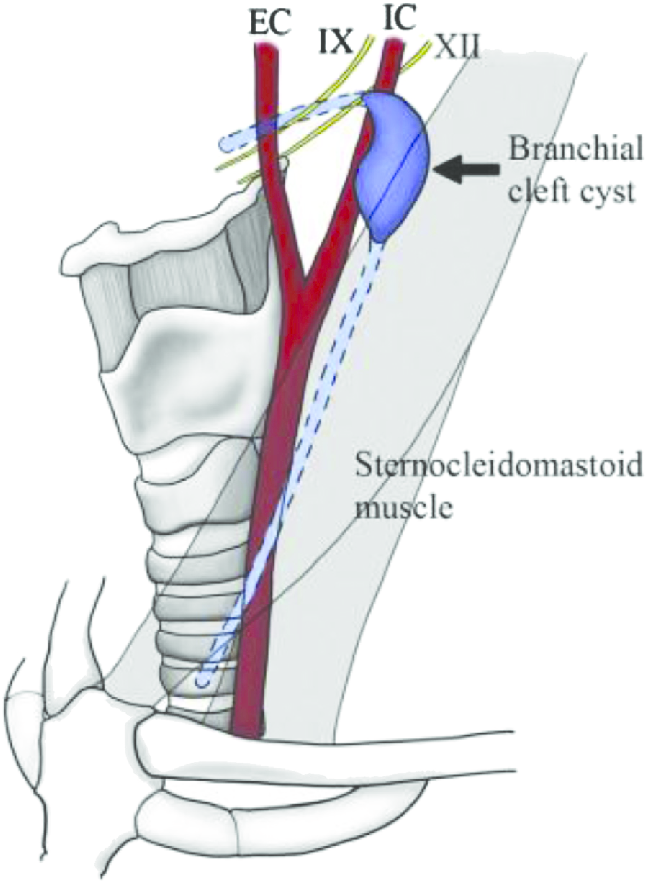
-
Setup
- GA, IV abx
- Supine, head ring, tilted away
-
Incision (this is for a second branchial cyst which is most common)
- Fistula
- Lacrimal probe into tract
- Elliptical incision around external opening - over the swelling
- Cyst only
- Transverse cervical incision along a natural skin crease at the level of the cyst
- Often 2–3 fingerbreadths below the mandible
- Fistula
-
Dissection
- Raise subplatysmal flaps superiorly and inferiorly
- Identify the cyst capsule carefully
- Dissect circumferentially using sharp and blunt technique
- Preserve the integrity of the cyst wall to avoid spillage
- Retract or divide overlying platysma and possibly a portion of anterior SCM
-
Identify deep relationships
- Cyst typically lies deep to platysma, superficial to or partly under SCM
- Lies lateral to carotid sheath
- Avoid injury to IJV, carotid artery, vagus nerve
- Superiorly, dissect carefully around the hypoglossal nerve and glossopharyngeal nerve
- Inferior pole may abut ansa cervicalis or extend toward the hyoid
-
Management of sinus or tract (if present)
- Pathway to follow
- Between carotid bifurcation
- Behind post belly digastric
- In front of Hypoglossal Nerve
- To tonsillar fossaIf sinus tract extends medially, follow it as high as needed—may reach tonsillar fossa
- May need higher 2nd incision (laddered caudad)
- May need to divide the posterior belly of digastric for access
- Ligate and excise tract at the upper limit safely identifiable
- Pathway to follow
-
Specimen removal
- Remove the cyst en bloc with surrounding soft tissue cuff if needed
- Avoid rupture to reduce risk of recurrence
-
Haemostasis and closure
- Achieve meticulous haemostasis
- Place a suction drain if dissection is deep or near vessels
- Layered closure of platysma and skin with absorbable or subcuticular sutures
-
Post-op considerations
- Monitor for haematoma, seroma, or infection
- Pathological confirmation to rule out carcinoma (rarely, cystic metastasis may mimic cyst)
- Drain usually removed in 24–48 hours
-
Risks
- Nerves
- MMN, CN12, CN 9
- Vessels
- EJV, facial V
- Carotid sheath and body