Definition
- Sympathetic chain disruption
- Miosis, partial ptosis and anhydrosis (+/- enophthalmos = inset eyelid)
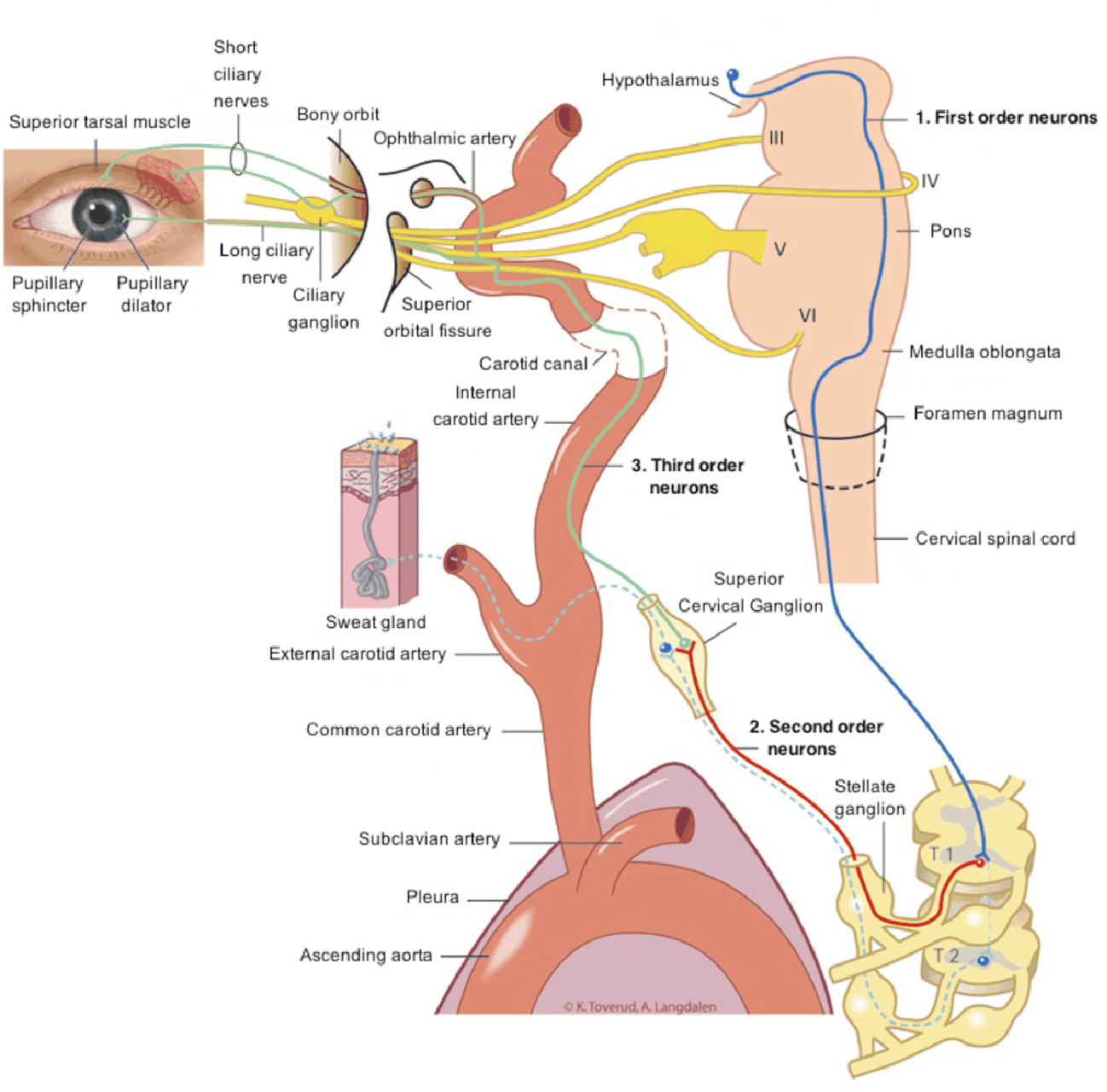
Normal anatomical pathway
- Oculosympathetic pathway made up of 3 neurons
- 1st order neuron
- Hypothalamus → SC (cervical C8-T2)
- 2nd order
- 3rd order
- Superior cervical ganglia along CCA to ICA and ECA plexi
- ICA plexi
- Pupillary constrictor - pupil dilation (mydriasis)
- Muller’s muscle (superior tarsal muscle) - ptosis
- Only partial ptosis as the levator palpebrae superioris is still innervated by CN3 and it is only the Superior tarsal muscle that has lost innervation
- Sweat glands to forehead
- ECA plexi
- Sweat glands to rest of face
Differential diagnosis
- 1st order neuron
- Injury above T1
- Stroke
- Brain tumour
- Trauma
- Syringomyelia
- 2nd order neuron
- Pancost tumour
- Thyroid cancer
- Cervical rib on superior cervical ganglion
- 3rd order neuron
- ICA dissection or aneurysm
- Cavernous sinus thrombosis
- Nasopharyngeal carcinoma
- Carotid body tumour
Clinical examination
- Cocaine eye drop test
- Normally NE causes pupil dilatation
- Cocaine blocks NE reuptake = more NE available
- So with cocaine should normally have dilatation
- But in Horner’s with non intact system = no change
- Apraclonidine eye drop test
- It is weak NE so should normally cause some dilatation
- Net effect = degree of difference (anisocoria) between the 2 eyes should diminish
- Alpha 1 and alpha 2 effect of NE
Investigations
- CT/MRI to assess for cause
- Localisation = Hydroxyamphetamine
- 1st or 2nd order neuron issue (preganglionic)
- Hydroxyamphetamine will DILATE THE MIOTIC HORNERS PUPIL
- If there is an underlying preganglionic lesion
- If it doesnt dilate with hydroxyamphetamine
- = postganglionic or 3rd order neuron issue
- Regardless they need investigation with imaging
Summary
- Neuroanatomy and causes
- 1 = hypothalamus to cervical SC C8-T2
- Stroke
- Brain tumour
- Trauma
- Syringomyelia
- 2 = cervical SC C8-T2 to superior cervical ganglion (through brachial plexus and over lung apex)
- Pancost tumour
- Thyroid cancer
- Kulmpke (brachial plexus trauma)
- Cervical rib on sup cervical ganglion
- 3 = superior cervical ganglion to ECA and ICA plexi (constrictor, muller, sweat of forehead/sweat of rest of face respectively)
- ICA dissection/aneurysm
- Cavernous sinus thrombosis
- Clinical = SPAM
- Sympathetic
- Ptosis (partial)
- Anhidrosis
- Miosis
- Testing
- Cocaine drops - no dilation if horners
- APRACLONIDINE = reduced anisocoria
- Hydroxyamphetamine = dilates a 1st or 2nd order but not a 34d
- Imaging
- CT/MRI of head, neck and chest