Section: Head and neck Curriculum: Curriculum, page 43
Definition
- A Paragangliomas of the chemoreceptor cells located at the carotid bifurcation
Epidemiology
- People living at high altitudes
- OSA
- 40-60yrs
Aetiology
- Unclear - ?Chronic Hypoxia leading to carotid body cell hyperplasia
- 50% have genetic cause
Clinical
- Painless slow growing lump
- Carotid triangle - upper neck below angle of mandible
- Dysphagia
- Hoarseness
- Horner syndrome
- CN deficit - CN7, 9, 10, 11, 12
- Rubbery non tender mass lateral neck
- Carotid bruit
- Pulsatile
- <5% secrete catecholamines
- Fontaine’s sign - Moves freely in horizontal but not vertical plane
Pathology
- Normal carotid body is 3-6mm nest of cells
- Local invasion of structures
- 5% malignant
- May be multicentric
Histology
- Epithelioid cells arranged in compact cell nests or trabecular patterns (the so-called Zellballen appearance)
Investigations
- Duplex USS - highly vascular mass at the bifurcation
- Angiogram - characteristic blush at carotid bifurcation
- CT - homogenous mass with delayed washout (like a phaeo)
- Genetic testing
- Biochemical - plasma metanephrines, urine catecholamines
Classification
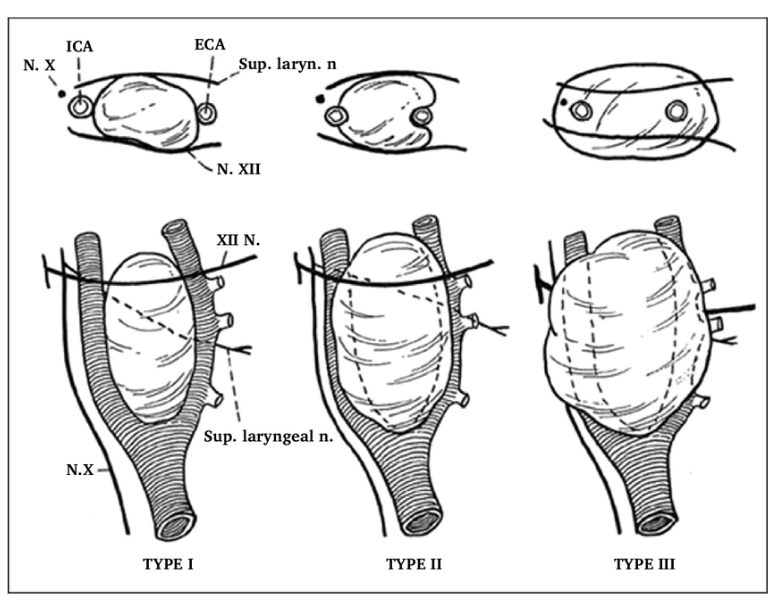
Shamblin Criteria
- Class I - localized, splaying of bifurcation, little attachment to carotids
- Class II - partially surround carotids
- Class III - intimately surround the carotids
Management
- Surgery is the only cure
- Malignant or Functional
- Complete excision along subadventitial space
- +/- arterial reconstruction
- Surgery
- Indications
- Secreting tumours
- Mass effect
- Only cure
- Technical
- Preadventitial dissection - avoid carotid artery injury
- Preserve local nerves
- Indications
- Radiation
- Unresectable tumour
Prognosis
- Slow growing