The following are “Does” from the syllabus
- Management of Internal hernia after gastric bypass in emergency situations
Procedure
- Laparoscopy
- Reduce obvious hernia
- Assess viability of bowel and consider resection is indicated
- If i am unclear if there is a hernia or not
- I would run the small bowel from the IC valve to the JJ anastomosis
- DJ flexure to the JJ anastomosis
- From the stomach to the JJ anastomosis
- I would the check the three defects and suture them close if open
- Petersen’s Space (Transverse Colon and Roux limb mesentery)
- Mesenteric defect behind the jej-jej anastomosis
- Mesocolic space (if retrocolic)
Information
- Occurs in 2% (usually months/years later)
- Massive weight loss creates long floppy mesentery with loose ligaments
- Presentation non-specific
- Suspect in any bypass with vomiting or abdominal pain
- Investigations
- CT scan (70-80% sensitive), signs can be subtle and difficult to diagnose
- Needs to go to OT if evidence of SBO on CT
- Mesenteric swirl sign, retroperitoneal stranding
- Increased volume of bowel in LUQ
- Closed-loop internal hernia
- Diagnostic laparoscopy
- CT scan (70-80% sensitive), signs can be subtle and difficult to diagnose
- Occurs in 3 locations:
- Petersen’s Space (Transverse Colon and Roux limb mesentery)
- Mesenteric defect behind the jej-jej anastomosis
- Mesocolic space (if retrocolic)

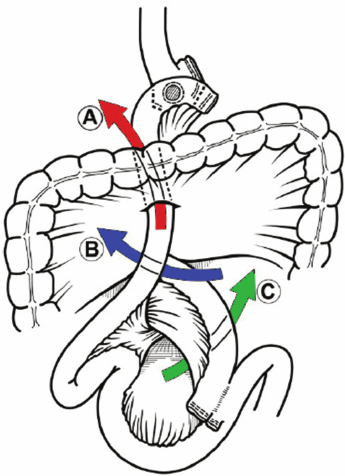 Mesenteric defects: A) transverse mesocolic; B) Petersen’s space; and C) jejunojejunostomy mesentery
- Needs to go to OT as can decompress biliary limb AND increased risk of vascular compromise
- Risk lower in laparoscopic cases and if mesenteric defects closed
- But can never prevent 100% risks